1. The Challenge Addressed
The practice addresses the challenge of making abstract mathematical concepts more concrete, accessible and engaging for learners. Geometry is often taught through theoretical explanations and visual representations, which may make it difficult for some learners to understand how geometric figures are constructed and how mathematical concepts relate to real-world experiences.
Geometry in Stitches responds to this challenge by connecting geometry with embroidery, transforming mathematical learning into a tangible, creative and tactile experience. Through practical activities, learners explore how complex shapes are constructed from basic elements such as points, lines and angles.
The practice also addresses the need to connect education with cultural heritage, creativity and inclusive learning, creating opportunities for learners with different abilities, learning preferences and levels of experience.
2. Why the Practice is Innovative
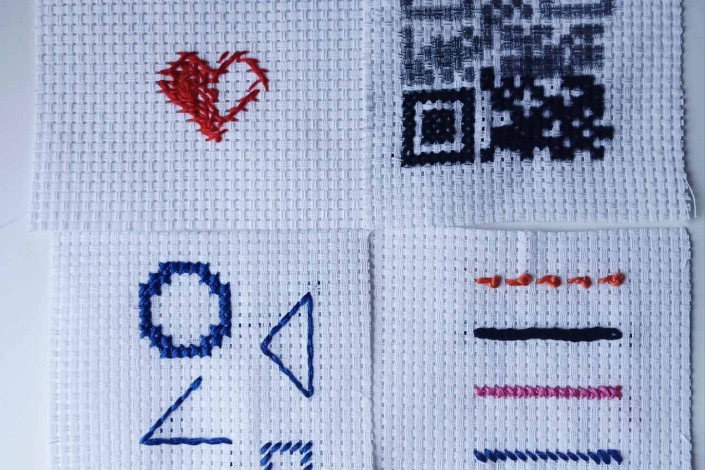
The innovation lies in combining traditional embroidery with modern approaches to mathematics and digital thinking. Each stitch is presented as a “pixel”, helping learners understand how geometric figures and images are constructed from small, basic units.
This pixelisation metaphor creates a bridge between analogue craftsmanship and digital representation, allowing learners to explore concepts such as resolution, structure and the composition of visual forms through a familiar manual activity.
The practice also connects theory and practice, mathematics and art, and cultural heritage and contemporary learning. Instead of simply studying geometric shapes, learners construct them through embroidery, producing visual and tactile outcomes that make their learning visible.
The toolkit is designed to be flexible and adaptable to different age groups, learning environments and educational objectives, including schools, workshops, museums and community-based activities.
3. Type of Integration and Key Competences
Geometry in Stitches is an interdisciplinary practice integrating mathematics, art, craftsmanship, digital thinking and cultural heritage.
The toolkit supports the development of the following key competences:
- Numerical, scientific and engineering competence, through the exploration of geometric concepts, shapes, perimeter, area, symmetry and construction;
- Personal, social and learning-to-learn competence, through activities that develop patience, precision, perseverance, fine motor skills, creativity and teamwork;
- Cultural awareness and expression, by preserving and reinterpreting traditional embroidery and connecting it with contemporary educational practices;
- Digital and technology-based competence, through the concept of pixelisation and the exploration of digital logic, image construction and resolution;
- Citizenship competence, by connecting cultural traditions, community participation and education, and by supporting social inclusion and appreciation of cultural diversity.
The practice therefore promotes a multidimensional learning experience, in which mathematical understanding develops alongside creative, social and cultural competences.
4. Role of the Teacher/Trainer
The teacher or trainer acts as a facilitator, guide and learning designer, supporting learners as they progress through the different levels of the toolkit.
The teacher introduces the relationship between embroidery and geometry, explains the tasks and provides guidance adapted to learners’ needs and abilities. The structured progression allows educators to support learners as they move from basic geometric concepts to more complex constructions and creative compositions.
The teacher can also encourage learners to reflect on the connections between manual embroidery and digital representation, helping them understand how simple units can be combined to create more complex figures and images.
Depending on the learning context, teachers can promote collaborative work, peer support and connections with local artisans, museums and community organisations.
5. Type of Learning Activities
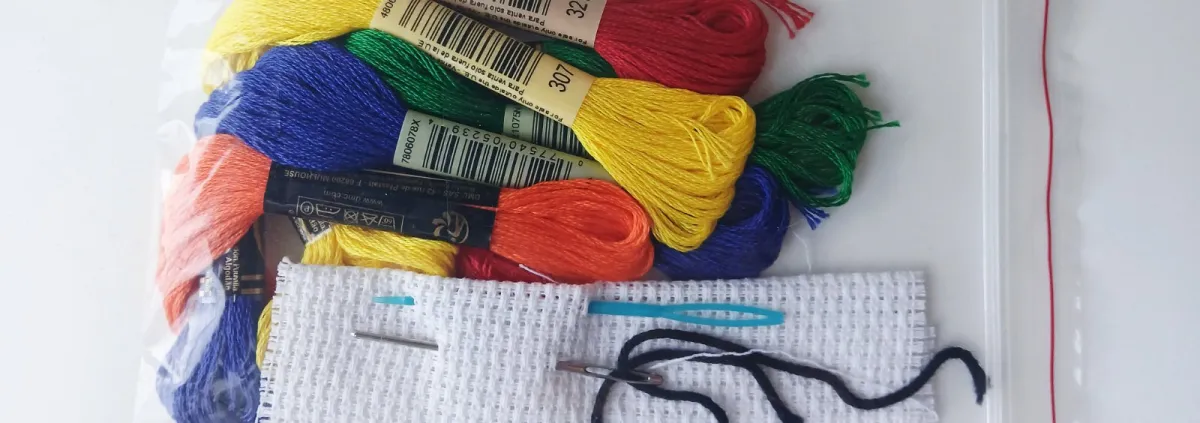
The toolkit consists of an embroidery set—including fabric, a hoop, needles, thread and a task book with instructions—and offers structured activities across three progressive levels.
Level 1: Basic Geometric Shapes
Learners use embroidery to explore fundamental concepts, including:
- Points;
- Lines;
- Angles;
- Triangles;
- Squares;
- Circles.
These activities introduce learners to the basic building blocks of geometry through practical and tactile experiences.
Level 2: Complex Figures and Measurement
Learners progress to more complex geometric figures and explore:
- Perimeter and area;
- The use of multiple colours and threads;
- The construction of figures through combinations of basic shapes;
- The relationship between geometric structure and visual composition.
Level 3: Constructions, Symmetry and Creative Composition
At the most advanced level, learners explore:
- Geometric constructions;
- Symmetry;
- Creative compositions;
- The creation of figures such as houses, animals and landscapes.
Each task results in a visual and tactile product—an embroidered figure—which learners can retain as evidence of their progress and development.
6. Impact of the Practice
The practice makes geometry more engaging, concrete and accessible by connecting mathematical concepts with a creative and practical activity.
The use of embroidery supports the development of precision, patience, fine motor skills, concentration and creativity, while collaborative tasks can strengthen communication and teamwork.
The pixelisation metaphor helps learners understand how shapes and images are formed from smaller units, supporting connections between mathematical reasoning, visual literacy and digital thinking.
The practice also contributes to the preservation and reinterpretation of traditional craftsmanship and cultural heritage, presenting embroidery not only as a cultural practice but also as a meaningful educational resource.
By producing tangible outcomes, learners can visualise their progress, develop a sense of achievement and engage with learning through different sensory and creative pathways.
7. Potential for Replication
Geometry in Stitches has strong potential for replication and adaptation across different educational and community contexts.
The toolkit can be implemented in:
- Formal education, including primary and secondary schools;
- Vocational education and training, particularly in creative, design and craft-related fields;
- Adult learning and lifelong learning programmes;
- Non-formal education, including workshops, museums and community activities.
The practice can be adapted to different age groups, levels of mathematical knowledge and learning abilities. Its use of accessible materials and structured tasks makes it suitable for inclusive and personalised learning environments.
The approach can also be expanded through collaboration with museums, local artisans, cultural organisations and community groups, strengthening the connection between education and local cultural heritage.
By linking mathematics, art, craftsmanship and digital thinking, Geometry in Stitches provides a transferable model for competence-based education that supports creativity, inclusion and lifelong learning.
Innovator: Milena Zivotic Ilic, Ivana Dokic - Grupa O