The challenge addressed
“Become an Agent of Social Change” is a digital simulation game designed to develop key competences through experiential, problem-based, and reflective learning. It responds to the growing challenges of social fragmentation, discrimination, and lack of empathy in increasingly diverse societies.
The practice is particularly relevant in the context of the war in Ukraine, which has forced millions of Ukrainians to leave their homes and integrate into new cultural communities across Europe. At the same time, host communities may lack a deeper understanding of the lived experiences, challenges, and emotional realities of refugees. The practice addresses this dual challenge by fostering empathy, intercultural awareness, and active citizenship through experiential learning.
Why the practice is innovative
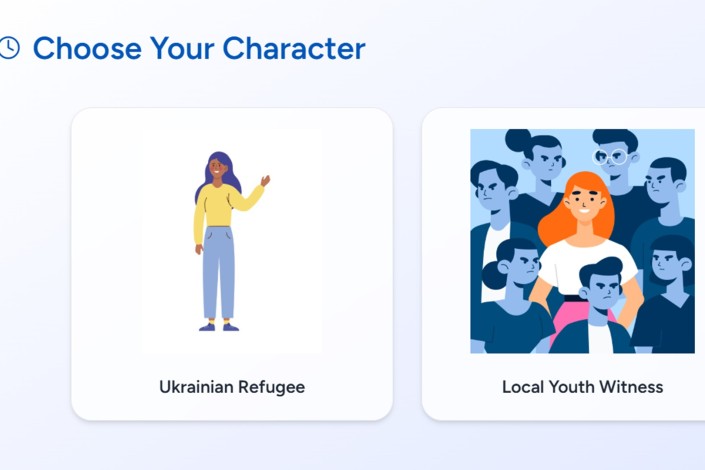
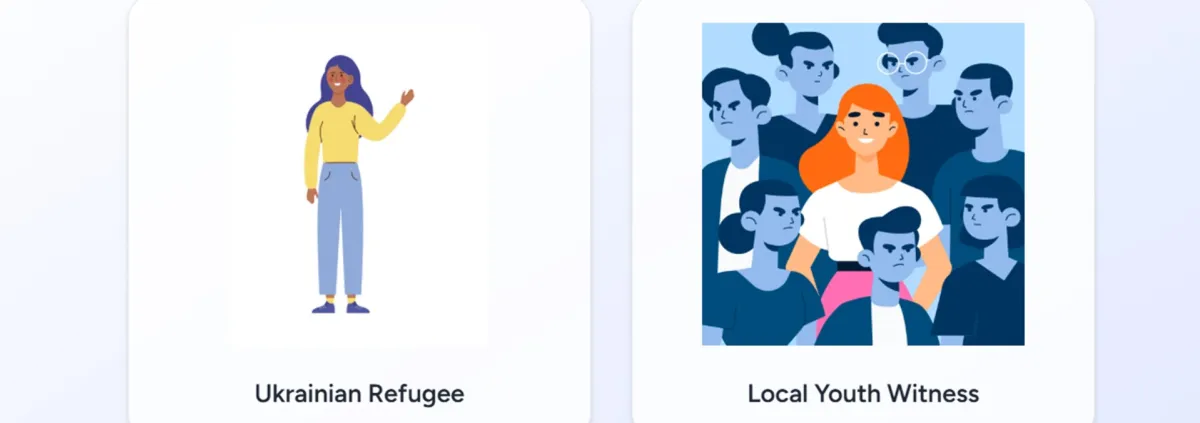
The practice uses a game-based simulation grounded in real-life-inspired scenarios involving discrimination and social exclusion experienced by refugees. Rather than being passive recipients of information, learners take on the role of social change agents, navigating complex social situations, making decisions, and reflecting on their consequences.
This immersive approach allows learners to engage emotionally with the experiences of others, strengthening empathy, perspective-taking, intercultural understanding, and ethical reasoning. The combination of simulation, decision-making, and reflection transforms sensitive social issues into an active learning experience.
Type of integration and key competences
The game supports an integrated competence-based learning approach, simultaneously developing several key competences.
It strongly contributes to Citizenship competence by promoting democratic values, social responsibility, inclusion, and solidarity. Personal, Social and Learning to Learn competence is developed through reflection, emotional awareness, cooperation, and self-reflection.
Cultural awareness and expression competence is supported through exploration of cultural differences and intercultural dialogue, while Digital competence develops through interaction with the online learning environment. The practice also contributes to Entrepreneurship competence by encouraging initiative, problem-solving, decision-making, and action in uncertain and complex situations.
Role of the teacher/trainer
The teacher or trainer acts as a facilitator, mediator, and guide rather than simply delivering content. The teacher supports learners before, during, and after the simulation by introducing the learning objectives, facilitating discussions, encouraging reflection, and helping learners connect the game experience with real-life social and community contexts.
This role is particularly important when addressing sensitive topics, ensuring that learners have a safe, respectful, and structured environment in which to explore different perspectives.
Type of learning activities
Learning activities include scenario-based decision-making, role-play, collaborative problem-solving, guided reflection, group discussions, and self- and peer-reflection tasks.
Through these activities, learners explore sensitive issues such as discrimination, belonging, identity, integration, and cultural diversity. The simulation allows them to experiment with different choices and perspectives while reflecting on the potential consequences of individual and collective decisions.
Impact of the practice
The practice contributes to increased empathy, greater intercultural sensitivity, reduced stereotyping, and a stronger sense of social responsibility.
For Ukrainian refugees, the game can support reflection on their experiences of integration and contribute to empowerment. For members of host communities, it can strengthen understanding of refugees' challenges while promoting tolerance, solidarity, and inclusive attitudes.
More broadly, the practice encourages learners to move from simply understanding social problems towards considering their own role and responsibility as potential agents of social change.
Potential for replication
The practice has strong potential for replication due to its digital format, flexibility, and relevance across different cultural and educational contexts. It can be used in formal, non-formal, and informal education, including online and hybrid learning environments.
The scenarios and learning activities can also be adapted to address a wider range of migration, integration, discrimination, and social inclusion issues, making the methodology relevant well beyond the Ukrainian context. Its digital and adaptable nature facilitates implementation across different educational levels and settings with relatively limited additional resources.
Innovator: Anna Kyrpa - Consortium of Union for the development of education and science (Ukraine), ACDC (Romania), KAINOTOMIA (Greece), CWEP (Poland)