The challenge addressed
Future teachers often face difficulties in systematically planning lessons, integrating key competences, and transferring theoretical knowledge into real classroom practice. There is a clear need for practical tools and methodologies that support step-by-step learning, reflection, learner autonomy, and the observation and measurement of learning outcomes.
Why the practice is innovative
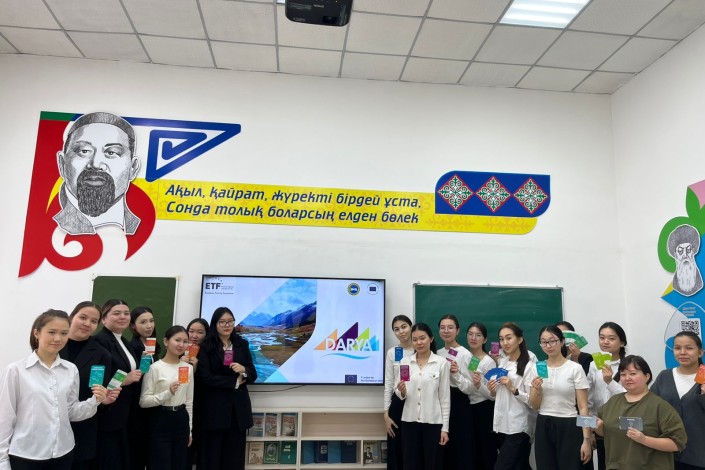
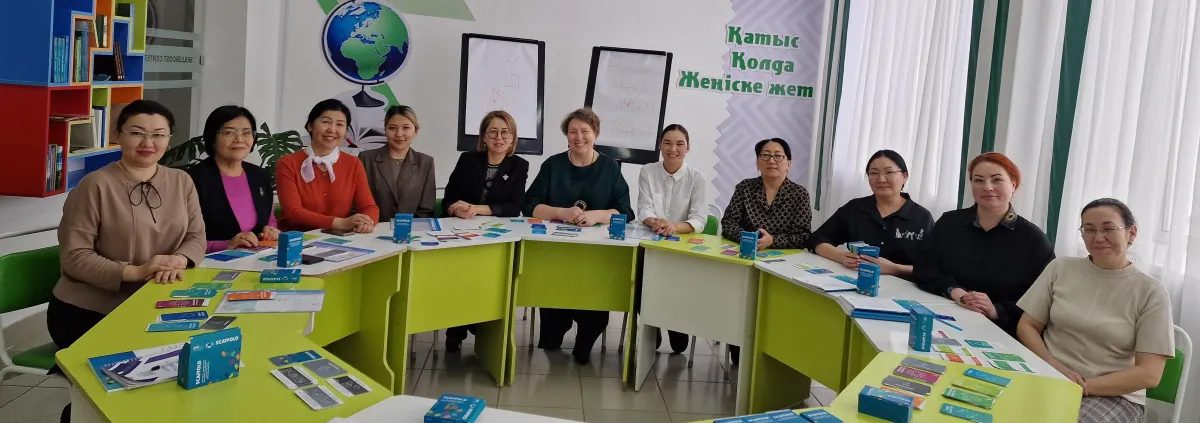
Since 2024, the Pedagogical Higher College named after B. Akhmetov has participated in the international DARYA project, aimed at introducing Scaffold Cards as a tool for competence-based lesson planning and learning support. The college acts as a pilot organisation in the Pavlodar region, adapting the ETF Scaffold approach to the specific context of teacher education.
A key innovation is the integration of Scaffold Cards with the Lesson Study approach, enabling the systematic observation, analysis, and evaluation of teaching and learning processes. This combination transforms Scaffold Cards from a planning and learning-support tool into part of an evidence-informed cycle of continuous improvement.
Type of integration and key competences
Scaffold Cards are used as structured learning and reflection tools that help students progress from simple to more complex tasks step by step. They support independent learning, critical thinking, decision-making, and problem solving in non-standard educational situations.
Teachers adapt the cards to different disciplines, taking into account the specific needs of future teachers. The cards are embedded in pedagogy courses, subject methodology classes, and teaching practicum.
The practice integrates digital competence, personal, social and learning-to-learn competence, and citizenship competence, in alignment with the national value-based programme “Adal Azamat.”
Role of the teacher/trainer
The teacher acts as both learning facilitator and reflective practitioner. Teachers design and adapt Scaffold Cards, guide students through learning activities, observe classroom practice, and use evidence to reflect on and improve instructional strategies.
Through Lesson Study cycles, teachers work collaboratively on lesson planning, classroom observation, data collection, and post-lesson reflection. This creates a culture in which teaching is continuously analysed and improved through collaborative inquiry.
Type of learning activities
Students are active participants in the implementation of the approach. Scaffold Cards introduce a new learning format that strengthens engagement, motivation, autonomy, and responsibility for learning outcomes.
Learning activities include case-based analysis, collaborative lesson planning, micro-teaching, reflective sessions, and peer feedback, delivered through both face-to-face and hybrid formats.
Lesson Study adds an important practical dimension: teachers and students analyse evidence of learning, discuss observed changes in learner behaviour, and adjust instructional strategies accordingly.
Impact of the practice
Final-year students participate in training seminars and apply Scaffold Cards during their teaching practice in schools, allowing the approach to be tested directly in real classroom contexts.
The use of Lesson Study enables the college to observe, document, and measure the effectiveness of Scaffold Cards. The practice therefore extends beyond the college itself and is transferred into school settings. Graduates who have started working in schools are already applying Scaffold Cards in their professional practice, demonstrating strong transferability and sustainability.
Professional development and cooperation
The practice has fostered a strong culture of professional learning and collaborative inquiry within the college. Results and experiences are shared with colleagues from other institutions, including international partners, strengthening opportunities for peer learning and professional exchange.
The experience also contributed to participation in the international DARYA SCAFFOLD competition, involving more than 80 educators from Central Asia and highlighting the potential of Scaffold as an effective and research-informed learning tool.
Potential for replication
The approach is low-cost, evidence-informed, scalable, and easily transferable. Scaffold Cards can be adapted to different subjects and educational contexts, while the Lesson Study methodology provides a structured mechanism for testing, evaluating, and improving their use.
The practice therefore has strong potential for replication in other pedagogical colleges, teacher professional development programmes, and non-formal learning contexts, offering a practical model for connecting competence-based planning with real classroom practice and continuous professional learning.
Innovator: Altyn Smailkanova - Pedagogical Higher College named after B. Akhmetov