The challenge addressed
The Digital Mobile Lab is an innovative, cross-curricular learning practice designed for Grade 10 vocational education. It addresses a common challenge in vocational learning: subjects are often taught in isolation, with limited integration of digital skills, entrepreneurship, sustainability, and real-life problem solving. This fragmentation can reduce learner motivation and limit the transfer of learning to real-world contexts.
Why the practice is innovative
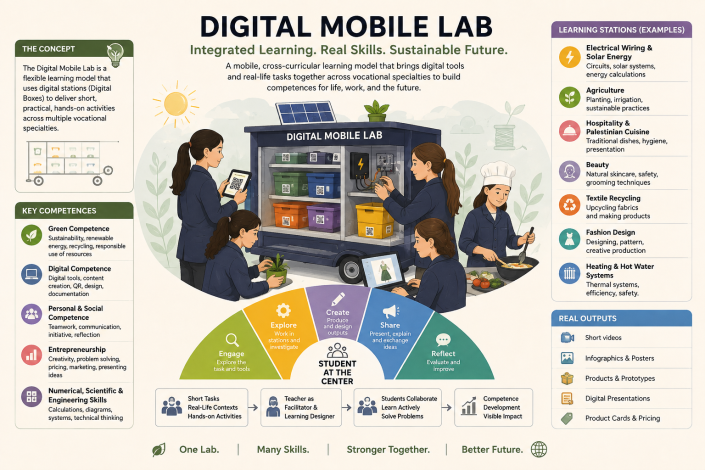
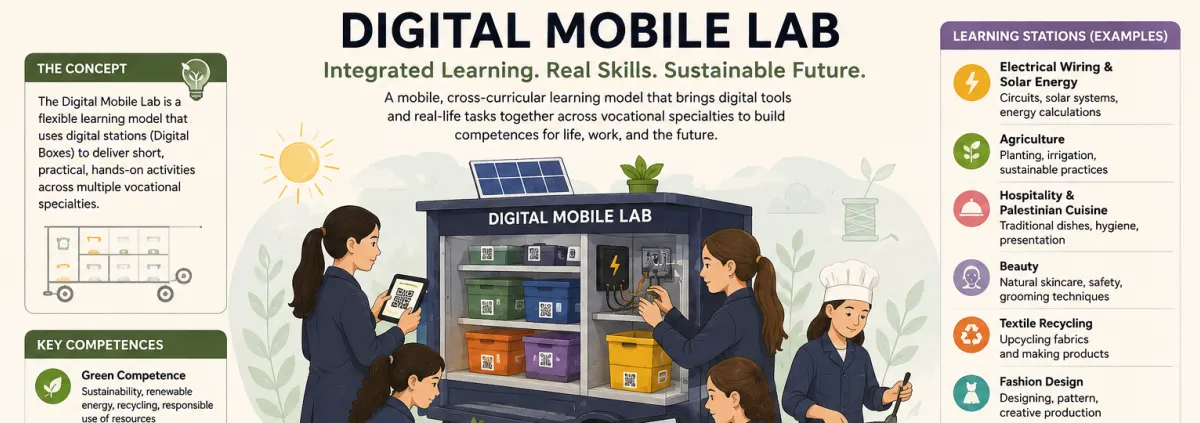
The practice introduces a mobile learning model based on digital stations, or “Digital Boxes,” that can be moved between classrooms and workshops. Each station represents a short, authentic learning task linked to vocational areas such as electrical wiring and photovoltaic systems, agriculture, hospitality and Palestinian cuisine, beauty, textile recycling, fashion design, and home heating and hot-water systems.
Students rotate between stations and complete hands-on activities supported by simple digital tools, including QR instructions, video recording, basic design platforms, and digital documentation.
The innovation lies in combining existing approaches into a new, coherent learning model. Instead of long lessons or single-subject projects, learning is organised around short, task-based activities that integrate several key competences at the same time. Students produce real outputs such as explanatory videos, diagrams, infographics, recipes, product cards, and simple system models, making learning visible, practical, and learner-driven.
Type of integration and key competences
The practice supports integrated learning by intentionally embedding a range of key competences.
Digital and technology-based competences are developed through filming, QR-based guidance, and digital design. Entrepreneurial competences are fostered through product ideas, pricing, and the presentation of outputs. Green competences are addressed through solar energy, sustainable agriculture, textile upcycling, and energy-efficient systems.
Numerical, scientific, and engineering skills are strengthened through electrical diagrams, power calculations, and system modelling. At the same time, personal and social competences are developed through teamwork, peer learning, and reflection.
Role of the teacher/trainer
The role of the teacher shifts from instructor to facilitator and learning designer. The teacher prepares the stations, guides learners during activities, supports collaboration, and encourages reflection rather than delivering content directly.
This approach also makes learning more inclusive and participatory, as activities are short, practical, and collaborative, allowing students with different abilities to participate meaningfully.
Type of learning activities
Learning activities are short, practical, hands-on, and collaborative, with students moving between different Digital Boxes and working on authentic vocational tasks.
The activities combine digital tools with practical vocational learning, encouraging students to create tangible outputs and apply their knowledge to real-life situations. Peer learning, teamwork, experimentation, and reflection are integral elements of the approach.
Impact of the practice
The practice contributes to increased learner engagement, improved digital confidence, stronger collaboration, and clearer connections between vocational skills and real-life applications. Students demonstrate higher motivation and greater ownership of their learning.
Schools also benefit from a collection of reusable digital outputs and prototypes, which can support further learning activities and provide tangible evidence of students’ work.
Potential for replication
The Digital Mobile Lab has strong potential for replication because it is low-cost, flexible, and adaptable to different vocational contexts. New stations can be added easily, allowing the model to evolve according to local curricula, resources, and labour-market needs.
Its modular structure makes it potentially scalable at school, regional, or national level. Overall, the practice represents a practical example of “New Learning”, aligned with ETF priorities for integrated, competence-based vocational education.
Innovator: Amal Darras - Al-Awda School, Beit Fajar School