The challenge addressed
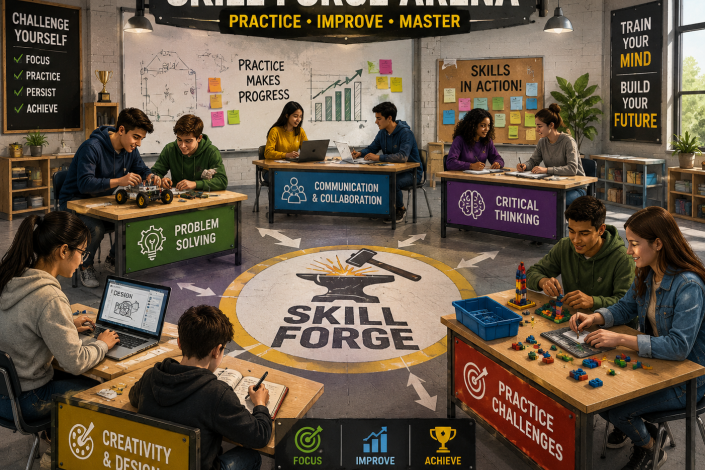
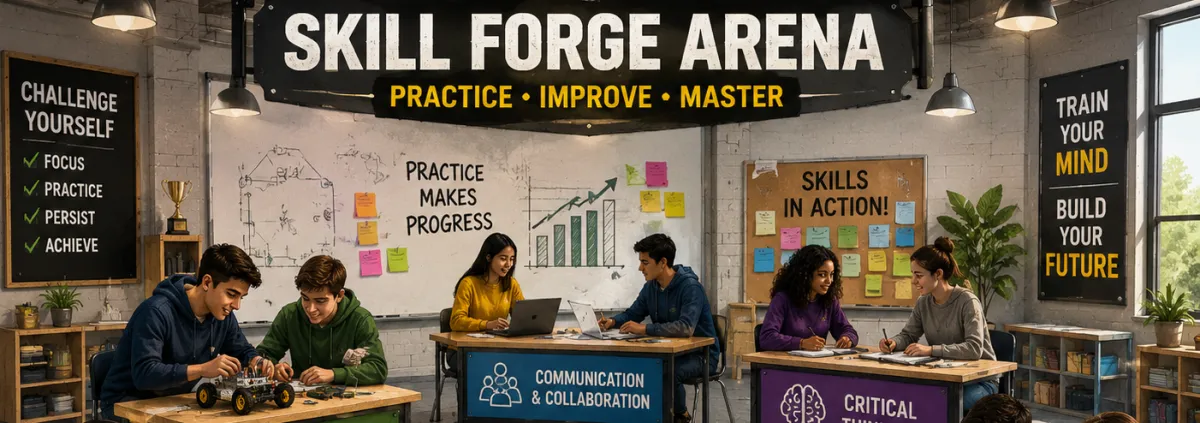
SkillForge Arena is designed as a place where skills are built “like metal in a forge”: students work hard, face challenges and come out stronger. The word Arena reflects the use of gamification, competition, team battles and quests. The practice transforms an ordinary VET classroom into a living workplace, where students develop real-life skills before entering the labour market.
It directly addresses some of the main challenges facing vocational education today: student disengagement, the gap between theory and practice, and graduates feeling unprepared for their first day at work. By allowing students to repeatedly “work” in a safe, physical environment and solve genuine business challenges collected from local companies, the practice creates a bridge between classroom learning and professional reality without requiring expensive equipment or constant internet access.
Why the practice is innovative
The most distinctive feature of SkillForge Arena is its offline-first philosophy. During the first eight to ten weeks, students work entirely within the school using cardboard counters, printed customer cards, recycled materials and authentic business cases. Activities include workplace stations, team prototyping, weekly championships and badge ceremonies.
Only the teams that demonstrate sufficient mastery earn access to the online phase, where they record short pitch videos and collaborate with peers from other countries through Zoom. In this way, the internet becomes a reward for achievement rather than a distraction, while students first develop practical skills through direct, physical and collaborative experience.
Type of integration and key competences
The programme can be integrated into existing VET curricula in banking, hospitality, IT, secretarial work and other vocational fields. It develops a broad range of competences for lifelong learning, including problem-solving, teamwork, entrepreneurship, digital literacy, sustainability and intercultural awareness.
The simulation-based approach also strengthens confidence, practical skills, individual learning and social interaction. Students learn by doing, making decisions, solving problems and working with others in situations that reflect the complexity of real workplaces.
Role of the teacher/trainer
Teachers move from being traditional lecturers to becoming game masters, mentors and facilitators. Their main responsibilities are to set up the physical arena, collect authentic cases from local businesses, guide the weekly tournaments and award badges.
Once the initial materials are prepared, daily facilitation requires relatively little time, with students taking responsibility for most of the activities themselves. This creates a student-centred learning environment in which learners are active participants rather than passive recipients of information.
Type of learning activities
The learning process combines workplace simulations, team challenges, prototyping, problem-solving quests, competitions, business cases and pitching activities. Students work with physical materials and realistic scenarios before progressing to digital and international collaboration.
The use of badges provides a visible and motivating progression system, while weekly competitions and team challenges encourage students to practise communication, collaboration and decision-making. The approach also creates opportunities to introduce global perspectives and intercultural learning through the international online phase.
Impact of the practice
The practice aims to produce significant improvements in student engagement, practical skill mastery and employability. Reported results indicate engagement levels of up to 80–90% and improvements in practical skill mastery of 60–70% compared with traditional classes. Furthermore, students reaching the Gold badge level are reported to receive at least one job or internship offer, often before graduation.
Beyond these measurable outcomes, the model helps students develop confidence, initiative, teamwork and a stronger understanding of workplace expectations, making the transition from education to employment more concrete and less intimidating.
Potential for replication
SkillForge Arena has strong replication potential because it requires very limited infrastructure and can be implemented with inexpensive and widely available materials. The entire system can fit into a single box containing printed cards, badge templates, scoring sheets and game instructions.
Any VET school can therefore adapt the model to its own occupational sectors and local business environment. By combining experiential learning, gamification, authentic workplace challenges and progressive access to digital and international activities, SkillForge Arena offers a flexible way to transform vocational education into a more engaging, practical and employment-oriented learning experience.
Innovator: Anna Karapetyan - Vardenis "Badeyan" State College