The challenge addressed
Modern professional practice in medicine, law, engineering, public administration and vocational fields increasingly requires making decisions in environments characterised by uncertainty, incomplete information and the growing presence of artificial intelligence. Yet most training systems continue to reward mastery, confidence and decisiveness, while offering limited guidance on how to recognise, communicate and ethically act upon the limits of one's knowledge. This gap between educational norms and real-world demands can contribute to avoidable errors, reduced public trust and greater risks for vulnerable individuals who rely on expert judgement.
Why the practice is innovative
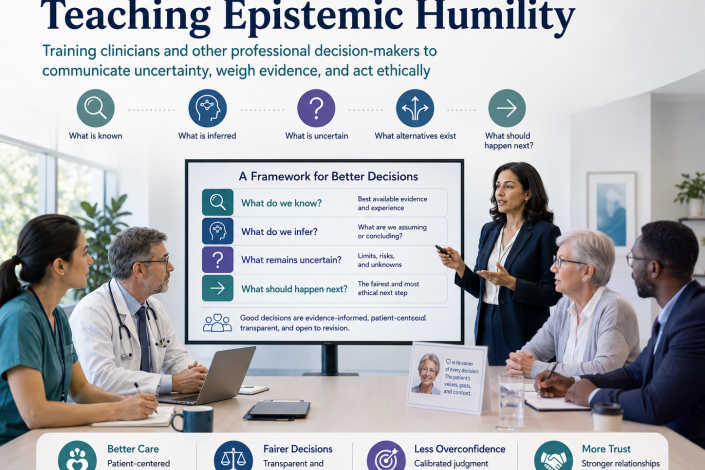
The practice introduces Epistemic Humility Training as an explicit, teachable and assessable competency for expert professions. Epistemic humility refers to the ability to clearly distinguish between what one knows, what one infers and what remains uncertain, and to communicate these distinctions responsibly. It is therefore positioned not simply as a personal virtue, but as a professional obligation in fields where expert decisions carry significant ethical consequences.
The practice is grounded in decision-science research and analysis of clinical communication challenges, including research on epistemic humility in medicine. Across different professional domains, experts may express unwarranted certainty because of cognitive biases, cultural norms and institutional pressures. These performances of confidence can obscure alternatives, limit shared decision-making and reinforce epistemic inequality. The practice responds by reframing humility as a practical and assessable professional skill set, supported by structured pedagogy.
Type of integration and key competences
The model integrates four complementary components:
- Uncertainty Navigation Workshops
Learners work through realistic scenarios requiring them to identify levels of evidence, articulate uncertainties and avoid premature closure. These activities strengthen analytical reasoning and reduce overconfidence. - Communication of Uncertainty Training
Through guided exercises, role-play and structured feedback, learners practise expressing uncertainty in ways that maintain trust while improving accuracy, transparency and communication. - Reflective Decision Audits
Participants examine successful and unsuccessful past decisions to identify cognitive biases, misplaced confidence and moments where acknowledging uncertainty could have improved outcomes. This develops metacognitive awareness and reflective practice, which are essential for lifelong learning. - Humility-Based Professional Activities (H-EPAs)
Adapted from established competency frameworks, H-EPAs define observable professional behaviours, such as seeking alternative viewpoints, calibrating confidence to available evidence, responsibly challenging AI outputs and documenting uncertainty. This enables institutions to evaluate humility as a core professional competence rather than an abstract personal quality.
Role of the teacher/trainer
Teachers and trainers act as facilitators of reflection, critical reasoning and professional judgement. Their role is not to provide definitive answers to every scenario, but to help learners recognise uncertainty, question assumptions, consider alternative perspectives and communicate the limits of their knowledge responsibly.
Through realistic cases, role-play, feedback and reflective decision audits, trainers create opportunities for learners to practise uncertainty management in a safe environment before applying these skills in professional contexts.
Type of learning activities
The practice uses a combination of scenario-based learning, workshops, role-play, structured feedback and reflective activities. Learners analyse complex situations with incomplete information, practise communicating uncertainty, review their own decisions and assess the reliability of different sources of evidence.
Particular attention is given to AI-supported decision-making, encouraging learners to question and responsibly challenge AI-generated outputs rather than accepting them uncritically. This helps develop a professional culture in which uncertainty, questioning and revision are understood as strengths rather than weaknesses.
Impact of the practice
By embedding epistemic humility into professional training, the practice prepares learners for real-world decision-making under uncertainty. It can improve collaboration, reduce preventable errors, strengthen metacognitive skills and contribute to greater transparency and public trust.
The approach is particularly relevant in an environment increasingly shaped by misinformation, technological complexity and social polarisation, where institutional legitimacy depends not only on expertise but also on the ability of professionals to acknowledge limitations and explain how decisions are reached.
Potential for replication
The practice has high scalability and replication potential. It requires no specialised technology and only limited resources, making it suitable for universities, professional schools and vocational training programmes, including low-resource settings.
Its principles are universally relevant: wherever professionals make decisions that affect other people, uncertainty needs to be recognised, managed and communicated ethically. The model can therefore be adapted across disciplines and professional contexts while maintaining its core focus on responsible judgement, transparency and epistemic humility.
Innovator: Guy Hochman - Reichman University