The challenge addressed
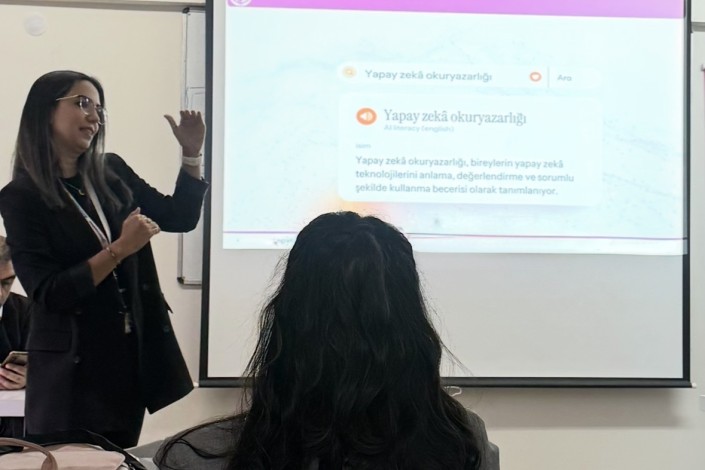
This resource is an innovative pedagogical framework that supports teachers in integrating artificial intelligence into learning in an ethical, meaningful, and competence-based way. The main challenge is the rapidly increasing use of AI tools in schools without sufficient pedagogical, ethical or competence-oriented guidance. Many educators feel unprepared, while students risk becoming passive consumers of AI-generated outputs instead of active, critical and responsible learners. The teacher guide responds directly to this challenge by providing a structured, accessible and theory-based model for hybrid human–AI learning design.
Why the practice is innovative
The resource is innovative because it bridges AI literacy with classical and contemporary learning theories, turning technology into a purposeful pedagogical partner. Rather than presenting AI as a shortcut, the guide positions it within frameworks such as Bloom’s Taxonomy, Constructivism, Connectivism, Universal Design for Learning and Social Learning Theory. This allows teachers to design learning experiences where AI supports inquiry, reflection, creativity, collaboration and ethical citizenship.
The resource integrates four key competences in a holistic way:
- Digital competences, through AI literacy, critical use of technology and data awareness.
- Personal, social and learning-to-learn competences, through reflection tasks, metacognitive prompts and self-regulation strategies supported by AI.
- Citizenship competences, through ethical scenarios, value-based decision-making, transparency questions and data justice.
- Green competences, through sustainability-themed learning tasks, real-world environmental problem scenarios and project-based modules supported by AI tools.
Role of the teacher/trainer
The teacher plays a central role as a designer, facilitator and ethical guardian. AI never replaces the teacher but expands their capacity by helping with routine tasks, generating differentiated materials, and supporting deeper inquiry. Each chapter of the resource describes how teachers can design activities in which AI supports, but does not dominate, learning.
The guide provides ready-to-use templates, reflective checklists, assessment suggestions and scenario-based examples, enabling teachers to move from theory to immediate classroom implementation.
Type of learning activities
The learning activities supported by the resource include inquiry-based learning with AI simulations, project-based learning with AI-generated research prompts, and collaborative tasks facilitated by AI-supported planning tools. Students also engage in metacognitive exercises, reflecting on their learning process through AI-guided questions.
The resource further promotes interdisciplinary learning, with activities linking STEM, ethics, digital skills and sustainability. This approach encourages students to use AI not simply to obtain information, but as a tool for exploration, problem-solving, creativity and reflection.
Impact of the practice
The impact of the resource has been significant. Teachers report increased confidence in using AI pedagogically, more time for meaningful interaction with students, and higher student engagement through personalised, reflective and interdisciplinary tasks. Students develop stronger agency, curiosity, creativity and critical thinking, which are key competences for lifelong learning in the AI era.
The resource also represents one of the first comprehensive guides in Türkiye to explicitly bring together artificial intelligence and pedagogy in a structured, theory-informed and practice-oriented format. This uniqueness increases its national relevance and positions it as a potential model for similar frameworks in other countries.
Potential for replication
The resource has high replication potential because it is tool-agnostic, adaptable to different subjects, and built on universal pedagogical principles. It can be used in primary, secondary and vocational education and can be further developed into digital courses, workshops or teacher training modules.
Any school or training institution can adopt the framework and adapt it to its own context, ensuring that AI serves educational goals responsibly, ethically and effectively, rather than becoming an end in itself.
Innovator: Esma Sila Tekinsoy - Madlen Technology (EdTech Company)