
Mentoring in the time of CoVid – Supporting Innovation in Serbia
Natasa Stojanovic
For the last five months, I have been engaged as a mentor to teachers involved in the project "Innovation in Secondary Vocational Education", which is implemented by the European Training Foundation. My task was to monitor the implementation of two school projects in a vocational high school in Požega, a small town in western Serbia. The projects I followed were multi-month and interdisciplinary. The goal of the project is to apply innovative methods of work to their own vocational programmesto encourage students to apply what they have learned, as well as to practice problem solving, decision making and other higher mental processes. In the long run, the goal is to encourage teachers to continue experimenting with teaching methods in the future, after the completion of the project, and so to bring about change to the classical, teaching teaching that dominates in our schools.
The time of the COVID-19 pandemic, in addition to all the problems, brought the possibility of gaining some new experiences and insights. Namely, school projects that I followed in the role of mentors, started at a time of strict epidemiological measures, a combined model of school work (half of the class follows classes online, and half come to school), unplanned mini vacations and the like. In such conditions, mentors could only hold online consultations.
As it was not possible to realize the usual pattern of mentoring through direct visits to school and observing activities in the classroom, I had to adapt and prepare myself to acquire new mentoring skills that I am sure we will need in the future.
I followed the course of the process within one of the projects through the Google classroom, which the teachers used as a platform for exchanging information, tasks for students and materials. This gave me the opportunity to follow the activity of teachers and learners live – task by task and my main impression is that the students intensively developed their digital competencies, because the teacher planned and gradually introduced new digital tools in each part of the project. These tools were necessary for students to solve certain stages of the project. Following the activities in the virtual classroom, I could see even more than I would have seen in a visit, because I synchronously followed the requests of teachers and students' answers, I was able to "visit" the classroom whenever I wanted. In other words, in this virtual way, a lot of information is more accessible to the mentor than during the live visit to the class. These insights gave me the opportunity to offer advice to teachers before each next step and to analyze the process of student progress together with them.
I received information about the realization of another project realized in the same school, at the zoom meetings that I held with the project coordinator. Zoom meetings mainly served to discuss the course of implementation, possible problems that arose and the mutual exchange of ideas on how obstacles can be overcome. So, the mentoring role was indirect, I could not directly follow any of the students' activities, but I found out about them later, after the realization. ItSince I didn't know the teachers personally, I started each meeting with a story about the atmosphere, the "pandemic" organization of work at the school and what is currently relevant to everyone. Since I also work at the school, we talked about events outside the project. It served to "relax" the atmosphere, build trust, better understand and get to know each other, in order to provide a more complete and accurate insight into the current phases of the projects and an open conversation about possible obstacles in its implementation. I realized that it is very important for teachers, and that they do not perceive me as an external controller who speaks from the computer screen, but as a collaborator, supporter and motivator.
From working on other projects, I know that direct communication is a simpler, more spontaneous and faster way to achieve professional respect and cooperation. In other words, I think that online mentoring makes it more difficult to build the necessary mutual trust between mentors and teachers. However, it is not impossible to win trust, but it is harder and slower.
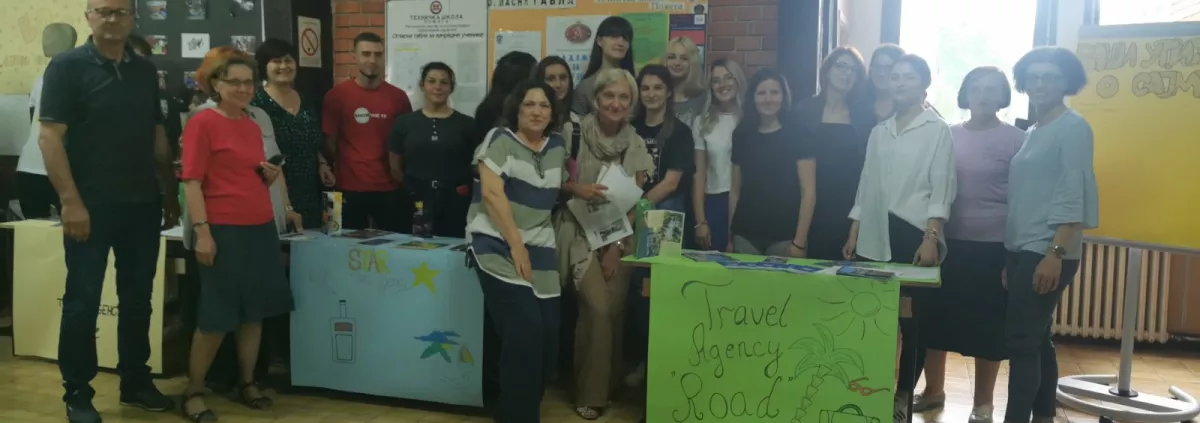
At the very end of the realization of both projects, I got the opportunity to go on a direct visit to the school, and to attend the presentation of the products of several months of work of both school projects. A large number of students and teachers (not only those who participated in the project), the school principal but also guests outside the school participated in this event. The atmosphere in the school was open and cordial, everyone was ready to talk about the products and the work process. All this, as well as the number and quality of the created products, testify to the success of the project.
At the beginning, unplanned, but due to the circumstances, I had to learn how to provide online mentoring.This enabled me to see all the possibilities but also the limitations of this kind of support. The extra benefit is that I developed my own digital competencies, as well as my mentoring skills. I hope that my experiences will help researchers to understand how mentoring can become hybrid – how we can continue to support one another professionally in these changed times.
To learn more about what happened in these projects - https://openspace.etf.europa.eu/blog-posts/webinar-report-learning-inno…
Читај на српском: https://openspace.etf.europa.eu/blog-posts/mentorstvo-u-vreme-covida-po…
Please log in or sign up to comment.