

Introduction and context
NQF snapshot
No law has been adopted yet.
Palestine is developing an eight-level national qualifications framework (NQF), based on learning outcomes and covering all education and training sectors. The framework is still under development; no qualifications are placed in the NQF’s levels.
The Ministry of Education and Higher Education and the Ministry of Labour currently oversee the NQF’s development, cooperating with the TVET Development Centre, which is concerned with technical issues and operational implementation.
Educational, social, economic and political context
The population of Palestine was 4.7 million in 2017 (4.1 million in 2011) [1]. In addition, 1.4 million Palestinians live in Israel and 5.6 million in Arab countries [2]. Young people (15–24 age group) comprised 35.7% of the total population in 2017, making for one of the youngest populations not only in the region but also in the world. This in turn puts enormous pressure on social services (education, health and housing) and on the labour market. Considering that the absorption capacity of the Palestinian labour market has not increased in the last ten years, this rapid population growth has led to high unemployment.
The unemployment rate rose from 26.9 per cent in 2016 to 27.4 per cent in 2017. This is the highest level recorded in the past 15 years, and is also the highest unemployment rate among the 170 countries and territories in the world for which current estimates are available. Youth unemployment is very high (43.8 percent in 2017 for aged 15-24), reaching a dramatic figure of 70% among young women. Poor labour market outcomes for young people combined with high early school leaving lead to a large proportion of young people not in employment, education or training (NEETs), reaching 33,2% in 2017. Given the limited possibilities offered by the labour market, the main destination for the new workforce has been the public sector, but the current severe fiscal crisis has pushed policy-makers to limit employment in this sector.
More than half of Palestinians live abroad. The need to look for job opportunities outside their own country is one of the reasons for the importance that students attach to attending and completing university.
The Palestinian economy is dominated by small and micro enterprises. According to the definition used by the Palestinian Central Bureau of Statistics, 90.5% of companies are micro (below four employees) and 8.38% are small (below 20 employees). The structure of the Palestinian labour market, and the inability of the formal sector to absorb employees, have led to an expansion of the informal sector.
[1] Palestinian Central Bureau of Statistics (KIESE updated data)
[2] Palestinian Central Bureau of Statistics, Palestine in Figures 2017, March 2018
Policy objectives
Education and training reforms
The main challenges that the NQF should address are fragmentation of education system governance, lack of coordination among public and private providers, and the limited relevance of existing qualifications to the labour market.
The draft national consultation paper for development of the NQF identifies the following problems and obstacles to be addressed:
(a) no clear identification of educational outcomes for individuals and employers (no clear signals);
(b) fragmented qualifications systems in all sectors (general education, higher education and vocational education and training, non-formal and informal learning);
(c) no unified governance of the various sub-systems of education and training;
(d) imbalance of academic and vocational programmes (balance in enrolment rates between academic, vocational education and vocational training streams) regarding the needs of the labour market;
(e) no valuation and encouragement for lifelong learning, adult education and continuing education; no recognition of non-formal and informal learning;
(f) no comprehensive and efficient accreditation system;
(g) no links between education systems and the Arab occupational classification (AOC);
(h) no facilitation of labour mobility by existing education systems;
(i) no articulation between and within the different education subsystems.
The planned NQF should provide a strategic, comprehensive and integrated national framework for all learning achievement, on lifelong learning principles. It should encompass all qualifications within the Palestinian national education system, across every field of education, and should address the requirements of education systems/ providers, individual learners and labour market systems/employers.
The NQF aims at:
(a) supporting the formulation of learning outcomes in terms of qualifications according to Palestinian occupational classification (POC) standards, subsequent to adaptation from Arab occupational classification (AOC) standards;
(b) improving understanding of qualifications and levels of qualifications and giving a clear picture of the relevance of educational outcomes to individuals and employers;
(c) organising and facilitating horizontal and vertical articulation across education and training by establishing credit transfer between qualifications;
(d) aiding access to education and training opportunities, and mobility and progression within education, training and career paths to improve learner, labour and career mobility; making progression routes easier and creating bridges within education systems;
(e) ensuring that qualifications are relevant to perceived social and economic needs by linking the education system with the labour market through the adapted POC, and by increasing the value and enrolment rates in vocational education streams;
(f) raising education and training quality by ensuring that all standards are defined by agreed learning outcomes and applied consistently; ensuring that education and training providers meet specified quality standards;
(g) making it easier to match Palestinian NQF levels with those of other countries, securing not only local recognition but also regional and international recognition for national qualifications.
International cooperation
The Palestinian ministries running the NQF have worked closely with the German development agency active in Palestine (GIZ) and with the Belgian agency for technical cooperation (BTC), as the two principal VET development agencies. GIZ has conducted much of the technical work.
Levels and use of learning outcomes
NQF levels and level descriptors
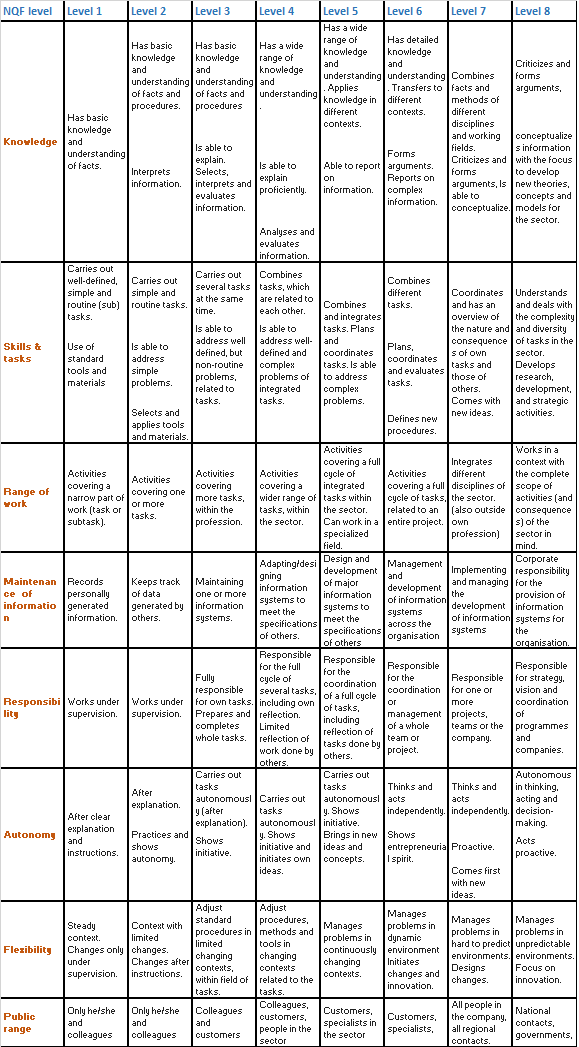
Palestine plans an eight-level framework.
The draft descriptors, as well as incorporating the familiar knowledge, skills and competences trinity, cover a range of technical and social competences: examples are range of work, maintenance of information, and flexibility. These will be further refined and then agreed with stakeholders between 2016 and 2017.
Use of learning outcomes
Learning outcomes are the conceptual basis of the qualifications framework and future qualifications. The intention is that they act as a tool to match education provision to the framework and as a reference of relevance of learners to the labour market.
NQF scope and structure
The national consultation paper envisages an eight- level national qualifications framework for Palestine. These levels are referenced to the Arab occupational classification (AOC), existing general education and higher education levels and technical vocational education and training (TVET) levels. The NQF will describe each level through descriptors covering a range of technical and social competences.
Stakeholder involvement and institutional arrangements
Legal basis of NQF
No NQF law has been adopted yet on the NQF; authorities plan to include provision for the NQF in the planned TVET law.
Governance and institutional arrangements for the NQF
The Ministry of Education and Higher Education and the Ministry of Labour currently oversee NQF development, cooperating with the TVET Development Centre, which is concerned with technical and operational issues.
This development is the result of a series of reforms taking place in the TVET sector. It did not start as an individual project, but as part of the wider reforms to the institutional framework which binds together all the different processes (including Palestinian occupational classification, curriculum development process), developed in the framework of the TVET strategy.
Consultation with stakeholders on current reforms has been extensive. A wide range of actors –several ministries in charge of TVET provision, social partners, public and private education providers, learners/ students and their parents, employment offices, awarding bodies and quality assurance agencies were engaged in the formulation of the first proposal for an NQF in Palestine. This consultation took place in 2012 through a series of workshops with the different sectors of the education system and with the social partners.
The institutional setting for the development and management of the NQF has changed over the years in relation to changes in the TVET governance model. Currently the NQF is not operational and no institution is formally tasked to oversee its functioning. The Higher Council for TVET has overall responsibility for defining policies in the TVET sector and will play a crucial role in the definition and approval of future NQF institutional settings.
A technical working group, which includes all key TVET stakeholders, has been created to follow up NQF developments.
Roles and functions of actors and stakeholders
Representatives of the labour market and private sector participated in the preparation of the NQF. A participatory approach was also present in preparing the technical needs assessment and analysis of 40 professions under the Belgian Technical Cooperation project, with direct participation and involvement of experts from companies and the labour market. Labour market representatives participated actively in the verification process, through reviewing the curriculum and providing professional feedback.
They also participated directly in defining the work tasks and required competences for each profession, under the competence-based task approach for curricula development and learning situations methodologies. There is a consensus that employer representatives should be involved in implementing and participating in practical exams in TVET institutions.
Resources and funding
Limited. There is considerable reliance on EU and other donor support.
Quality assurance of qualifications
The Palestinian Cabinet has set up an Accreditation and Quality Assurance Commission (AQAC) for to accredit the technical education institutions (TEIs) and their programmes. These apply to all community and technical (post- secondary) colleges. This mandate does not apply to other TVET institutions (vocational schools and vocational training centres).
No procedures have yet been agreed to level or place qualifications in the framework.
Recognising and validating non-formal and informal learning and learning pathways
Improving horizontal and vertical progression routes, and establishing effective mechanisms for recognition of prior learning, are two of the main objectives in developing the NQF. Appropriate operational mechanisms will be developed following the national consultation but priority is given to establishing the framework and mechanisms to reference qualifications to it. Validation of prior learning will be tackled at a later stage.
NQF implementation
Inclusion of qualifications in a register
There is no register or national database of qualifications yet.
Monitoring, evaluation and review of the NQF
As the framework is still being developed, no review has taken place.
Impact for end-users
No impact yet, as the qualification framework is not in implementation.
Referencing to regional frameworks
The readability of Palestinian qualifications among the neighbouring countries is one of the priorities identified in the national consultation paper. Specific attention will be given to the issue of regional and international recognition in the framework of the consultation process.
The planned NQF is linked to the Arab occupations classification (AOC) system, which includes the skills’ arrangement as below:
(a) semi-skilled;
(b) skilled;
(c) craftsperson;
(d) technician;
(e) specialist
Important lessons and future plans
Following the national consultation conducted in 2012, the Ministry of Labour and the Ministry of Education have approved the NQF concept. The decision has not yet been brought to the cabinet. In the meantime, TVET stakeholders are working on further technical documents necessary for operationalisation of the framework. In 2016, a pilot exercise was conducted to reference existing qualifications in the fashion design sector to the framework. Based on this exercise, TVET actors are currently developing a methodology to reference qualifications to the framework.
One of the key priorities of the development centre for the coming years is to revise the TVET law which will include the NQF concept.
Abbreviations
AOC Arab occupations classification
AQAC Accreditation and Quality Assurance Commission
BTC Belgian Technical Cooperation (active donor in Palestine)
GIZ Deutsche Gesellschaft für Internationale Zusammenarbeit (German development agency active in Palestine)
NQF national qualifications framework
POC Palestinian occupational classification
TEIs technical education institutions
TVET technical and vocational education and training
Please log in or sign up to comment.