

Introduction and context
NQF snapshot
The NQF is legislated by several legal acts including some preceding its official adoption. The Action Plan on implementation of "National Strategy for the Development of Education", (Presidential Order no 995, 19/01/2015) includes the preparation and application of the NQF and is instrumental for introducing competency-based education. The Strategic Roadmap for Vocational Education (2016) emphasised elements of the NQF implementation, like competency-based standards and curricula and the validation of non-formal and informal learning.
The NQF was adopted by the Cabinet of Ministers Decree No.311 dated 18 July 2018. Further legislative changes in 2018 are the Employment Strategy 2019-2030, giving attention to training and qualifications in combatting informal employment and unemployment, the Law on Vocational Education, amendments to the Law on Education, and the Law on the 2019 budget of Unemployment Insurance Fund.
The NQF has eight levels, comparable to the EQF and linked to formal qualifications or key stages. Level 1 covers outcomes of basic education, level 2 outcomes of lower secondary, etc. Level eight covers outcomes of PhD and Doctor of Sciences Degrees in line with international practice. VET qualifications cover Level 3 and level 4 (initial VET) and level 5 (higher VET). All qualifications from level 3-7 with a labour market orientation will be based on occupational standards. Occupational standards will be adapted to NQF levels. NQF level descriptors have three domains: Knowledge and Understanding, Skills, Autonomy and Responsibility. Key competences are integrated.
The MoE has the policy lead. A provisional NQF secretariat was established by Ministerial Decree (05/08/2016) to prepare legislation. Important MoE implementing bodies are the VET Agency, the Department of Nostrification and Accreditation, and the Institute of Education. The MoLSPP is in charge of coordinating occupational standards. It has established a section for occupational standards in the Department of Employment and Demography. Stakeholders from sectors and line ministries (Sectoral Committees) will be actively involved in developing standards and possibly certification. The VET Agency, MoE and MoLSPP are working on developing VNFIL.
Educational, social, economic and political context
Azerbaijan faces challenges in the education and economic sectors. The economic recession in 2016, driven by the fall in oil prices and oil production, triggered the need for a ‘non-oil’ economy. This “knowledge-based economy” requires the development of human capital and calls for an improved, modern education system for the whole population. The ‘Strategic roadmaps for the national economy and main economic sectors’ were approved in December 2016. Government strategy on matching education and training to labour market requirements is further outlined in The ‘Azerbaijan 2020: Look to the future’ development concept, the Education Strategy and Action Plan and the Draft Employment Strategy for 2017 -30.
With a population of 9.81 million, Azerbaijan is one of the few countries in Europe and the Commonwealth of Independent States with a young population. Almost one quarter (22.5%) are children (0-14 years) and young people aged 14-29 make up 27% of the population. The business environment is vibrant, with proactive reforms such as a one-stop-shop company registration scheme and a best practice e-government portal making start-ups easier. Globally, Azerbaijan is in fifth place in the ranking of 190 economies on the ease of starting a business and the country ranks 65th out of 190 countries in the 2017 Doing Business report.
Vocational training and skills are one of the top priorities of government policy, reflected in recent strategy outlined in Strategic Roadmaps to boost the economy and competitiveness. The State Agency for Vocational Education was established in April 2016 and a new employment strategy for 2017-2030 has set 16 targets for 2030. These targets aim to reduce the number of young people not in employment, education or training and lower unemployment rates, as well as increase employment in SMEs. Increasing the scope and scale of training and self-employment measures is also at the forefront, as well as validation of skills acquired in non-formal and informal learning.
Policy objectives
Education and training reforms
For sustainable growth, Azerbaijan needs to reduce its dependency on oil and gas, and diversify its economy. The Strategy for Azerbaijan 2020, a Vision to the Future, (December 2012) aims to support the rapid development of the non-oil sector. This should result in an export-oriented opener economy, with more innovation, and with a better environmental balance. Key elements of the developmental strategy are better infrastructure & telecommunications to create a better business climate throughout the country and more cooperation with growing developing countries, as these economies are growing faster than the industrialised world.
Azerbaijan still has a very large pool of unqualified labour. There is some progress in recent years with the youngest generation gradually becoming more educated, including more and more students studying abroad. However, about half of the graduates from secondary education do not enter initial vocational education, secondary specialised education or higher education. Moreover, only one in five companies train their staff systematically. One of the difficulties companies face is determining what to train their staff for, so that their company can grow and develop.
The Strategy for Azerbaijan recognises the importance of the development of human capital to diversify the economy. This requires investment in the education system, giving more importance of adult and lifelong learning, and ICT assisted learning through the internet. The strategy also underlines the importance of efficient health care and social protection and better governance. A National Strategy for the Development of Education was adopted in October 2013. It has five strands of action of which three directly related to AZQF: Education based on competences focused on individuals requiring the development of curricula for all levels of education; providers apply modern training methods for competency based education, and ensure the quality; A transparent management system is established, to ensure the quality of education.
The Action Plan for the Implementation of the Education Development Strategy (adopted January 2015), mentions the adoption of the NQF. Development of the NQF preceded the action plan, but approval came only in 2018. There were important preceding steps however. In 2016 a NQF Secretariat in the Ministry of Education was established to support the implementation. Moreover, a series of international, EU funded and bilateral projects have helped to develop new outcome based curricula. In addition to higher education, VET has become a national priority since 2015. In 2016, the VET Agency was established and a Strategic Roadmap for VET established as part of a wider set of 11 strategic areas for the development of the country. A VET Law was adopted in 2018.
The NQF aims to improve the relevance, quality and transparency of qualifications. It takes into account the demands of the society and labour market when defining qualifications (occupational standards), and hence improve national economic performance and facilitate communication and movement between education and training sectors and the labour market. It aligns national qualifications and qualifications levels with the QF-EHEA and the EQF. The NQF supports, and widens access to qualifications and learning. It promotes lifelong learning of Azerbaijani citizens. Validation of non-formal and informal learning is recognised as a key component. The NQF should also facilitate the national and international mobility of learners and workers through increased recognition of the quality and comparability of Azerbaijani qualifications abroad and increase of competitiveness and mobility of people.
The NQF is closely linked to other policy initiatives, including the reduction of informal employment, employment promotion and labour mobility. In education, it is clearly seen as a QA tool. The recent openness towards VNFIL is a real victory over conservative attitudes and shows that Azerbaijan is not only focusing its attention to raising the quality for those in education, but is serious in improving access to learning, qualifications and jobs. ICT tools are expected to play as well an important role in introducing the NQF as Azerbaijan is quickly developing ICT services.
International cooperation
The NQF is fully in compliance with the Qualifications Framework of the European Higher Education Area (QF-EHEA) and the European Qualifications Framework for Lifelong Learning (EQF).
The NQF is an important tool for implementing the Bologna Process. The EU has funded a number of Twinning projects and Tempus and Erasmus Plus projects to support curriculum development and quality assurance in higher education, and in particular the use of learning outcomes. A new Twinning Project for HE will continue the support in this area in 2018-2019, making a link as well to occupational standards, assessment and certification and quality assurance. The results are becoming visible. According to the latest Bologna Report (Paris 2018) Azerbaijan is now describing all higher education programmes and their component in learning outcomes. There are still many more steps needed. Learning outcomes and ECTS are implemented, but they are not yet systematically monitored as part of the external QA policies for Higher education. Azerbaijan still seems to be a few years removed from self-certification. Tools are developed but not yet embedded systematically and integrated in QA and recognition procedures. In Higher Education there is not yet any VNFIL. Azerbaijan is also a signatory of the Lisbon Convention. Recognition processes are expected to take progressively account of the qualifications reforms and quality assurance measures. A large number of Azerbaijani students studies abroad, many with a governmental grant.
The EU has become most important donor in the Education sector, a role previously fulfilled by the World Bank. ETF works closely with the EU Delegation in planning and supporting this work. Under the AP 2014 includes a series of measures to support the Ministry of Education with implementing aspects of the NQF, including the development of outcomes based standards and curricula, based on occupational standards, assessment and quality assurance procedures and the systematic involvement of representatives of the world of work. The projects and grant schemes promote coherent approaches in VET and Higher Education. The EU is also developing support under AP2016 for the MoLSPP on improving labour market intelligence and occupational standards. Follow up measures are being planned under the AP 2018 with attention to developing modularisation, credit systems and VNFIL etc. There are also bilateral VET reform projects that support the development of new competency based programmes for VET and for teacher training.
Levels and use of learning outcomes
Alignment to other classification systems
Labour market monitoring should inform the development of occupational standards, coordinated by the Ministry of Labour and Social Protection of the Population. Labour market oriented qualifications should be linked to specific occupations (and occupational standards). The Ministry of Labour is also responsible for keeping the National Employment Classification in accordance with the requirements of labour market. But unlike in some other post- Soviet countries, the NQF is not directly linked to the tariff qualification system, which is not anymore operational.
NQF levels and level descriptors
The work on levels started originally from an analysis of the descriptors of in the country, but has been inspired as well by the Dublin descriptors for the Qualifications Framework for the European Higher Education Area (QF- EHEA) and the EQF and the eight European key competences (2006). The result in the end is a list of 8 levels with level descriptors which are more detailed than the EQF descriptors, addressing knowledge and understanding; skills; and autonomy and responsibility and which are calibrated and fine-tuned with the main qualifications types in the country. Key competences are integrated in the level descriptors.
Qualifications
According to the NQF decree a qualification is a formal outcome (diploma, certificate) of an assessment process confirming an individual’s achievement of learning outcomes as defined in given standards. This definition is close to the EQF definition.
The decree provides however more details. It states that qualifications need to be described in terms of minimum learning outcomes required from learners. This is repeated in other words, when the decree states that all qualifications are described in terms of knowledge, skills and autonomy/responsibility, and referenced to the AzQF levels. Qualifications are developed in accordance with the requirements of labour market and occupational standards. All qualifications are quality assured and quality assurance encompasses all relevant processes including description of expected learning outcomes, assessment and validation of an individual’s learning achievement;
The qualifications at the levels 3-7 that are related with a specific occupation and specialities at the labour market are based on occupational standards. These include initial VET qualifications, secondary specialised (Sub-bachelor’s) qualifications, Bachelor’s qualifications, basic medical higher education qualifications, Master's and postgraduate medical education (residency) qualifications, as well as relevant qualifications of further education.
Education standards for VET and HE are generic in character and only provide indications for the outcomes and inputs for the type of qualification. There are no real qualification standards in Azerbaijan, but the curriculum structure offers assessment elements. No external QA or independent assessment of professional competences, but state exams are available to test the knowledge of graduates.
Occupational standards are generally seen as the new starting point for developing state educational standards, but there is not yet a system-wide use of them. Different approaches have been tested to involve representatives from the world of work more in renewing vocational and higher education standards, but so far there a more consolidated new approach is only coming into place, slowly with the support of European projects. For Initial VET qualifications a new curriculum template has been developed and tested by the EU VET reform project. For Higher Education learning outcomes are used but without referring to occupational standards so far. The Twinning Project - Support to strengthening HE system in Azerbaijan is also exploring how to strengthen competency-based higher education in Azerbaijan.
Access, progression and credit
The university entrance exam and entrance to colleges (post- secondary vocational education/ sub-bachelor degree) is centrally administered and compulsory for everybody who wants to enter a bachelor programme, including graduates from colleges, although credit transfer from sub-bachelor to bachelor degrees is foreseen in the future. It is going to be experimented in the EU NQF project. Graduates from vocational lyceums receive so far two qualifications, the attestation of maturity (general secondary education diploma), and a diploma of specialisation. One in seven graduates actually enters higher education. Graduates from vocational schools only receive a diploma of specialisation. It is expected that more flexible credit arrangements may be developed in the years to come. Currently people can only have access to qualifications is granted only to those that have achieved the qualification at the preceding level.
Use of learning outcomes
A national curriculum for general education based on learning outcomes was introduced in 2009 and improved in 2010. General education does not offer any specialisation. Development of qualification standards for primary education (AzQF level 1), general secondary education (AzQF level 2) and full secondary education (AzQF level 4) do not exist yet, although learning outcomes have been identified for key stages. Azerbaijan participated in PISA 2018, but the results are not yet known. This round should provide some indication whether these reforms have led to better learning outcomes.
Occupational standards developed by the international projects since 2008 and especially by the World-Bank Project on Development of Improved Occupational Standards (DIOS) between 2011 and 2014, have been used in pilot curricula for initial vocational education and training (IVET) prepared by the Ministry of Education. Learning outcomes in the new curricula for IVET are based on competences identified in occupational standards. Until 2017, 67 modern VET curricula were developed, although they were not systematically implemented in VET schools. The first new curricula were developed by donor projects, such as the UNESCO project, and the Tacis VET Reform Project, that developed their own occupational standards for that purpose. The MoE also initiated the development of forty new curricula with the Institute of Education and developed some more with World Vision. The EU funded Twinning project for VET in Agriculture also developed some curricula, partially using occupational standards. Ten curricula were developed for the Sumgait Chemical-Industrial Park under the Ministry of Economy and one new curriculum for beekeeper is developed with support of UNDP.
A critical analysis of these curricula showed that:
- different methodologies/ approaches were used to define curricula,
- the structures of curricula varied considerably,
- the link with occupational standards was often weak, and sometimes absent,
- available curricula are only used by selected VET schools and sometimes not used at all
- assessment is rarely independent and solely based on evaluating learning outcomes
Since 2017, the EU funded VET Reform project has developed and tested a new template for modular curricula based on occupational standards that is progressively being used in other projects.
All occupational standards include key and specialised competences required from workers. Key competences can be used for development of learning outcomes for general subjects and specialised competences for vocational training subjects by specialty. All the occupational standards developed by the DIOS Project identified future-oriented competences, thus creating a floor for further training. They can be used in further education and training, also because they incorporate training pathways covering non-formal and informal training, as well as recognition of prior learning. All the occupational standards are available online http://dios.az/standards/.
ETF carried out an evaluation of the use of occupational standards which showed that they can be better used in education. In the meantime, agreements have been made to coordinate the development of new standards and VET curricula. Funding for OS has been approved for 2019 and beyond from the Unemployment Insurance budget. Legislative changes have been drafted that should come into force soon and lead to a more active programme of development and maintenance of occupational standards.
As far as standards for adult learning (additional education according to the Law on Education) are concerned the MoE is developing standards for educational professionals, and there are the 69 qualification standards developed under the DIOS project by the Ministry of Labour, but overall this is still a highly contested area. Modular programmes for the training of unemployed are not linked yet with the occupational standards.
There is a linking of linking different databases on occupational standards, qualification standards, curricula, providers and assessment centres. It is important to develop a database of units or modules in addition to the register of qualifications, to support the development of qualifications and modular curricula. It is recommended that the AzQF should integrate a national credit system that is based on the units and linked to ECTS and ECVET.
NQF scope and structure
The NQF Degree states that qualifications included in the AzQF are defined in line with the education stages and levels described in the Law on Education (2009). These include qualifications for general education; for initial vocational education and training; for secondary specialised education (sub-bachelor education); for higher education; and for further education/ adult learning. Qualifications can be obtained through formal, non-formal and informal learning in accordance with the "Law on Education". This law included reference to non-formal and informal learning and a wide spectrum of qualifications for adult learning. The NQF therefore is not limited to formal education but it includes only qualifications that are quality assured, which refers to setting standards, assessment and certification processes and the involvement of relevant stakeholders. Recently, the positions on the scope of the NQF and the possibility of VNFIL have progressively opened up and evolved.
The NQF has eight levels, comparable to the EQF and linked to the main formal qualifications or key stages. Existing qualification types have been analysed in order to provisionally allocate them to the NQF levels. Level 1 covers outcomes of basic education, level 2 outcomes of lower secondary, etc. Level eight covers outcomes of PhD and Doctor of Sciences Degrees in line with international practice. Initial VET qualifications could be divided in Level 3 and level 4 qualifications. NQF levels will also be used to level occupational standards.
Stakeholder involvement and institutional arrangements
Legal basis of NQF
The Law on Education (2009) has been the starting point for the development of the NQF as it gave importance to lifelong learning including non-formal and informal learning. These were later followed by: Azerbaijan 2020, A Vision for the Future (2013), the Education Development Strategy 2013-2020 (2013) and related action plan, the establishment of the Department for Nostrification and Accreditation (2015, the establishment of the VET Agency (2016), the convergence of the State Committee for Admission of Students into the State Examination Centre (2016), the NQF Secretariat (2016) and the adoption of a roadmap for VET (2016).
In 2018, many new legislative documents were adopted that regulate the implementation of the qualifications framework. The most important act was probably the NQF Decree, but also the VET Law, amendments to the Law on Education and the employment strategy have an impact on the implementation of the NQF. Moreover, a set of regulations have been developed but not yet approved on the development and maintenance of occupational standards. Also new legislative documents are under preparation to establish a system for the validation of non-formal and informal learning and for the attribution of roles for the implementation of the NQF.
The NQF Decree assigns key responsibilities to both the Ministry of Education and the Ministry of Labour and Social Protection of the Population. Within the Ministry of Education, the provisional NQF secretariat has been preparing the NQF legislation. However, new structures are needed to ensure coordination of the implementation. The VET Agency has a leading role in developing the system for Validation in cooperation with the Ministry of Labour and Social Protection that is in charge of coordinating the development of occupational standards. These standards are in line with the NQF Decree the basis for all labour market related qualifications at all levels. However, to ensure the development and maintenance of the standards additional regulatory document are needed to define a new work flow, with a stronger role for sectors. For VET curricula have become the main documents defining the qualification requirements. They are modular in structure and can be used to obtain a full qualification through state exams as well as reference-certificates for completion of modules.
The basis for the AZQF was the law on education (2009). It provided a start to move beyond the formal education system and address both formal initial education and adult learning in a coherent system. However, the law was not always very specific on the use of learning outcomes, assessment, and quality assurance. Moreover, it does not describe the interinstitutional cooperation beyond the Ministry of Education, the Cabinet of Ministers, the Higher Attestation Committee.
The legal status of occupational standards have been strengthened by the NQF Decree, the VET Law, the VET Road Map and the road maps for economic development and tourism, the Employment Strategy 2019-2030 and a Law on the use of the budget of the Unemployment Insurance Fund for 2019.Secondary legislation has been drafted to establish a new work flow for developing standards that is likely to be adopted in 2019.
Roles and functions of actors and stakeholders
According to the NQF Decree, the Ministry of Education is responsible for the development of educational standards, typical curricula, assessment standards and accreditation standards; the quality assurance of qualifications; the development and updating of the national register of qualifications.
The Ministry of Labour and Social Protection of Population is responsible for monitoring and analysis of labour market; submits proposals on improving the National Employment Classification; coordinates the development and application of occupational and qualification standards. It has established a section for occupational standards development in the Department of Employment and Demography.
The Ministry of Education should create a system for the validation of non-formal and informal learning in cooperation with the Ministry of Labour and Social Protection.
Different line ministries, which are in charge of their own education institutions, can submit proposals on education and occupational standards and are involved in quality assurance of the related qualifications.
The Higher Attestation Commission oversees the certification of doctor of philosophy and doctor of science degrees.
The future of the NQF Secretariat and other implementing structures is not yet clear. The NQF Secretariat established in August 2016, is not actively functioning, apart from support for the preparation of the NQF Decree by the Chair. There is no obvious focal point for the Secretariat in the Ministry of Education and its agencies. Within the Ministry, a new permanent unit or department would need to be created. The three agencies from the Ministry of Education: VET Agency, Institute of Education and Accreditation and Nostrification Office, each could have a strong supportive role for the Secretariat, but none seems to show much enthusiasm to coordinate the NQF.
Nothing is indicated in the NQF Decree on the role of social partners, sectoral organisations or professional bodies, although the NQF decree leaves the door open for establishing sectoral frameworks.
The Ministry of Labour and Social Protection of the Population has developed secondary legislation that could give an important role to sectoral bodies. The employment law already acknowledges the responsibilities of trade unions and employers in the development of occupational standards.
There are several initiatives on-going to develop implementing structures.
Quality assurance of qualifications
Quality Assurance is the key principle of the NQF. The NQF Decree has a whole chapter dedicated to Quality Assurance. Quality Assurance encompasses the development of relevant qualifications, based on learning outcomes, that will be vetted before they are included in the NQF register. The register therefore becomes a repository of quality assured qualifications. Where appropriate occupational standards are available they should be the basis for qualifications (educational standards). Beyond the standards, the assessment and certification processes will also be part of the quality assurance arrangements as is the programme accreditation of providers. The quality assurance principles are in line with the European Standards and Guidelines, EQAVET and European Guidelines for the Validation of Non-Formal and Informal Learning. External quality assurance will be carried out by the Office for Nostrification and Accreditation, while external assessment will be carried out with support of the State Examination Centre. These principles for quality assurance are seen as very important and needed, but at the same time difficult to implement under the current conditions.
Recognising and validating non-formal and informal learning and learning pathways
The VET Agency is in charge for developing the validation of non-formal and informal learning. It does this in cooperation with the MoLSPP. VNFIL is part of the NQF Decree. There is growing interest in VNFIL. Two EU funded support development and piloting of the validation of non-formal and informal learning through the NQF project and a grant project managed by UNDP to establish an assessment centre in Ganja. Policy papers are under development under the responsibility of VET Agency. The VET Law mentions VNFIL. The VET Road Map states that after 2025 vocational qualification could be compulsory for employment. The public debate has started with high profile events and articles in the press.
The NQF decree legislates VNFIL and assigns the MoE with the task to develop a national system in cooperation with the MoLSPP. One of the objectives of the NQF Decree is supporting lifelong learning, as well as providing recognition of the competences obtained through non-formal and informal learning. The NQF decree mentions that recognition of competencies gained through informal and non-formal education as a process of identifying, documenting, evaluating, and certifying competencies, against the relevant standard, gained through informal and non-formal education carried out by an accredited body.
NQF implementation
Inclusion of qualifications in a register
The register is a key instrument for the NQF. It will include all quality assured qualifications that are part of the AZQF. The National Qualifications Register will be regularly updated and accessible on a national website. The register is not yet established. There are currently lists of specialisations for initial vocational education, for post-secondary vocational education and for higher education. The MoLSPP maintains an on-line database of occupational standards http://dios.az/standards/.
The NQF Decree was adopted in 2018 and is not yet fully implemented, but aspects of it, including the use of learning outcomes, development of occupational standards, new curricula, competency-based education, externalised assessment procedures have been tested of the previous years. Different projects have contributed to pilots and studies, and the present generation of EU projects (VET Reform project, NQF project and Twinning for the Higher Education System) are moving developments forward in a more systematic way. One difficulty however is the lack of clarity on the institutional settings. The future role of the NQF Secretariat and other implementing structures are not yet clear. The NQF Secretariat established in August 2016, is not actively functioning, apart from support for the preparation of the NQF Decree by the Chair. There is no obvious focal point for the Secretariat in the Ministry of Education and its agencies. Within the Ministry, a new permanent unit or department would need to be created. The three agencies from the Ministry of Education: VET Agency, Institute of Education and Accreditation and Nostrification Office, each could have a strong supportive role for the Secretariat, but none seems to show much enthusiasm to coordinate the NQF.
Monitoring, evaluation and review of the NQF
No evaluation conducted yet.
Impact for end-users
The NQF is no longer just a topic for experts, but the wider public is only becoming gradually aware. There are several donor projects (EU funded, British Council, GIZ) to support its development and implementation, the adoption of the NQF. The NQF is part of important national education and labour market policies. There are more capacities in public institutions but it is not yet enough to reach end users. Providers and representatives from the world of work and line ministries are the next groups to be mobilised. Methodologies for standards and curricula have advanced. Next steps are VNFIL, use of credits, independent assessment and QA.
Referencing to regional frameworks
Azerbaijan is a member of the Bologna Process and the NQF will be self-certified to the Qualifications Framework of the European Higher Education Area. The framework was developed on the basis of the principles of the QFEHEA and the EQF for lifelong learning. Links to the EQF are mentioned in the EU-Azerbaijan Mobility Partnership, in EU programming documents for support to the Education sector in Azerbaijan and in the NQF Decree. Azerbaijan still has to implement a number of steps before it can self-certify. It has support of EU funded Twinning projects to prepare this, with emphasis particularly on using learning outcomes in assessment, learning and QA, as well as ECTS, diploma supplements and recognition procedures. The new EQF Recommendation offers as well the opportunity to link AZQF to EQF.
Important lessons and future plans
2018 was a very important year for the NQF developments in Azerbaijan. It witnessed the formal adoption of the NQF Decree, the developments of new arrangements for occupational standards. A legislative basis for occupational standards. The VET Law and the Employment Strategy were adopted. Funds approved for the development of new occupational standards. A methodology for developing competency-based VET curricula through the EU VET project was tested. The conceptualisation of a system of VNFIL discussed through two EU projects, to name just a few results. The EU support that is on the ground can accelerate some of these developments, but in the end much depends on institutional capacities in the country. 2019 will show whether the institutional capacities can be strengthened, whether the practical work can advance (in terms of standard and curriculum development and VNFIL) and the register of qualifications can be launched. During the coming stages it is important to clarify the coordination mechanisms, and to empower sectors and training providers to start playing a more active role in standard and curriculum development. Quality assurance procedures will need to link with qualifications. Teachers and trainers will need retraining to implement competency-based education.
Abbreviations
AzQF Azerbaijan qualifications framework
DIOS Development of improved occupational standards
ECTS European credit transfer system
ECVET European credit system for vocational education and training
ESG European standards and guidelines
EQAVET European quality assurance in vocational education and training
EQF European qualifications framework
IDPs internally displaced persons
ISCO international standard classification of occupations
MoE Ministry of Education
MLSPP Ministry of Labour and Social Protection of the Population
NQF national qualifications framework
NSDE National strategy for the development of education
QF - EHEA qualifications framework for the European higher education area
VET vocational education and training
Further information
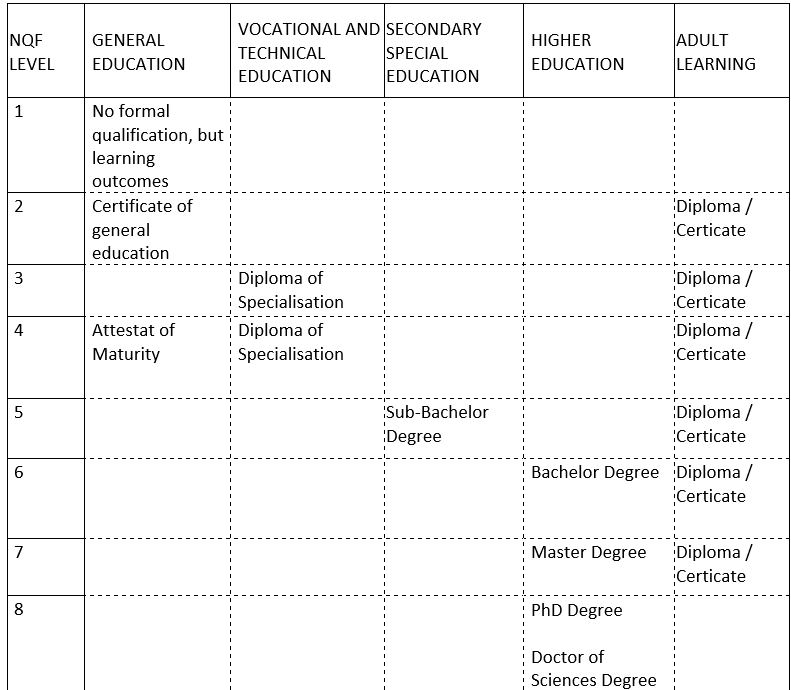
Annex C. Types of Qualifications in AzQF
The allocation of qualifications by type to the NQF level is purely indicative. No levels have been attributed yet. The NQF has only been used to formulate occupational qualifications standards in IT and management but no certificates for these have been issued.
Please log in or sign up to comment.