ETF is organising the webinar ‘New ideas for final exams’ on Wednesday 13 May from 10.30 to 12.00 (CET). The webinar is part of a series of actions launched by the ETF in order to support education in this challenging time due to the COVID-19 pandemic.  Experiences from ETF partner countries and EU member states will illustrate options in assessing learners for the end-of-year assessment: maintaining the assessments as planned, cancelling, postponing, online assessment and other alternatives.  

Join our multilingual webinar to learn from experts in the field and ask questions. 

Practical info 

The Webinar will be held in three languages: English (here on Open Space) with simultaneous interpretation to French and Russian.

For English speakers, please follow the broadcasting available here on this page.

All Russian and French speakers have register for this multilingual event, please go to https://portal.voiceboxer.com/events/jf5spz/register.

Note that we only have 250 places, participation is on a “first come, first served” basis.  

Для русскоговорящих коллег - пожалуйста зарегистрируйтесь на платформе с помощью этой ссылки - https://portal.voiceboxer.com/events/jf5spz/register.

Tous les francophones se sont inscrits à cet événement multilingue, rendez-vous sur https://portal.voiceboxer.com/events/jf5spz/register.

Need more info? 

This event is organised by the European Training Foundation (www.etf.europa.eu).  If you have any questions about the invitation, please contact Alina.codrescu@etf.europa.eu. If you need technical assistance for an issue related to the login on the day of the event, please contact support@voiceboxer.com

IN VIEW OF THE DATA PROTECTION AND PRIVACY POLICY WE WOULD LIKE TO INFORM YOU THAT: 

The webinar will be recorded. By participating in the webinar you accept that the event is being recorded and the recording can be further disseminated. 

This webinar is part of a series of actions that you will be able to follow on ETF Open Space (https://openspace.etf.europa.eu/) where you can find background documents, resources and blogs.  

We are looking forward to meeting you online on 13 May! 

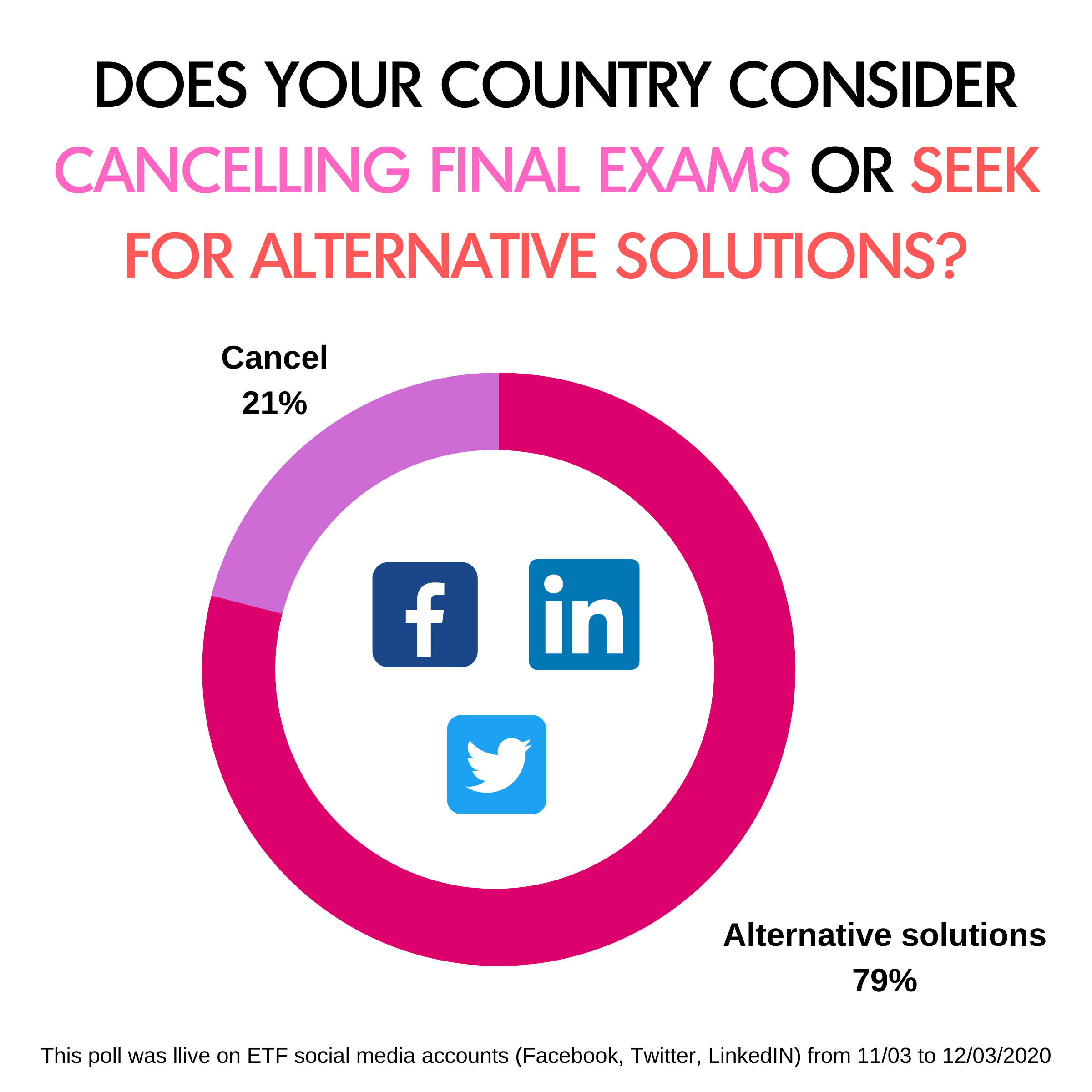
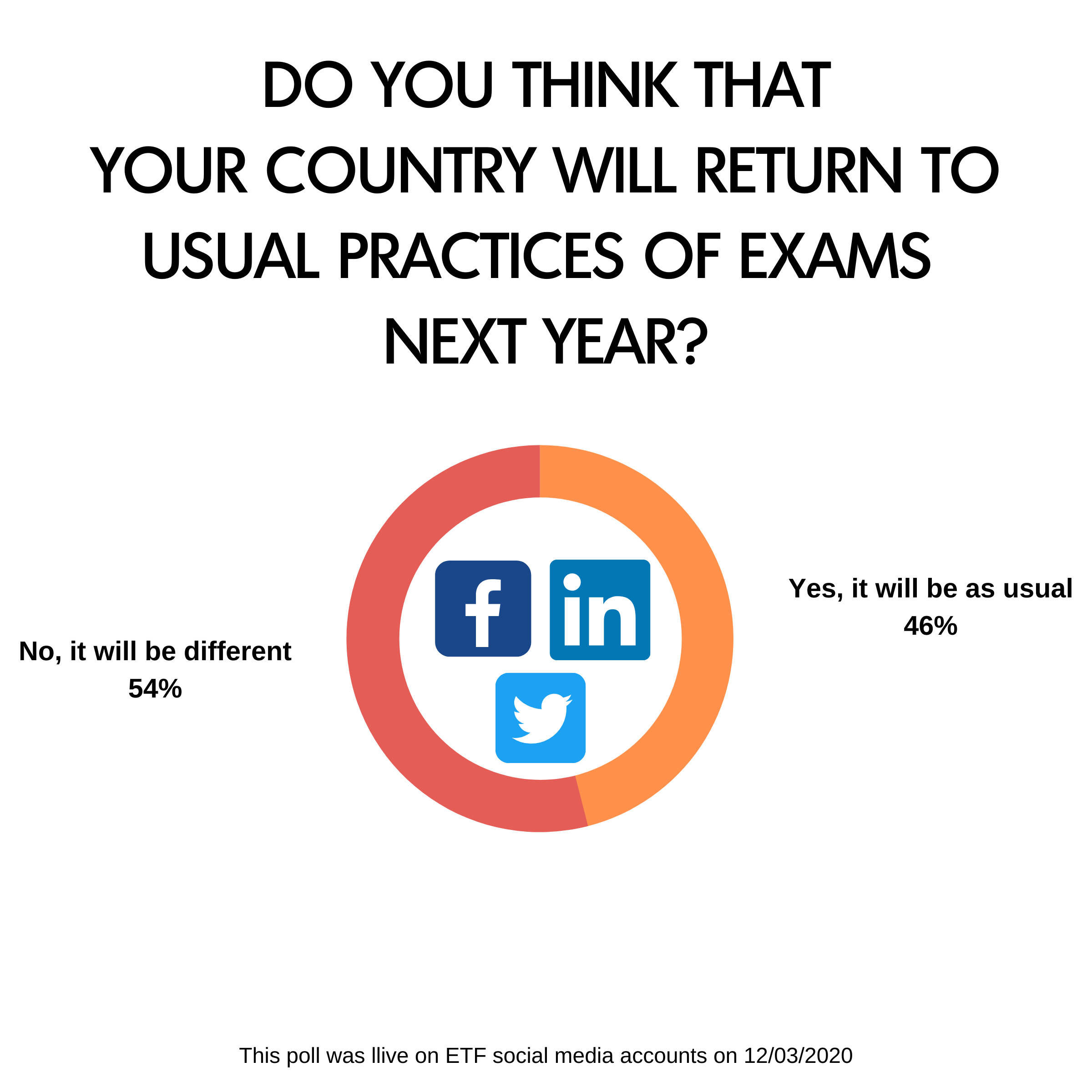
The results of the polls ETF has organized on its social media channels ahead of the webinar:
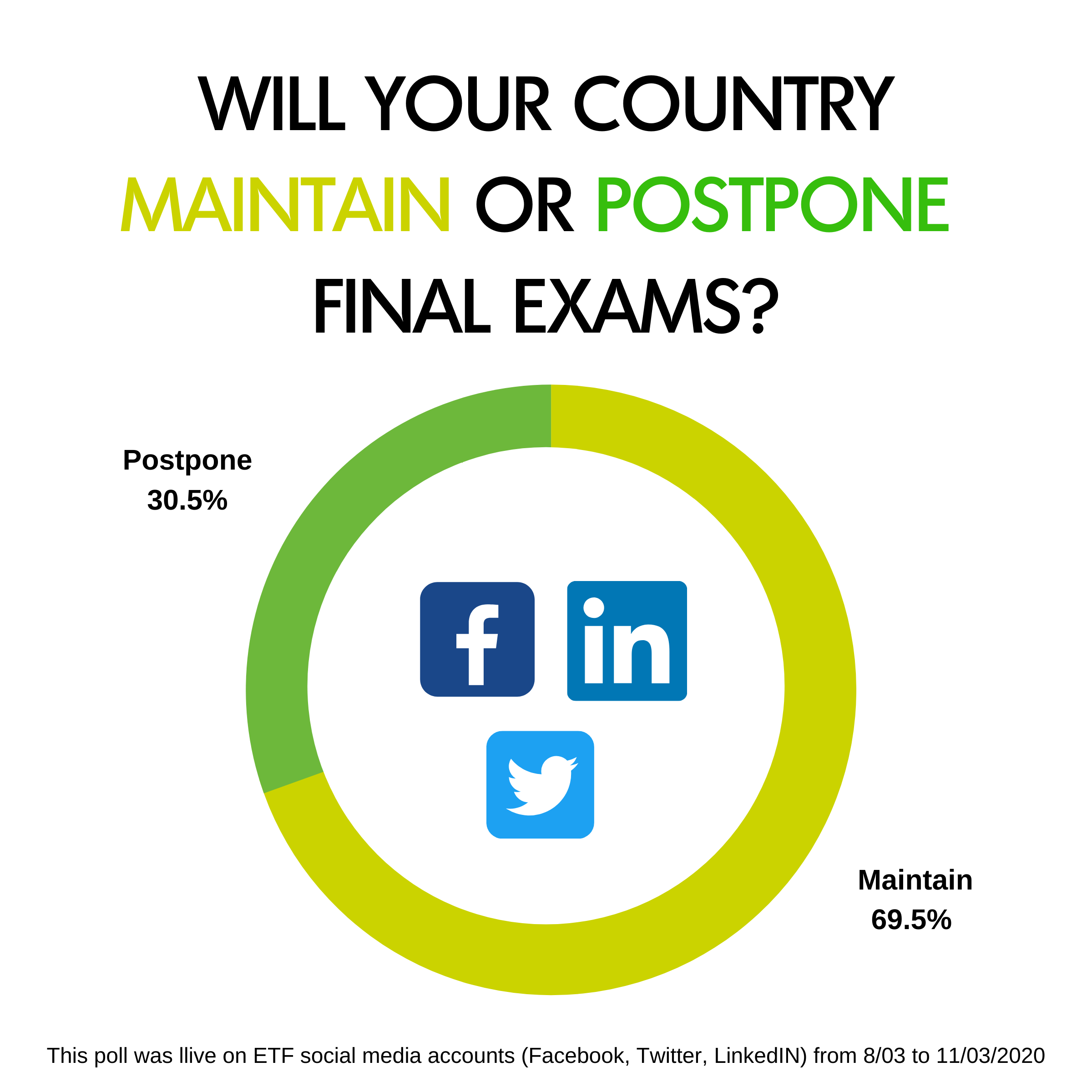
Image removed.


Image removed.


Image removed.


Comments (81)

Mirjam De Jong
Open Space Member

I hear that in most countries schools are closed until the new school year. Are there examples of countries that open the schools for final examinations, both theory and practice? This seems feasible as students can be divided over classes and workshops for safety precautions.

Arjen Deij
Open Space Member

In France it seems that the final assessment is being replaced at least partially by the completion of modules (competence blocks).
80% of completed blocks can give you a diploma

Arjen Deij
Open Space Member

Very sorry participants for all these technical difficulties, hope you can bare with us. In Kazakhstan teaching and assessment are brought on line.

Marko Vukasinovic
Open Space Member

To all presenters: Will you introduce COVID VET solutions after COVID? Should we all think about introducing certain alternative approaches in order to have something (in the reserve) in the time of crisis. I would really love to see these COVID efforts to be sustainable since all countries obviously invested quite a lot. At the end, hat off to ALL the teachers out there since they pushed themselves to the unknown...

Hanna Autere
Open Space Member

There was a question during the webinar on the biggest challenge in Finland in dealing with Covid 19. Main challenges have been in organising work based learning. The obstacles are profession specific. In some professional fields it has been easier to continue arranging work-based learning than in others. For example, the service sector has faced broad restrictions and/or closures of work places due to COVID.

An overall challenge in all levels of education, is the risk of increasing inequality and learning differences. In terms of access to the necessary ICT equipment for home-based learning, there are differences between regions, institutions and individual learners. Municipal- or institution-specific mechanisms are in place for ensuring that all TVET students would be able to learn at home. For example, some institutions are lending computers to students.

Külli All
Open Space Member

The same for Estonia - work based learning. practical emplacement in some sectors (tourism and hospitality were the biggest challenge. In order to help with access with IT equipment, in some cases/schools, laptop/devices were given to to students for home use and also VET school dormitory were kept open for these students who haven't got possibilities from their homes to do the distance learning

SREĆKO MIKULIĆ
Open Space Member

I Think, in my Bosnia and Herzegovina chances for return in normal are so weak! But, always stay hope. It is important to be part of international communities and share possibilities!


Please log in or sign up to comment.