

What is happening with assessment: results of the ETF mapping
Since the start of the pandemic ETF has been mapping the developments concerning VET in the partner countries. One of the topics ETF is closely following are the approaches taken to assessment. The outcomes presented here only show the status by the beginning of May. Countries are still making or changing their decisions based on what is possible in the current context.
The lockdown continues in most countries, except for Belarus and Turkmenistan where schools remained open after extended spring breaks. In other countries plans are in place for the start of phase two, which, in some countries includes a return to school, extension of the school year, or measures to ensure final examinations. Most countries, however, have confirmed there will be no return to school this year, and are putting in place detailed measures for final exams, as well as preparing scenarios for the new school year.
Based on the mapping exercise we were able to create a rough overview of the choices countries made at the moment. We have tried to cluster answers of countries into four different categories: maintaining exams, cancelling exams, postponing and implementing alternative solutions (online assessment, alternative assignments, etc.). Nonetheless the division is not so net and simple as it seems in the overview below. Many times, countries have adopted more than one option: they might have organised online assessment for certain degrees and cancelled assessment for another educational level. They may also have different approaches depending on occupations and even sectors.
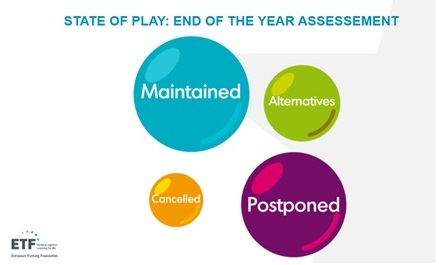
The size of the bubbles represents the number of countries choosing a specific approach.
When thinking of “maintaining” we included also countries, like Israel, where, exams are maintained but will be conducted in a lighter version. Israel for examples is reducing the number of subject to be assessed. The main challenge in the case of maintaining the exams is to provide a safe environment taking all necessary precautions.
Cancelling is the option adopted, for example in North Macedonia, where they decided to cancel the state Matura and final examinations in secondary schools. Summative (end of year) marks for the students in primary and secondary schools will be given by teachers based on marks for the first semester and formative assessment during on-line learning.
Postponing is the most preferred option. For example, in Algeria they recently decided not to re-open schools (therefore no third quarter) and to postpone exams (BAC and BEM) to the second half of September. Also in Palestine the practical VET exams will take place at the end of June, after the academic exams.
In terms of alternative approaches, we mainly considered all other options not listed in the previous ones. Basically, it is about online exams and its evaluation. In Kazakhstan for example they will organise online assessment. In Egypt they have developed applied research assignment (case studies) for end-of-year assessment for students who are not yet in their final year.
Please log in or sign up to comment.