

2.1 EU policies for policy makers
New Skills Agenda
With the ‘New Skills Agenda for Europe’ (2016), the European Commission launched a comprehensive framework to make the right skills, training and support available to people in Europe.
The New Skills Agenda supports countries to:
• Improve the quality and relevance of skills formation
• Make skills and qualifications more visible and comparable
• Improve skills intelligence and information for better career choices.
The Skills Agenda has 10 actions to achieve these aims. The actions provide a legal base, resources for implementation and monitoring support, which countries can use to shape and implement their strategies and policies. The Commission is continuing to take forward each of the 10 actions. It calls on EU countries, employers' associations, trade unions, industry and other interested parties to continue to work together to ensure that these initiatives produce the best possible outcomes.
The 10 actions are:
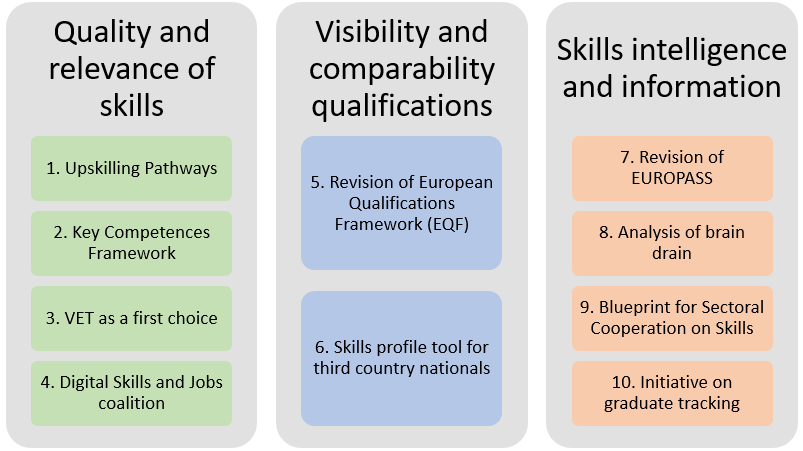
Detailed information about initiatives and progress under each action is accessible on the European Commission website. Here we look more in detail to the first action, Upskilling Pathways.
Upskilling Pathways: New opportunities for adults
The Recommendation on Upskilling Pathways, adopted by the European Council in 2016, is the main legislative proposal of the Skills Agenda for Europe. It is a response to the findings that close to one fifth of adult Europeans struggle with basic reading, writing and calculation and with using digital tools in everyday life, and around 22% of adult Europeans obtained only lower secondary education level. Without basic skills and with low qualification levels, people are at higher risk of unemployment, poverty and social exclusion. The main aim of the Recommendation is to bring a coherent strategic approach to addressing the challenge of adult upskilling.
With the adoption of the Recommendation by the European Council, EU member states committed to create upskilling pathways for adults who need to strengthen their basic skills, whether they are in employment, unemployed or economically inactive. Upskilling Pathways should provide support to individuals. Member States can define priority target groups for this initiative depending on national circumstances. Upskilling pathways have three key steps:
- Step 1 – Skills assessment; enabling adults to identify their skills and needs for upskilling. It may take the form of a ‘skills audit’: a statement of the individual's skills that can be the basis for planning a tailored offer of learning.
- Step 2 – Learning offer; the beneficiary will receive an offer of education and training meeting the needs identified by the skills assessment. The offer should aim to boost literacy, numeracy or digital skills or allow progress towards higher qualifications aligned to labour market needs.
- Step 3 – Validation and recognition; The beneficiary will have the opportunity to have the skills she or he has acquired validated and recognised.
The EU supports countries through mutual learning and capacity building events and through various funding programmes. The Upskilling Pathways initiative is also a key building block of the European Pillar of Social Rights, which promotes equal rights to quality and inclusive education, training and life-long learning.
Implementation
In February 2019 the Commission published a stock-taking report of implementation, plans and progress on upskilling pathways, based on information from Member States. A number of countries have started ambitious initiatives to support upskilling and reskilling of adults with a strong convergence between national policy agendas and the Upskilling Pathways objectives. Examples are France and its new Skills Investment Plan, Germany and Ireland with a new focus on supporting the upskilling of people in employment whose jobs are at risk of displacement through automation and the Nordic and Baltic countries that are further improving their already rather good systems.
The report mentions four main challenges:
- The scale of the challenge facing all Member States. Latest data show that 61 million adults aged 25 to 64 – many of them in employment and most of them native Europeans – are still low-qualified. There are only a few Member States that have ambitions to match the scale of this challenge. Most measures target only a few thousand individuals. More action is required from Member States if they are to achieve the objectives of the Recommendation.
- Addressing basic skills. Most measures do not explicitly address the three basic skills on which the Upskilling Pathway focuses, namely literacy, numeracy and digital skills. Instead, vocational and job specific skills for employment emerge most prominently. In the future, basic skills provision needs to be more strongly embedded into skills assessment and training offers targeting low skilled adults.
- A coherent pathway with three steps. Only a small number of initiatives include the three steps set out in the Recommendation (skills assessment, tailored learning offer, validation and recognition of skills). A large number of implementing measures rely on block offers or generic training. What is needed now is development of the missing elements and individualised, tailored offers based on assessment.
- Coordination and partnerships. As demonstrated by the initiatives reported by Member States, many small-scale, disparate initiatives (largely already-existing ESF projects) exist without evidence of mechanisms for coordination or partnership between providers and other stakeholders. Countries need to develop a coherent strategic approach to addressing the challenge of adult upskilling.
Further reading:
- European Commission (2016). News Skills Agenda for Europe.
- European Commission. Upskilling Pathways – New opportunities for adults.
- European Commission (2019). Council Recommendation on Upskilling Pathways: New Opportunities for Adults: Taking stock of implementation measures. Brussels: SWD
- European Commission. Delivering on the European Pillar of Social Rights.
Please log in or sign up to comment.