
Drawing on good practice and the latest state of the art technologies
Policy makers, education and training providers, employers, adult workers, young people and their parents all want to be informed about future skills demand. They all want to know about the skills in which they should invest.
Skills anticipation provides the means to assess future skill needs, where the future might be this time next year, the situation in ten years’ time, or even further ahead.
Methodological developments in skills anticipation have come on leaps and bounds over a relatively short space of time. So it is an opportune moment for an assessment of what is seen to work well in practice.
What works well in practice draws upon European Training Foundation (ETF) research which has used a combination of state-of-the art techniques and more traditional approaches to identify future skill needs. This includes, amongst other things, studies on agri-tech in Israel, the automotive sector in Turkey, and agri-food in Morocco.
The ingredients of good skills anticipation
Skills anticipation needs to deliver two things. First, an indication of the scale of skill demand. Second, detail about the skills needed. In other words, how many people are required to work in a job, by a given date, and the skills they will they need.
So far, so simple.
To this one might add a third requirement, that results are robust, readily understood, and convincing. Intended users will only act on results if they believe what they are being told.
This is where matters become more complicated.
If you want to understand scale and detail, you need some idea of what is driving skills change and to what extent. Estimates of the scale of skill demand tend to rely upon forecasts of the number of people working in a particular occupation in, say, ten years from now. Forecasts are an important part of skills anticipation but, as will be demonstrated, not sufficient.
The importance of forecasting
Skill forecasts at national or sectoral level can be produced in many different ways. From extrapolating existing trends in employment by occupation through to macroeconomic modelling of occupational employment by sector.
Skill forecasts tend to rely on occupation and qualification as measures of skill. These are proxy measures. Occupational classifications - such as the International Standard Classification of Occupations - group jobs which are closer to one another in content than they are to other jobs. Depending upon the level of disaggregation one might be looking at a varied set of jobs under any one occupational heading.
Developments in skills forecasting provide the means of producing more disaggregated results. Whereas once upon a time, forecasts might have provided information at a fairly aggregate level, more detailed estimates are now potentially available. Even so, where existing national data are being drawn upon, there tends to be a limit to the level of occupational disaggregation that can be credibly undertaken.
At the end of the day, occupational forecasts, especially those that rely upon macroeconomic models to rigorously determine future employment levels, provide data a level of aggregation that reveals limited information about the demand for people to work in actual jobs.
From forecasting to data science
There will always be a limit to the level of detail occupational forecasts can provide. This is where big data techniques, such as natural language processing, drawn from data science, can fill the gap.
ETF’s approach to advancing skills anticipation has drawn upon techniques associated with data science. Text mining techniques have been used to construct databases on the key technologies increasingly coming on stream in a particular sector. This recognises technological change as a prime determinant of future skill needs.
By drawing data from patent databases, for instance, it is possible to detect those technologies which are likely to be increasingly commonplace in a sector over the next few years. Companies tend to apply for a patent to protect something which is about to enter market.
Data on technologies can then be used to search skills databases to identify those skills linked to a specific technology. Information resources - such the European Skills, Competences, Qualifications and Occupations (ESCO) one - can the searched to detect correlations between technologies and skills.
Data science techniques provide detailed information on the skills required for an individual to work in a range of jobs in a given sector. It is not sufficient because it does not necessarily give you an indication of the scale of skills demand.
Squaring the circle
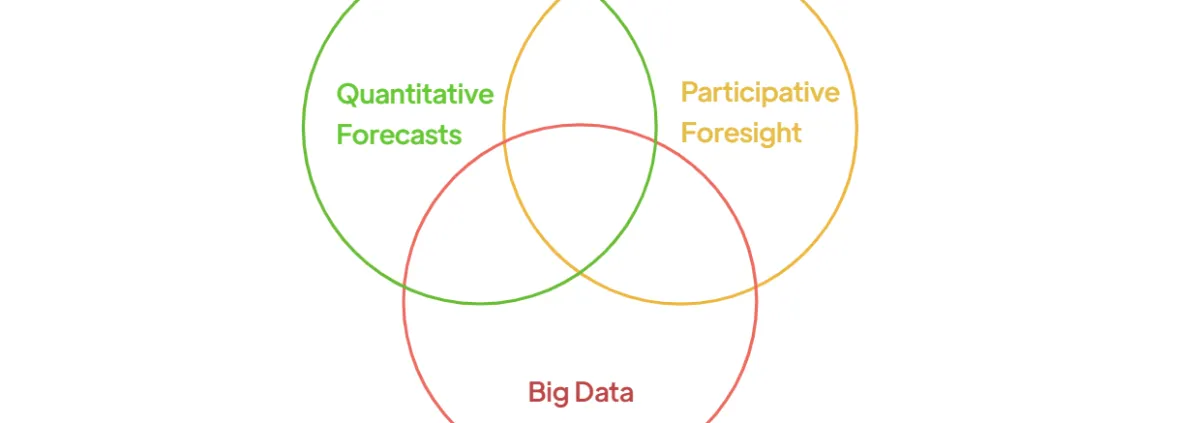
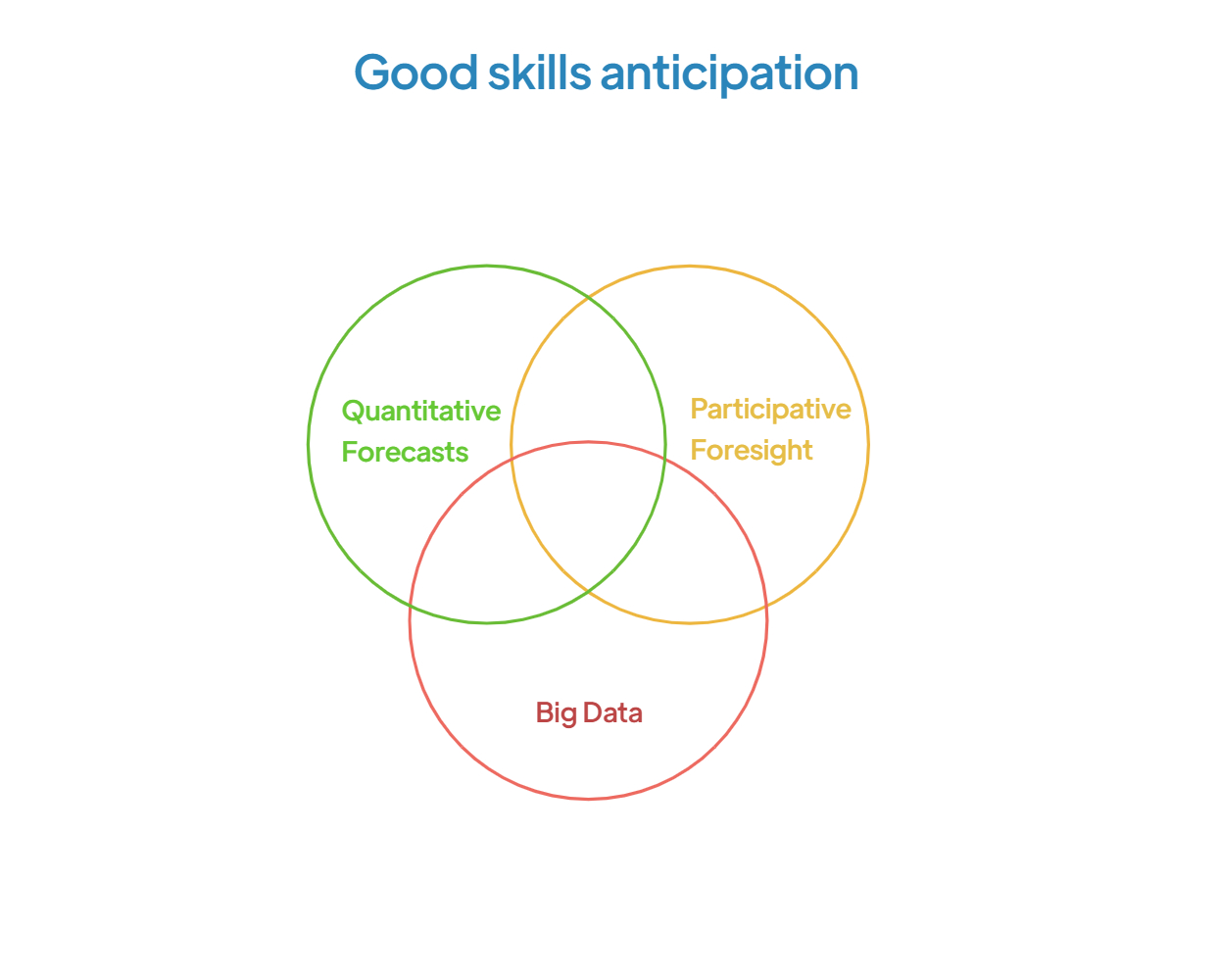
Forecasts provide scale and data science provides detail. How can they be combined? Ultimately skills anticipation is an art rather than a science. An understanding of future skills demand will be dependent upon obtaining the views of stakeholders in a sector about the veracity of the findings from the forecasting and big data elements of skills anticipation. And it will be the stakeholders who will provide the vital insights which allow data from the forecasting and the granular level information from the data science part to be combined.
The importance of the participative element in good skills anticipation should not be under-estimated. In the ETF’s research mentioned above, gathering information from stakeholders was an important part of the skills anticipation exercise. It is also an important means of disseminating information.
At the end of the day a variety of methodologies are required to produce information that gives a believable estimate of the scale and detail of future skill demand. Any one method is not the enemy of the other.
By combining forecasting with the new data science techniques to determine skill needs at the sectoral level, within the framework of a participative foresight approach which engages key stakeholder, the process of skill anticipation is advanced and the circle is nearly squared.
Thank you, Terence, for a very well elaborated, short and very informative material. What makes me worry a bit is the result of actual data analysis and skills demand forecasts. Sometimes it reminds me an old anecdote on the question how the marmalade gets inti the candy...
What I observe (and not only in Ukraine, where the situation at labour market shows the combination of incomparable factors) is the variety of macro- (climate change), meso- (Industry 4.0, automatisation and digitalisation) and micro factors that in their unpredictivity could make all anticipations uncertain...
Please log in or sign up to comment.