
Artificial intelligence, robotics, Internet of Things (IoTs), digitalisation and automation. These are not something out of a sci-fi movie. They describe the 4th industrial revolution that we are currently in and will be in for the foreseeable future. In recent years, there has been much discussion on the future of work and given the recent global COVID-19 pandemic, we could even look at the future of work as the AC (after-COVID) era of work. In this era, the skills of resilience and flexibility, creative thinking, entrepreneurial mindset, critical thinking, virtual collaboration, cross-cultural competency, transdisciplinarity, emotional intelligence and sense making are essential for the generations who will work in this future world of work.
Let us begin with some generational trivia. Did you know that in 2020, 41% of the global population was under the age of 24[1], 26% under the age of 15[2] and Millennials made up 35% of the global workforce[3]? Did you also know that Generation X has the largest number of start-up founders and entrepreneurs of any generation to date and in the US and UK, baby boomers were the fastest-growing age category in the workforce in 2020[4]? So, what does the future of work look like for these generations?
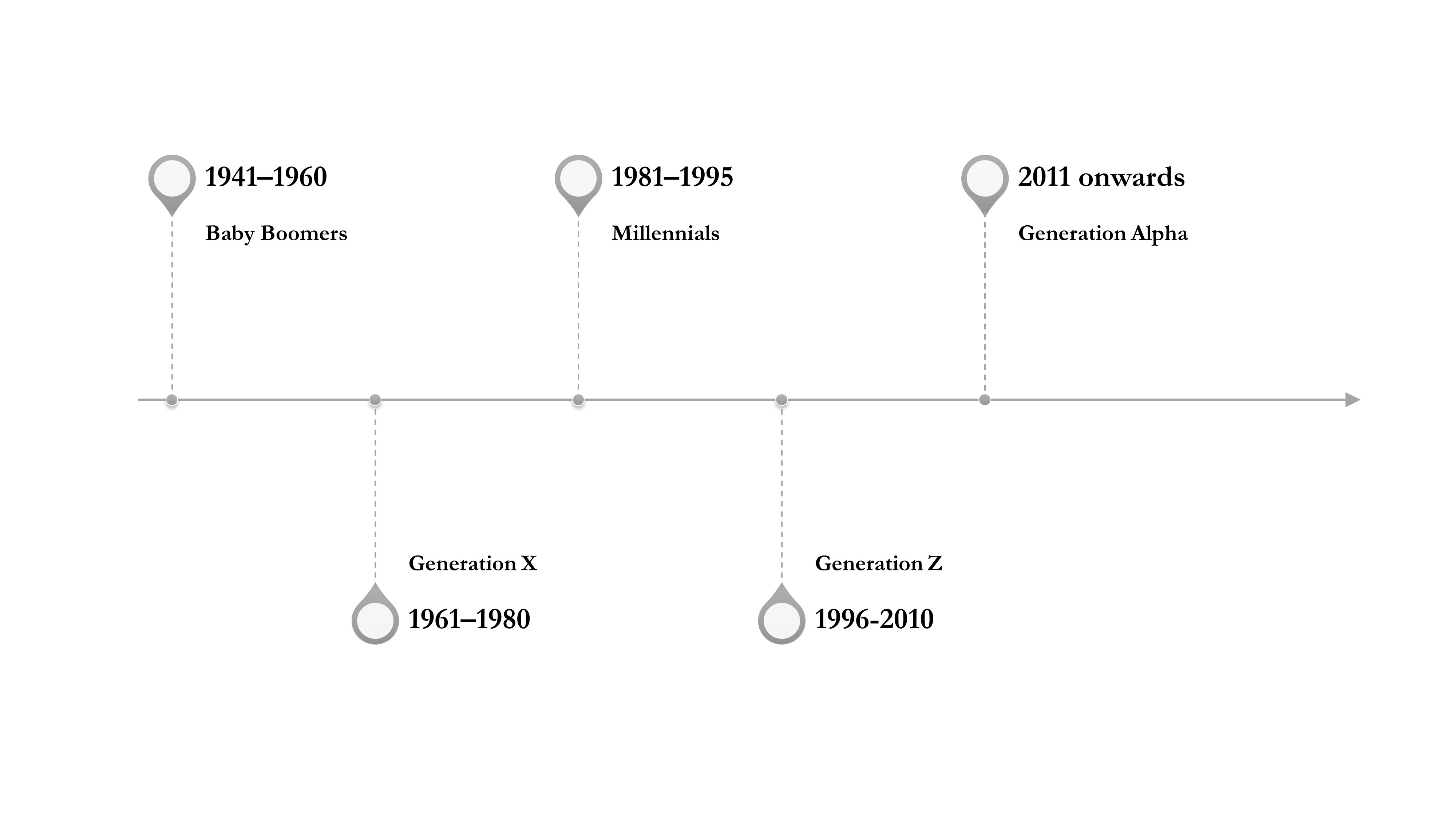
The younger of the baby boomers are known as the YOLD or Young Old generation – a generation challenging the traditional expectations of the retired as people who do gardening and look after the grandchildren. At the peak of their careers, they were known as the workaholic generation, fiercely loyal to their organisations, motivated by position, perks, and prestige. Today’s boomers are resisting retirement given how much their identities are intertwined with their work. They have a wealth of experience and know-how to share, but at the same time yearn for flexibility to pursue their other passions which may include advancing environmental, social, or cultural causes or travelling the world or pursing higher learning courses.
The middle to senior management positions in today’s organisation are predominantly held by Generation X. This cynical generation who witnessed their workaholic parents lose their jobs in the recession in the 1970s and 1990s have prioritised authentic leadership and work-life balance. They are using their seniority to create the companies of the future – ones that are focused on sustainability – while also nurturing company cultures that prioritise diversity, equity, and inclusion; humane and servant leadership; and employee mental health and well-being.
The Millennials are today’s optimistic generation, being advocates of change and seeking opportunities to take on social and environmental issues. These Millennials are working their way swiftly through the organizational hierarchy, motivated by work that is meaningful and that has positive societal impact. They also seek opportunities for continuous learning, while demanding flexibility and freedom in how and where they work.
The youngest in today’s workforce are from Generation Z or the “the YouTube generation” where FOBA (Fear of Being Alone) and FOMO (Fear of Missing Out) define this generation’s view of technology and the role of social media. Apps like Instant Messenger and WhatsApp have created a generation that demands and expects instant communication and feedback from their managers and colleagues. This generation recognises the power of collective effort to solve the world’s biggest challenges - climate change, mental health, and racial and social justice. Most of Generation Z are still students and have been studying remotely during the pandemic lockdowns of 2020 and 2021. This generation defining experience will likely influence how this generation choose to develop and use AI technology, leaning towards achieving a natural balance between the roles of technology and human interaction.
The youngest of Generation Z have witnessed their parents being forced to Work-From-Home (WFH) through the lockdowns. For those that have also had positive remote learning experiences, they are likely to advocate for Work-From-Anywhere (WFA) models of work, meeting face-to-face with colleagues periodically for team building. At the same time, they have seen that the halting of air travel and other modes of transportation during the pandemic, along with factories being shut can have such a positive impact on the environment. There is a good chance that this generation will not forget this, fuelling a greater sense of agency and they will be seeking opportunities to work for purpose-driven companies.
Now, what about Generation Alpha – the youngest generation and the generation we know least about? It may be a while before we see them in our workplaces, but we may get some clues as we observe their early life experiences. Through the pandemic, kindergartners and nursery children in many parts of the world have either begun their formal education virtually or have seen a delay in their educational journey. Many have never stepped inside a classroom and are having virtual playdates - if at all - rather than being at the playground with their friends. The long-term impact of this and the impact on how Generation Alpha defines work in the future remains to be seen. Perhaps this is Generation Hope that will create a burning desire in older generations to change the way things have been for a more just and sustainable world for their children and grandchildren.
It is hard to predict what the future of work will look like but with these generations leading the way, it looks bright, doesn’t it?
[1] United Nations, “Percentage of Total Population by Broad Age Group, Both Sexes (Per 100 Total Population),” World Population Prospects 2019 (2019).
[2] https://www.statista.com/statistics/265759/world-population-by-age-and-…
[3] https://www.statista.com/statistics/829705/global-employment-by-generat…
[4] https://www.cnbc.com/2019/11/12/baby-boomers-will-be-workforces-fastest…
Dr. Poornima Luthra , thanks a lot for this blog! very interesting! Generational aspects of the future of work are fascinating.
Do the employers (businesses) think about it when planning for recruitment/future of work/new jobs (e.g. for Gen Z)?
Maria Lvova Great question! They are certainly paying more attention to it in recent years. Managing a multigenerational workforce has not necessarily been consciously looked into; it is just assumed to manage itself with the belief that generations have always existed. In the past 7 years, there has been increasing focus on it. Companies have realized that to attract and retain Gen Z talent, they need to change the way "things have always been done". Gen Z in turn is putting pressure on companies to change the way things have been done in the past and focusing on what they desire out of work.
Please log in or sign up to comment.