
Each of the seven countries that form the South Eastern Europe and Turkey (SEET) region is distinct from the others, and diverse in its own make-up. Many specific local and national factors influence the development of their vocational education and training (VET) systems.
However, monitoring and analysis work undertaken by the countries as part of the ETF’s Torino Process reveal commonalities and shared themes. For example, as a group these countries have shown improvements over the past two years in relation to EU education, employment and social benchmarks, in some cases progressing towards 2020 targets faster than the EU average. Overall levels of educational attainment have also improved.
But despite these and other efforts, the speed and scale of global trends – from migration and demographic change to technological and economic shifts – mean that the seven also share significant challenges.
Human capital development: A mixed picture
Demographic factors, such as migration and ageing populations, are combining to reduce the availability of skilled workers. And, while general employment levels are improving, unemployment and inactivity remain problematic, particularly for women, young people and socially disadvantaged groups. Meanwhile, the skills that employers look for are constantly evolving, putting pressure on initial education, which tends to be slow in responding. And because of the region’s low lifelong learning participation rates, those already in the workforce are less able to adapt to future change. This restricts the ability of businesses to adopt new technologies needed, which in turn inhibits trade and investment potential.
But there is good news as well. Labour market information systems are improving, more attention is being given to practical learning, better school-to-work transition schemes are spreading, and cross-cutting competences such as digital and entrepreneurial skills are increasingly embedded within learning programmes. Furthermore, national qualifications frameworks have been established or consolidated, steps are underway to modernise quality assurance, and governance arrangements show stronger recognition of the role of social partners.
Policies for progress: Go further, faster
Naturally, local and national contexts also play a big part in determining policy responses from country to country. But here too, there are important similarities in the SEET region emerging from the Torino Process analysis. The core recommendation, heading into 2020 and beyond, is that holistic, results-oriented strategies are the way forward. Clear and achievable goals must be set, and matched with detailed costing, viable responsibility for implementation, and transparent accountabilities.
The themes in the report’s recommendations will not produce many surprises. The question is how far and how fast the following issues can be addressed: improving the relevance of VET outcomes; ensuring stronger digital and entrepreneurial skills; creating a culture of continuous improvement in curricula, teaching methods, qualification standards and the continuing professional development of teachers; fostering work-based learning; and matching governance and finance arrangements with the expectations of other parties, including learners.
Mitigating the effects of the lifelong learning deficit is also vital, and must be addressed through upskilling and reskilling services that are available to all on a fair basis, and backed with thorough quality assurance procedures. And all of this needs to be underpinned by further development of skills intelligence systems, including consolidating monitoring and evaluation within education.
Sounds simple, never easy
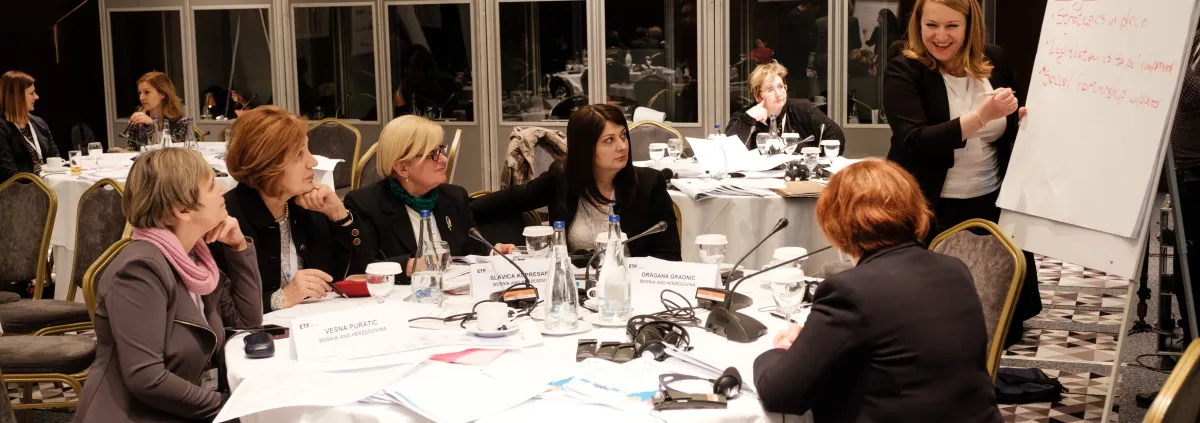
As the ETF continues to build its role as a global knowledge hub in the field of human capital development, it is able to broker relationships and share ideas among partner countries, and between them and EU and international donors and partners. But it is only able to do so with the willing and extensive contribution of the partner countries themselves, particularly in their collection of policy updates and relevant statistics for the Torino Process and participation in workshops organised at country level.
The ETF can make recommendations for policy and system change, and do everything in its power support the change process, but it is the policy makers, practitioners and learners themselves who will decide what to do and how to do it. Saying ‘do more, and do it faster’ may sound simple. Making it happen is never easy.
The Torino Process, now in its fifth round, is a periodical review of VET systems in ETF partner countries, building on four principles; ownership, participation, holistic approach and evidence-based analysis. For more information, visit https://www.etf.europa.eu/en/practice-areas/policy-analysis-and-progress-monitoring
Ezri Carlebach Cristina Mereuta
Congratulations to Cristina and the team ! Bravi
Very much looking forward to read this, congrats to the team!
Please log in or sign up to comment.