

The Organisation for Economic Co-operation and Development (OECD) just published the 2018 results of the Programme for International Student Assessment (PISA).
The survey compares reading, mathematics and science performance of 15-year-old pupils around the world every three years. Over half a million 15-year-olds from 79 countries and economies, including 18 ETF partner countries, took part in PISA in 2018, with a special focus on reading.
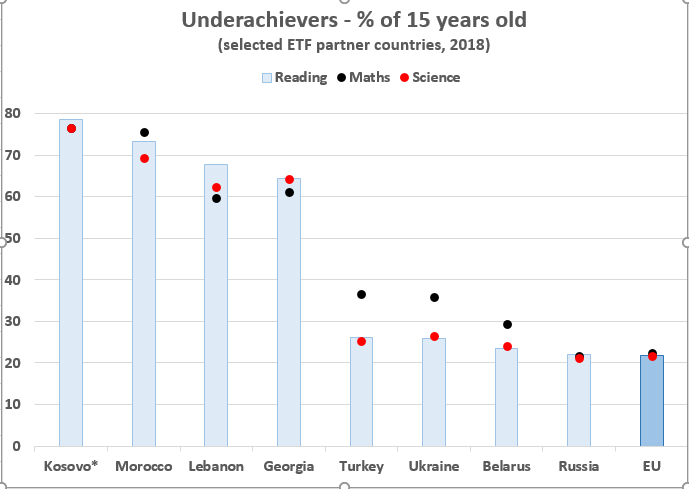
The 2018 results show high levels of underachievement (ie students who are failing Level 2 on PISA scale in reading, mathematics and science) for more than half of the ETF partner countries. The indicator provides a measure of the youth population most at risk through a lack of foundation skills.
Source: OECD PISA database
Data shows that around three out of four students aged 15 in countries such as Kosovo* or Morocco, about two-thirds in Azerbaijan (Baku), Georgia, Kazakhstan or Lebanon and about half in Albania, Bosnia and Herzegovina, Moldova, Montenegro, North Macedonia, can be considered underachievers, failing to complete even simple tasks in the tested domains.
At the other end of scale, only about a quarter of students aged 15 are underachievers in Belarus, Turkey or Ukraine. At the EU level, about one in five students falls under this category, but the cross-country differences are sizeable. Compared with the previous round of the survey (2015), only North Macedonia and Turkey have witnessed sizeable decreases in the share of underachievers (see more).
PISA also makes it possible to analyse national performance by gender, socio-economic status and immigrant background, and contains other contextual information and pupils’ attitudes. The results show a wide performance gap in reading exists between pupils in general education and those in vocational programmes. Therefore, when analysing the incidence of low achievement among students aged 15, it is worth noting that in most ETF partner countries, this is the typical age for entering VET. Thus, students entering VET are at high risk as a result of a lack of foundation skills.
Please log in or sign up to comment.