
An old Latin proverb says: Nomen est omen - a name is a sign, meaning the name is the signifier of the essential characteristic of someone or something. Thus, in the Serbian language, the word teacher has the verb “to learn” in its root. The teacher should be an expert in teaching, its planning, organization and implementation, but the teacher should also be an expert in learning. The learning expert enables all that planning, organization and realization to lead to growth and change in students: cognitive and social, affective, moral, aesthetic, physical. A learning professional knows how to challenge and support the learning of individuals and groups, how to enable learners to organise and communicate what they know and, at the same time, he is constantly learning. In the past, training a teacher was modelled on the training of an apprentice in a workshop - he watches and imitates what the master does. However, a teacher is not an apprentice who needs to learn a set of specific operations in order to do his job well. He must be well educated in various fields, not just his own discipline, in order to teach others well. With significant insights gained from contemporary research and best international practices, the concept of teacher education has been transformed into a concept of teacher professional development.
The researches across the world have shown that successful education reforms are characterised by making teachers the partners of education authorities in developing and implementing changes and adapting them to specific local situations (school-based-reform). In Serbia, we have not yet created the precondition for this approach - space for pedagogical autonomy of teachers. There is little room for pedagogical, professional autonomy of teachers, because changes (reforms) happen as a rule "from above" (top-to-down approach) and teachers are expected to implement new curricula or new assessments. But if teachers do not understand the intentions of educational policy, why certain changes are being introduced, what problem the authorities are trying to solve, they are far less likely to make a success of implementation.
Continuing professional development means working to improve the professionalism of teachers and professionalism consists of competencies and autonomy - it is taking responsibility for professional decisions that are made on the basis of competencies. Continuous improvement of professional competencies (knowledge, skills, attitudes and values) is a process. The first step in this process is crucial - teachers must become aware that their teaching and their students’ learning could be improved. This is where we started in our joint project with ETF which is concerned to support innovation in teaching and learning in vocational schools in Serbia. Some teachers expressed concern about low motivation from learners, others that students were not able to connect or apply what they were learning and others that students were not achieving professional standards or values. These then are the drivers which should shape the particular innovations that teachers have been invited to develop.
The Partnership for Innovation in Teaching and Learning involves 31 teachers from 6 secondary vocational schools in Serbia. Teachers in the project work in different Serbian regions and cities: Požega (Technical School); Vrnjačka Banja (School for tourism and catering); Vlasotince (Technical School); Vršac (School for chemistry and nursing); Užice (Technical School) and Belgrade Aviation Academy. The community members teach different subjects, some teach general subjects (Serbian and foreign languages) but most of them teach professional subjects in their schools.
The teachers have been encouraged and supported to design their own innovations, building upon international practices, research and examples provided by Education Forum, Belgrade, international expertise and ETF. The projects will receive small-scale funding from Serbia GIZ and the schools have been encouraged to participate by the national development agency Zuov. The innovations in teaching and learning will contribute to achieving educational goals of one or more subjects and should be a learning experience for all participants in the process, students and teachers and the entire school. The innovations will be researched by ETF – so that this learning can be captured and shared.
Innovative teaching is not the application of a new template. Education is socio-culturally conditioned, so even the best solution cannot be directly applied from one environment to another. Instead, innovative teaching should be reshaped according to the characteristics and needs of the pupils, environment and conditions in which we are working. With age, a person's ability to learn decreases, but their capacity to connect meaningful novelties with previous knowledge and experiences, to experiment, to monitor and learn from their experiences can, with support, increase. Developing the habit of listening, monitoring, testing and modifying practices is a key objective of professional development. The teachers in our project already have this habit but now they are try to design new learning situations and challenges to address the specific deficiencies that they themselves have identified. They work on projects that promise to bring joy back to schools - the joy of learning, the joy of working together meaningfully, the joy of creating and sharing knowledge.
In my next blog, I will share with you an account of how the teachers prepared to undertake these innovations.

Professional Development is a requirement considering the changes and advances in education
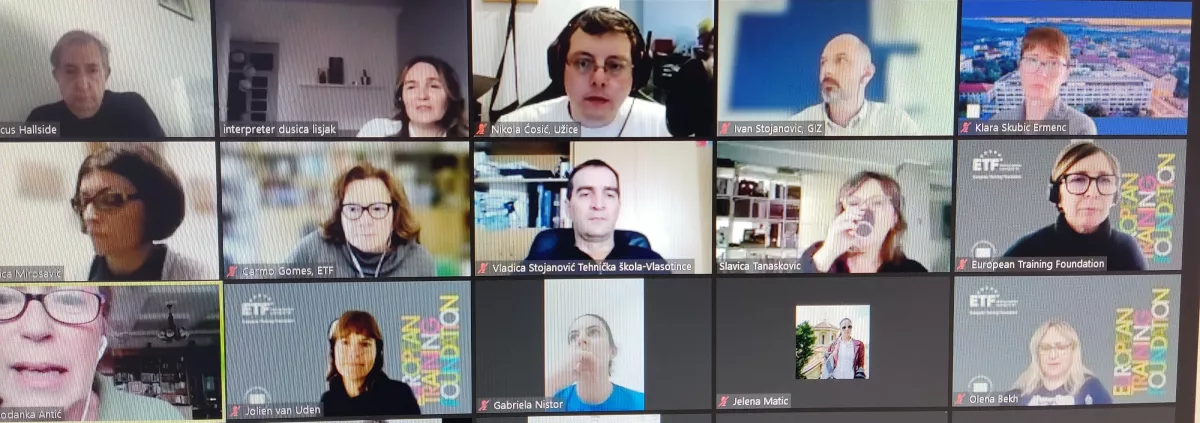
Thanks for this report Boda! I have uploaded an image from the webinar that we had last week!
You can also read in Serbian: https://openspace.etf.europa.eu/blog-posts/treba-li-ucitelj-da-uci-stva…
Thank you!
Thank you, Boda. This is a great blog with many discussion points.
You say "But if teachers do not understand the intentions of educational policy, why certain changes are being introduced, what problem the authorities are trying to solve, they are far less likely to make a success of implementation", which is so true, so how can we make sure that teachers are consulted properly on policy developments in the first place?
Please log in or sign up to comment.