
Lifelong learning has become a global priority, and skills provision and qualifications are opening up to a wide circle of providers. As these processes are ongoing, many countries are introducing different ways to encourage the provision of continuous vocational education and training programmes (CVET) closely linked to labour market needs - to support upskilling, reskilling and employability of people. While the existence and uptake of such programmes is seen as very beneficial for the labour market and economy at large, their quality and trust in their results is an important issue. The recent activity of the ETF Forum for Quality Assurance (ETF QA Forum) zoomed in on exactly this domain: external quality assurance mechanism for the implementation of continuous vocational training/retraining programs in Georgia.
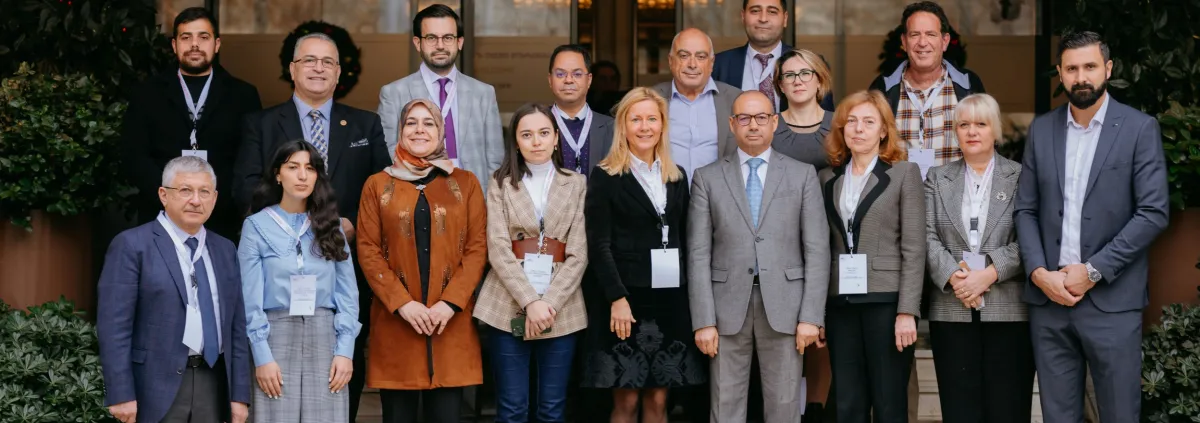
On 6-8 December the National Centre for Educational Quality Enhancement of Georgia (NCEQE) hosted a peer visit of the ETF QA Forum. The Deputy Director of NCEQE and National Contact Person of the ETF QA Forum, Mr Kakhaber Eradze, steered the organisation and information sharing, together with a wide circle of national stakeholders.
The video brings the highlights of the 3-day peer visit!
Peers (representing ETF QA Forum member institutions) from Albania, Armenia, Azerbaijan, Bosnia and Herzegovina, Israel, Moldova, Montenegro, Morocco, Palestine, Tunisia and Turkey visited Georgia to get acquainted with the Georgian quality assurance measures (for the implementation of CVET training and retraining programmes) and provide their constructive feedback and recommendations.
Formalised procedures for continuous vocational training/retraining (short courses 2 weeks to 12 months) were introduced in Georgia in 2019. In the new formalised system, quality assurance has obtained a prominent role. Institutions aiming to become providers of vocational training/retraining courses were given a possibility (but not mandatory requirement) to obtain the right to implement these courses through a nationally defined authorisation procedure. High rate of economic growth in the post-pandemic Georgia led to an increased demand for upskilling of people. Vocational training/retraining programs are also an integral and important element of the ongoing State employment support programme in Georgia. They are used as Active labour market measures in order to increase the competitiveness of job seekers and to support the employment.
In Georgia, there are 2 possible tracks for obtaining the right to deliver vocational training and retraining programs: a regular track and a simplified track. The National Center for Education Quality Enhancement is responsible for the implementation of these external quality assurance mechanisms.
The simplified track applies if the program is based on an already authorised Vocational Education Program. It means that the Vocational training or retraining program represents the compilation of learning outcomes from a “bigger” program, that Vocational college, HE or GE institution is implementing under the umbrella of “big” authorization.
The regular track applies when not authorized legal entities or VET colleges, higher education institutions or general education schools aim to deliver program that is not related to an already authorised “bigger” vocational education program. The peer visit zoomed in at this regular track.
A rich programme was organised by the hosts to provide an in-depth understanding of the system. Thus, peers visiting Georgia had a possibility to look at the Georgian practice from different angles – institutional, practitioners, and beneficiaries. All the insights from the peer visit and the Georgian experience in the implementation of quality assurance of CVET training/retraining courses is summarised in the attached Peer Visit Report.
The ETF QA Forum is a transnational collaboration initiative between national institutions with mandates for quality assurance in vocational education and training (VET) in ETF’s partner countries. The aim of the Forum is to support member countries to modernise and improve quality assurance in vocational education in training. The Forum was launched in November 2017, initially for the representatives of countries of Western Balkans and Turkey, and Southern & Eastern Mediterranean regions.
The Forum uses a special Methodology for the organisation of its peer visits as way to improve quality assurance in VET. In order to maximise the potential of peer visits, ETF developed a Peer Visit Guidance and Training Manual.

Great event! Thanks to ETF and peers for very important work done! TVET system will definitely benefit from this!
Please log in or sign up to comment.