
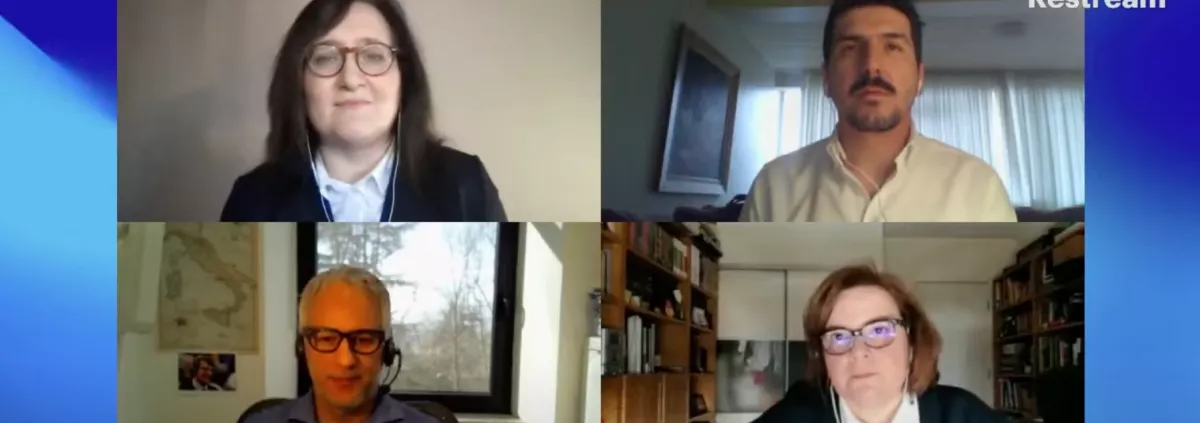
Policy advice must be evidence-based, address issues of continuity vs. change, and promote best practices. Those were the main conclusions of an online video conference called ‘Policy Advice: new ideas for achieving sustainable reforms’ organized by the European Training Foundation (ETF) and broadcast on Tuesday via LinkedIN LIVE.
“Evidence is fundamental, especially nowadays that policymaking is very complex, and is often questioned,” said Georgios Zisimos, Head of Policy Advice and the EU Programming Unit, ETF. Data is essential, he added, “but you need to analyse them and come up with solutions… Policy advice looks into the context, the data, and the trends.”
Eren Suna, Policy Advisor, Ministry of National Education, Turkey, described how teams in his country collect data from teachers, students and other stakeholders to gauge the “effects of policies and sometimes make predictions about” outcomes. They are also tasked with helping to define the needs of the ministry and finding solutions.
When it involves outside institutions such as ETF, “Policy advice, first of all, is done upon request,” Zisimos noted.
Carmo Gomes, Senior Human Capital Development Expert, ETF, provided examples of a few initiatives in the European Neighbourhood Region, a diverse group of nearly three dozen counties set geographically around the edges of the European Union. The EFT customarily collaborates with education ministries or other policymakers, she noted. In Ukraine, it worked directly with local officials to help create a new government agency to implement a reform of the country`s qualifications policies.
“The ETF was able to bring some examples to the table, and discuss what could be the best institutional setup,” she said. In Egypt and Azerbaijan, it worked in tandem with the European Commission`s delegations in those countries to help carry out and monitor projects supported by the EU.
Educational policies generally need a long time to prove their worth. “It takes a generation to produce those results,” Gomes noted. Many countries implicitly recognize this by adopting in five- and 10-year plans. Turkey’s Education Vision 2023 programme has shielded educational spending from short-term budgetary pressures due to economic instability, Suna noted.
But newly elected politicians often want to step on the gas. “Sometimes they want to restart from scratch and reset the system,” said Gomes. She called it “the biggest challenge in education in the last decade.” Impatient new ministers may want to shake up the staff, partnerships and consulting agreements. They often press for what the speakers referred to as “quick fixes.”
“Any minister would like to bring forward his or her own agenda,” observed Zisimos. But policy advisers also need to keep an eye on “continuity and structures… even when faces are changing.”
Speakers offered suggestions about how to respond to demands for quick fixes while maintaining consistency. Zisimos talked about having a flexible medium-term strategy. “How flexible is that strategy?” he asked. “How realistic are the targets and goals?” It also helps to maintain contact with a broad range of stakeholders, he noted.
Gomes sometimes tries to convince decision-makers to table “some of the most controversial policy decisions because these might require a little bit more of time.” After focusing on more achievable parts of their agendas for a few months, new policymakers frequently “get a reality shock. They start understanding that reality is much more complex and sometimes much more demanding than they were thinking. That might be the moment when we can come back to some of the issues that we had left aside in the beginning of the mandate.”
Suna had similar thoughts: move on a few initiatives that can be implemented quickly and gradually chip away at others, “which shows you the problem is getting easier.” A step-by-step approach.
If elections are big disruptors, nothing can match the pandemic and its collateral effects. But a few lessons have already been learned.
“If there is one positive thing in this pandemic, it is the fact that we appreciate more the importance of facts and flexibility in our systems,” said Zisimos. “It has a lot to do with timing. We realize that there are things that should have been done four years ago.”
The pandemic also highlighted the usefulness of sharing experiences internationally, said Suna.
“Everyone is trying to find the best solution under their own conditions,” he said. “Sharing expertise and having the best practices has increased.”
To see the full conversation:
Please log in or sign up to comment.