

This blogpost presents the first results a review of scientific literature for the Creating New Learning project describing the roles and profiles of 21st-century VET educators.
Educators play a crucial role in the transition of VET systems, and the policy imperative of focussing on innovating the role and profiles of VET educators clearly stems from the literature. International organizations agree that educators are a key to the structural reforms that transition and developing countries are putting in place, and that innovating educators’ roles and profile contributes to structural change.
Global changes are putting VET systems under pressure, creating new labour market dynamics and new jobs, and they are changing the way people learn, work and interact. A new generation of students with new learning styles is emerging, that cannot be trained with traditional methods. By screening existing literature, we conclude that six main trends that are having an impact on VET educators:
1. Digital transformation, including industry 4.0
2. New teaching paradigms and approaches, including Competence-Based Education (CBE)
3. Migrations
4. Climate change
5. New forms of entrepreneurship
6. Increased networking and collaboration.
These trends are placing new demands on educators, to meet the new demands from both industry and society. Agreement exists within literature on four aspects related to this new idea of educators. First, educators are encouraged to take up new roles. Literature shows that there is a trend to avoid using the words teacher and trainer and to refer to educators as facilitators, coaches, supervisors, mentors, counsellors, orchestrators of individual and group learning, alchemists who compound strategies, techniques and resources, welders who connect bits and pieces of knowledge and activities into a meaningful whole. Existing studies show that educators perceive this pressure to change, but at the same time it is not always clear what the practical implications of this are for their jobs. Second, educators are expected to expand their responsibilities, becoming active in administration, management and quality assurance tasks, actively cooperating with colleagues and with companies and taking more responsibility in curriculum design. Third, educators are increasingly considered as key agents of change within VET reform processes, contributing to designing new classroom and workshop learning and providing feedback on training outside classrooms. To play this active role, educators need to continuously develop professionally and reflect on their new behaviours and roles. Fourth, educators are called to work through collaboration and networking, with colleagues, experts and external stakeholders such as companies or social parties. The idea is that sharing expertise with colleagues in day-to-day work helps them to concentrate on their own strengths, promoting well-being and social capital development. Literature recognises that this transition is difficult because it represents a major cultural shift within educators’ self-perception, related to the need of rethinking and reshaping the roles played within the teaching process and the underpinning knowledge production process. Because of this complexity, educators should be given sufficient time and resources to develop innovative teaching processes, and training programmes should ensure that staff have the capacity to deal with such initiatives.
By reviewing existing literature, we have condensed the characteristics of a 21st-century educator in the picture below. These competencies should exist side by side with the traditional competencies.
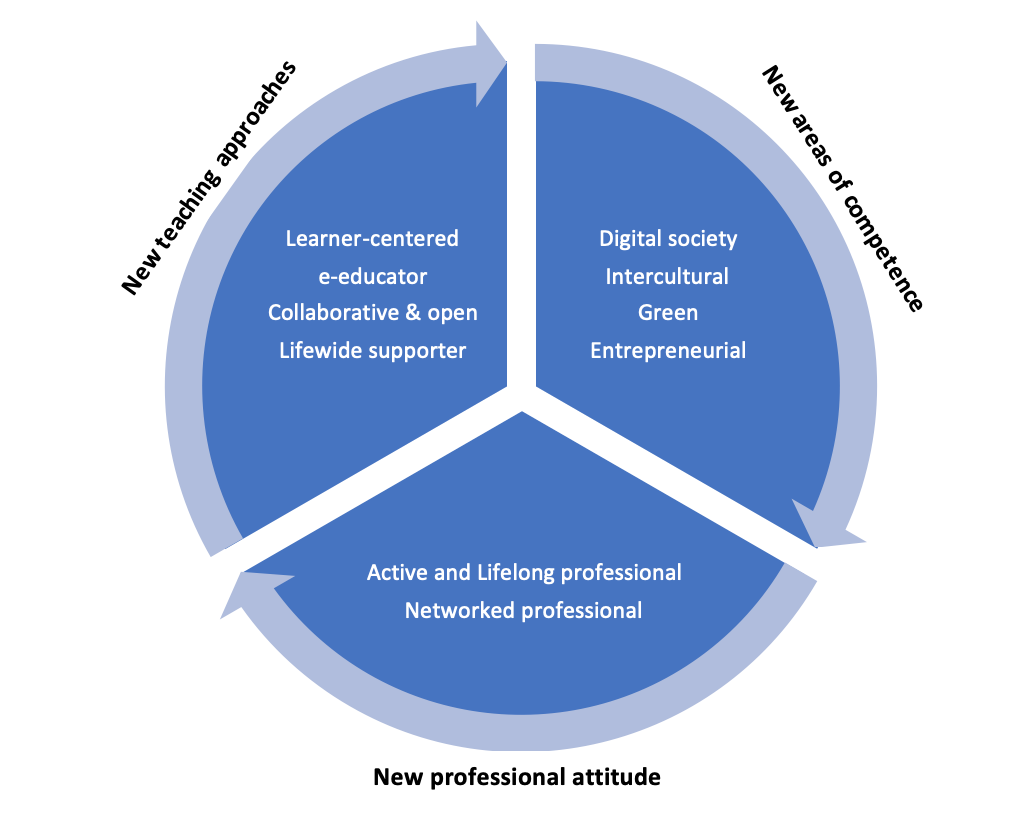
The new role and profile of educators can be presented through three areas.
- First, educators should be able to implement new teaching approaches, by being a) Learner-centred, b) e-educators, c) Collaborative and open and d) lifewide supporters of learners.
- Second, educators should be fluent in four new areas of competence: a) Digital society competence, b) Intercultural competence, c) Green awareness and skills and d) Entrepreneurial competence.
- Third, educators should have a new professional attitude, by being a) Active and Lifelong professional and b) Networked professional.
In the literature review that ETF will share with you soon this will be unpacked further.
We have started to look into existing national, regional and super-national educators profiles to understand how many of these characteristics emerging from literature are actually embedded in new profiles. I will write about this in my next blogpost, but it would be really good if you could let me know in the comments below whether you recognise some of these characteristics in your own educators’ profiles.
Thanks Lynne.
The emerging terminology to refer to teachers/trainers is indeed fascinating, we go from facilitators and mentors to more exotic terms such as alchemist and orchestrator. I personally like the term educator because of its "neutrality".
More on the report soon!
Fabio