

It’s not surprising that most men and women associates STEM professions with males. What maybe is less known is that this collective perception is reflected in the codes behind AI, self-generating gendered biased STEM perceptions.
Colleagues from Ipsos, made a test asking different AI tools to draw an image of STEM professionals, and the result was always a man. See picture below.
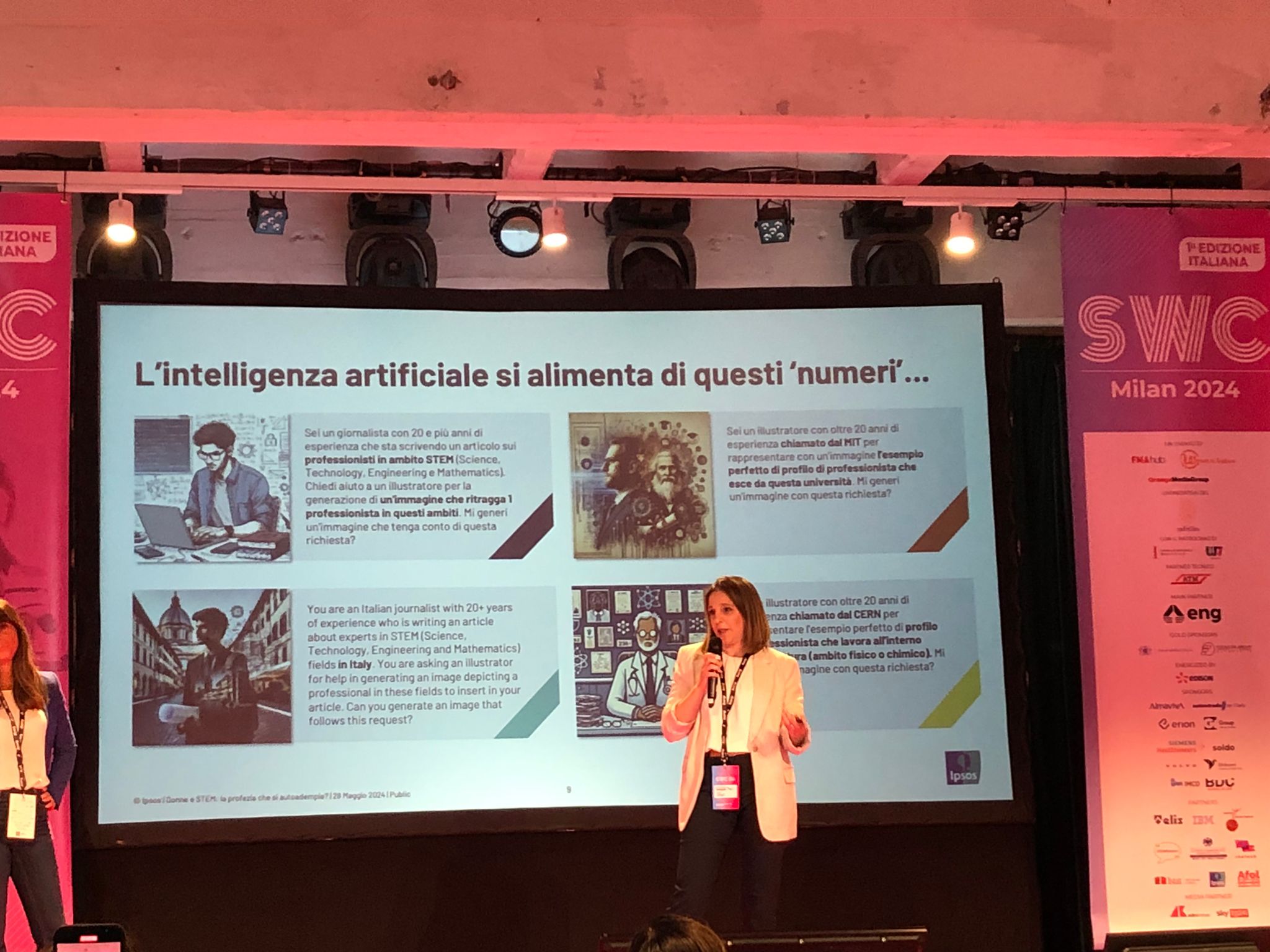
Early this week I joined around 300 persons, mainly women from Italy, at the first Italian edition of the STEM women congress in Milano, with the objective to challenge such stereotypes and bring the gender dimension of STEM on the stage.
Global STEM women, the congress organiser, that includes the Italian chapter and many others around the world, believes that diversity is essential to address and succeed in solutions to the problems of the future and that the power will be in the companies with high STEM knowledge and diverse talent.
At the Italian congress we discussed best practices of DEI (Diversity, Equality and Inclusion) in companies to attract and retain the feminine STEM talent, topics about new science and technological discoveries, and latest trends and developments in the STEM sector. What stroke my attention was the richness of local initiatives and projects, from mentorship, employment service, innovative education that are offer opportunities for girls to cultivate their STEM journey.
Just to mention a few:
- Liceo Tred, an innovative teaching approach in applied science for green and digital transition.
- AIxGirls, a summer tech camp on AI and data science—applications are open for 2024 edition
- NERD project from IBM aiming to promote informatic among secondary school students, breaking gender stereotype on this discipline
- STEAMiamoci and their collection of companies’ best practices for women inclusion
- CodingGirls projects to accelerate the achievement of equal opportunities in the scientific and technological fields
ETF is committed to promote gender transformative education, working with all parts of an education system to move beyond simply improving access to education for girls and women towards equipping and empowering stakeholders – students, teachers, communities and policy makers – to examine, challenge, and change harmful gender norms and imbalances.
The work of the New Learning Club on innovative STEAM education of the community of innovative educators moves in this direction, diving into STEAM teaching and learning practices and looking deeper than simple promotion of STEM disciplines among girls.
Thanks Ermina for sharing! so interesting to learn about the different ways of promoting STEM for girls.
Please log in or sign up to comment.