
ETF Teachers' Week
Most countries around the world resorted to some form of lockdown as an initial response to the COVID-19 pandemic. Vocational education and training (VET) suddenly moved online. When and where social distancing measures were partially or fully lifted, many jurisdictions adopted hybrid learning – combining on-site instruction with distance learning.
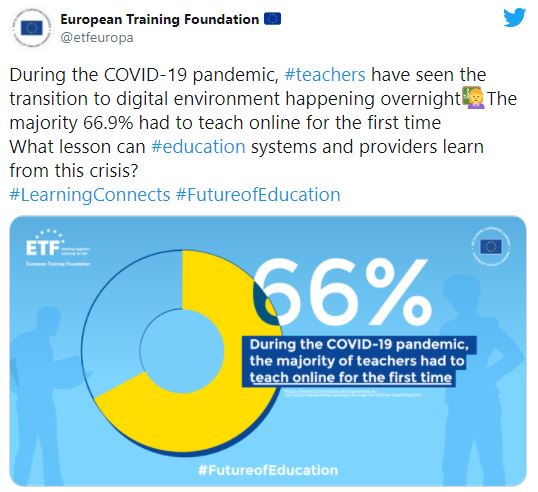
This adaptation and plans for the future dominated the European Training Foundation’s (ETF) online agenda during Teachers' Week, November 16-20.
The main events were two webinars: Exploring distance and online learning in Central Asia and Should we change our approach to summative assessment?. In parallel, the ETF continued to provide materials to support the continuous professional development of teachers, especially in the context of the pandemic.
The Central Asia webinar primarily featured breakout sessions where practitioners and students discussed their experiences with distance and online learning. One main conclusion: countries that already had experience with online learning proved best able to react quickly to the new reality. Elsewhere, managers and directors had to scramble to help provide teachers with resources and support. Challenges included the lack of computers, poor Internet access and insufficient bandwidth for students, along with difficulties in finding ways to offer practical experience.
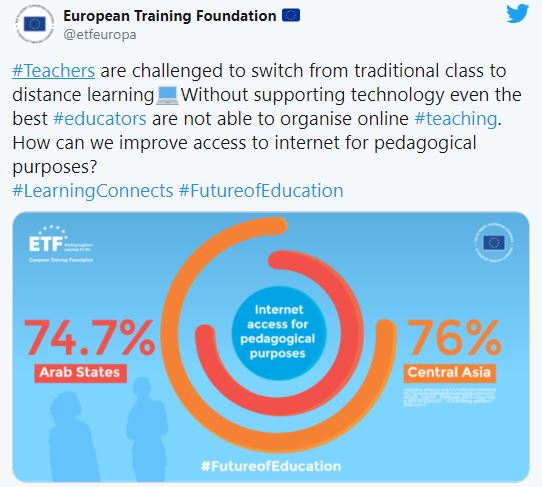
Of interest to teachers specifically, takeaways included:
- The workload for teachers and trainers increased as they made the shift from face-to-face to distance learning.
- Teachers are working longer hours but are generally not being paid more.
- Teachers who already understood online platforms and tools adapted more easily.
- Theoretical parts of the curriculum can be adapted more easily to distance learning. Practical learning experience must be done on-site in some disciplines.
- Distance learning works better for some disciples, such as computer science and programming, than for others.
- Partnerships with businesses are important and have been beefed up in some cases.
- Instructional videos can be useful and effective tools.
The assessment webinar had two main objectives:
(1) to analyse some emblematic approaches to assessment, partly in light of the COVID-19 pandemic and the responses to it; and
(2) to look at lessons from the scholarly literature about the pros and cons of standardised vs. authentic (performance-based) assessment.
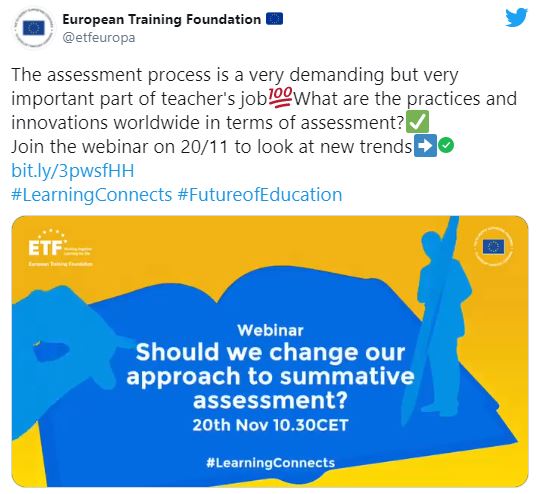
Perhaps accelerated by the crisis, there seems to a movement toward hybrid and flexible approaches to assessment. This includes modular assessment which, among other things, give learners continuous feedback around their progress.
The webinar recording is available on the ETF YouTube channel:
Inspirational Educators
The current and potentially long-term adoption of distance and hybrid learning requires new skills and a new approach for teachers, wrote award-winning vocational teacher Sergio Banderas in a blog post published during the week.

His ‘10 ways to keep online education engaging’ made the following points:
- Deliver education bites - Successfully shifting from classroom-based to online teaching requires an engagement strategy. Help students stay focused by delivering short and clear messages. Break large topics into smaller elements.
- Avoid passive learning - Incorporate interactive activities. Encourage students to participate, communicate among themselves, and work in groups. Use online tools, such as digital mind maps and infographics to encourage creativity and drive collaboration.
- Online self-training (learn to learn) - Adopt a fun-focused online teaching plan. Introduce learning techniques and activities that students can use throughout their lives. These include learning how to make priority lists, forming chunks of information, brainstorming, and self-assessment.
- Soft skills in the digital sphere - In the switch to online teaching, a few soft skills stand out: adaptability; being proactive and taking responsibility your own learning; time management; and creativity. Embrace these soft skills and help your students make the most of them.
- Visual content for digital - Engagement requires variety - make use of visuals to grab attention. When possible, show yourself on camera to humanise your voice. You may want to pre-record your sessions, edit them and add special effects.
- Gamification in vocational education - Use this to motivate students and help them address challenges. Scoring can keep students engaged in competition, which in turn can drive teamwork and collaboration.
- Webinars with former students - Reconnect with former students and ask them to share their experiences. Peer-to-peer connections are often stronger than those between teachers and students.
- Use social media as professional branding - Creating a dedicated social media account may support your online teaching. Use this to connect with fellow practitioners and keep up with best practices and innovation. Make sure that students understand the benefits of these platforms for job searches. Help them create or enhance their online profiles.
- Produce cross-generational collaborative digital projects - Bringing together different generations of students encourages engagement.
- Internationalisation of vocational education - Encourage the expansion of language skills by reaching out to international schools and organisations.
Education innovator Märt Aro was featured in a video on the future of education, as part of the ETF Teacher Booster:
Aro, who has co-founded three ed-tech related platforms, lamented the continued prevalence of educational systems designed in the 19th century, when most workers performed routine tasks and were not expected to think creatively, collaborate in teams or solve complex problems.
He asks two questions:
- Do our education systems meet the requirements of the 21st century?
- What is the purpose of education in the 21st century?
He suggests that we constantly ask ourselves the second one.
Education technology is not an end in itself, nor can it answer those questions. But it can help learners and educators become better equipped to meet today`s challenges. He cites digital learning assistants, flow theory and virtual and augmented reality as possible tools.
eTwinning ambassador and teacher of Hotel Management, Tourism Business and Economy Kornélia Lohyňová was also featured in the Teacher Booster series:
Lohyňová approaches the EntreComp PlayBook, where collaboration is one of the nine principles that can guide the design and implementation of entrepreneurial learning.
“No successful project or idea is just the result of one person,” Lohyňová argues in the video introduction.
She invites teachers to consider project based learning as a tool in developing students' interpersonal skills as well as their ability to take ownership over their whole learning process.
The Teacher Booster is part of the Creating New Learning initiative.
Please log in or sign up to comment.