
The COVID19 crisis has shut down schools and compelled teachers to switch to distance teaching and to make use of various digital and on-line tools. It follows that digital competences will be critical for teachers now and in a future where a more systematic use of information and communication technologies in teaching is to be expected.
There is a need for a self-assessment process that will identify and analyse the digital competences of teachers and permit the analysis of relevant current CPD provision. Teachers, schools and systems must make judgements about which digital competences are most important in the light of their individual, organisational and national goals. The self-assessment process can help to inform these decisions.
The ETF will to take the lead but will work in partnership with the EU’s Joint Research Council and with the ERI-SEE TET Network together with those particular economies that wish to participate in the pilot. Currently it is agreed that Albania, Serbia, Montenegro and Moldova will pilot the tool.
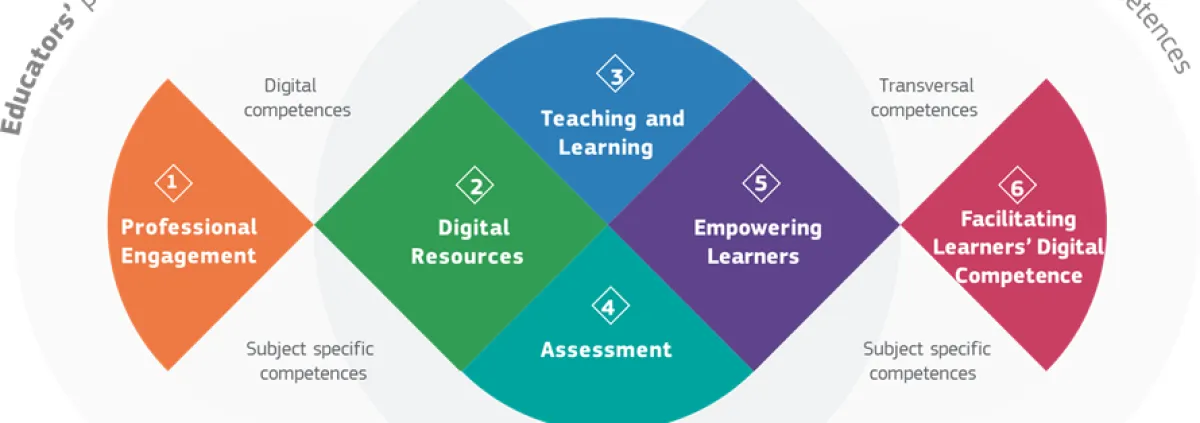
The project will make use of the European Digital Competence Framework for Educators (DigCompEdu) and of the related self-assessment tool to map the digital competences of a sample of teachers and to audit training for digital competences for teachers. The DigCompEdu is an European reference framework developed in 2017 for educators at all levels of education. DigCompEdu details 22 competences organised in 6 Areas. The focus of the framework is not on technologies, rather on how educators can use digital technologies to enhance and innovate their practices.
A previous phase of research is already complete. This has been concerned to describe, analyse and evaluate the current processes for needs analysis for teachers in SE Europe. The current phase of the research is concerned to develop a methodology that makes it possible to assess the adequacy of the in-service training offer in relation to teachers’ self-assessment of digital competence needs and will elpo schools, countries and donors to identify opportunities to improve quantity and quality of training for educators.
For the purposes of the pilot the survey will focus on the training needs of upper secondary teachers – both general and vocational in the countries. It is planned that the survey will be small scale, consisting of approximately 400 teachers in each country, distributed across approximately 24 schools, of which half will be general schools and half vocational. The survey will take the form of an on-line survey.
The survey should collect reliable data which permit analysis at regional, national and (selectively) at school level. In this way, the research will (1) help to understand training needs at different levels (2) analyse how well training provision currently meets these needs at different levels (3) address the issue of how information about needs at different levels should shape decision making about the provision and coordination of training and support.
Please log in or sign up to comment.