
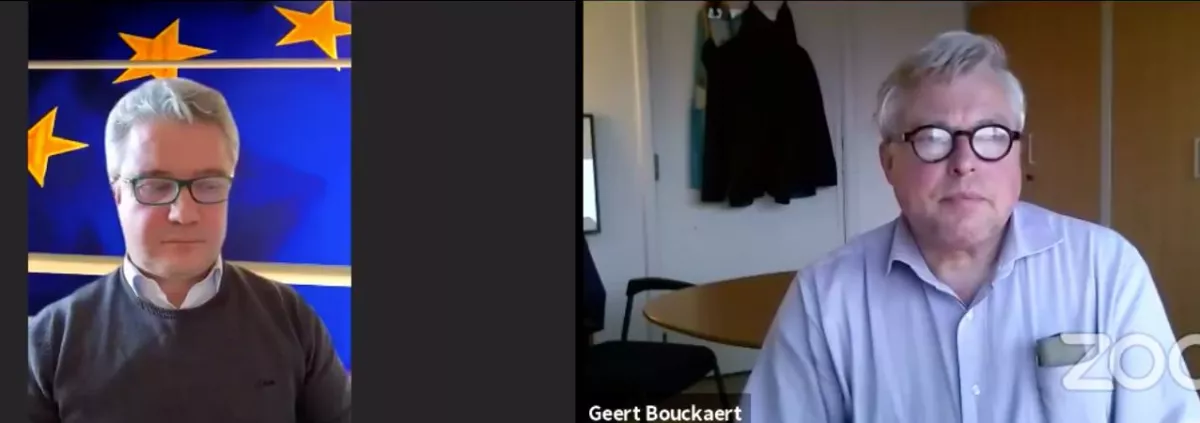
The ETF’s #LearningConnects sessions bring together speakers for an online conversation on key topics for the community of learners worldwide. Ahead of the ETF and IIAS’s high-level round table on “The nexus between human capital and climate action”, which will be broadcast live on Wednesday at 11am CET, three of the speakers took part in a #LearningConnects session on Monday 14 December. They were joined on Facebook Live by people from a host of ETF partner countries including Albania, Algeria, Jordan, Lebanon, Morocco, Palestine, Tunisia and Uzbekistan, who were invited to pose questions to the panel via chat.
So how can human capital development (HCD) help tackle the climate crisis affecting us all?
“The climate challenge is all-pervasive and requires us to think in innovative ways”.
One year after the presentation of the European Green deal, heads of state and governments are moving towards ambitious targets for carbon neutrality. Meanwhile, the 17 Sustainable Development Goals show how diverse factors such as poverty eradication and education are all interconnected in the pursuit of a sustainable world.
All this means that jobs and skills needs are changing faster than ever before – not just because “green is good”, Onestini said, but because it makes firms more competitive and able to deal with the new realities. In ETF partner countries around the Mediterranean climate change has directly affected sectors like agriculture, tourism and traditional industries, which calls for a forward-looking approach to training as well as upskilling and reskilling the working population. Onestini’s key message was: “Simply adding good practice to good practice is not good enough anymore. We need to move from learning from good practice to changing our systems and finding new ways of training, upskilling and reskilling. That is part of the change that is needed.”
“Simply adding good practice to good practice is not good enough anymore. We need to move from learning from good practice to changing our systems and finding new ways of training, upskilling and reskilling. That is part of the change that is needed.”
Flanked, as she spoke by the Georgian and EU flags, Tamar Kitiashvili, Deputy Minister for Education, Science, Culture and Sport in the Republic of Georgia said promoting awareness of climate change was a big challenge for educators. She noted the effect of the Covid-19 pandemic on people’s perception of climate change: “Before it was far away […]. Now we feel in Georgia, like in the rest of the world, that this topic is more tangible for all of us.” To help educators in their task, “we need to deploy a set of instruments and mechanisms […] bringing it to the hearts, not just the minds of the people, to make them feel and not just internalise”.
“Before it was far away […]. Now we feel in Georgia, like in the rest of the world, that this topic is more tangible for all of us.” To help educators in their task, “we need to deploy a set of instruments and mechanisms […] bringing it to the hearts, not just the minds of the people, to make them feel and not just internalise”
In terms of rapidly changing skills needs, governments also need to rethink qualifications for the future, Kitiashvili said. In Georgia, as with many economies in transition, 40% of the population is involved in agriculture; they are affected by climate change in their daily lives and they need to be better prepared to adapt, requiring more proactive, flexible and agile policies. But beyond skills and contents, she said, there are also values: “The values we need to carry should start from early childhood.” To bring all these strands together she envisages “a big ecosystem of education and skills development which includes both formal and informal mechanisms of HCD”.
“The values we need to carry should start from early childhood.”
Geert Bouckaert, Professor at KU Leuven, brought his expertise in public-sector reform to bear on the question of a crisis within a crisis: Covid-19 was a shock crisis, unforeseen and demanding urgent measures, whereas climate change is a chronic crisis perceived as slow and incremental, “but the implications will be even more terrible”. To cope with this twin challenge requires a strong – not necessarily big – state. It needs structures and capacity, but it must also foster trust. “We have to reinvent delivering services and combine it with chronic crisis management,” he says. “We also have to create a space where we can reinvent and innovate possible futures.”
"We have to reinvent delivering services and combine it with chronic crisis management. We also have to create a space where we can reinvent and innovate possible futures”
Covid-19 has exacerbated the wealth gap and it is imperative to leave no one behind. This is where partnerships – whether public-private or public-public – are essential. In a brilliant analysis of the SDGs, revealing that Bouckaert is probably a master crossword-solver, he explained why all 17 SDGs must be addressed together as an interconnected network in order to be able to “solve chronic and shock crises” in the future.
The digital agenda is important, but there must be accountability. “You should not experiment with societies, but you have to experiment to learn,” he concluded, adding that, as well as learning, “unlearning is also important”.
Questions from the virtual audience revealed that several watchers were start-up founders with a sustainability agenda wanting to know more about how to access funding and expertise. Onestini outlined what the ETF is doing to support and connect donors and individuals, including the Skills Lab, and promised to talk more on this on Wednesday. Kitiashvili gave some specific examples of partnership programmes to target key competences and policies to reshape agriculture and support inclusiveness, and Bouckaert summed up the key words of the session:
- Flexibility
- Partnerships
- Inclusion
- Leadership
Watch the #LearningConnects session on #HumanCapital development & #ClimateAction here: https://www.facebook.com/etfeuropa/videos/393745818515477
To see the recording.of the High-Level Round Table on the nexus between human capital and climate action that took place on Wednesday 16 December at 11am ECT -
Please log in or sign up to comment.