
From Dreamers to Doers:
a STE(A)M Journey of Hope and Resilience in Palestine
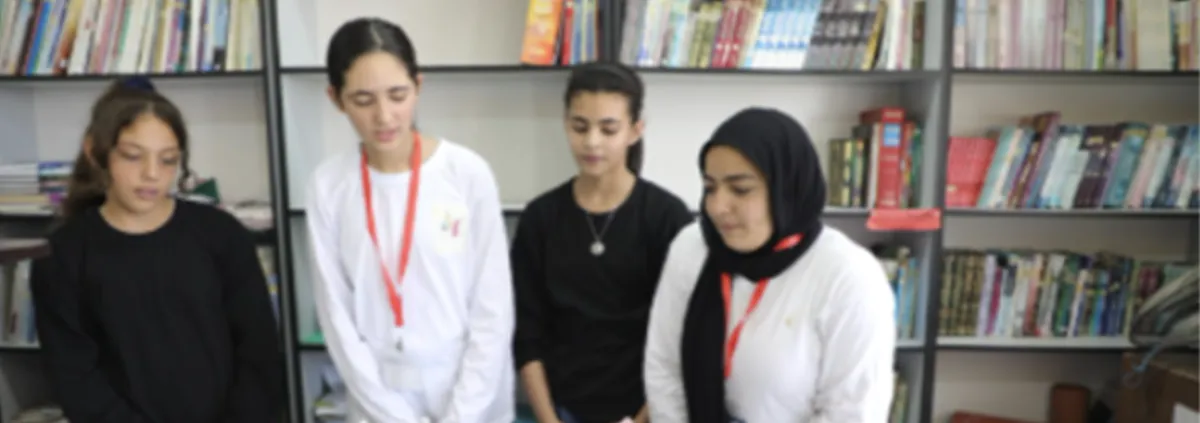
The “STE(A)M Pal House” initiative, led by the A.M. Qattan Foundation, Enabel’s local partner in the Quality Education & Learning (QEL) project in Palestine, centres on engaging students in Science, Technology, Engineering, Arts, and Mathematics (STEAM) clubs. In these clubs, students can brainstorm, design, and create STEAM projects that address local community needs with an awareness of global challenges, sustainability, and environmental issues. Over the course of a year, participants receive ongoing coaching to help develop their ideas. Students present their prototypes at public pitching events, where they gather feedback and insights to further refine their projects.
1. Background and context
The grant between Enabel and A.M. Qattan Foundation was signed before October 7, 2023, but the socio-political context in Gaza and the West Bank changed drastically afterward, requiring major adaptations. Instability, movement restrictions, and limited access to basic goods disrupted plans, making national pitching events impossible. The project responded by organizing district-level events, which preserved the program’s intent but doubled logistical efforts.
Target areas include Jenin, Tubas, Ramallah, Bethlehem, and Hebron—regions separated by checkpoints that severely hinder mobility. In Jenin, heavily affected by military operations, the team partnered with a local community centre to provide a safe venue for children, an unplanned but necessary adjustment. Training formats also shifted from winter camps to after-school activities to reduce travel and address safety concerns for families.
2. Description of the project
The initiative, implemented by A.M. Qattan Foundation, The Ministry of Education, local Civil Society Organisations and Enabel and other Belgian partners, addresses gaps in STEAM education within the Palestinian context, where formal adoption remains limited. It promotes hands-on, integrated learning to combine STEAM subjects with 21st-century skills, active citizenship, and environmental awareness. By supporting informal education to strengthen formal systems, the program enables students to explore STEAM creatively while equipping teachers with innovative teaching approaches.
Activities include establishing STE(A)M clubs in eight schools and two hubs for 80 students (age 12–16), complemented by a year-long capacity-building program for 16 teachers through training, workshops, field visits, and expert sessions. Students design projects tackling local and global challenges, showcase prototypes at pitching events, and receive mentorship. Inclusivity is central, with special efforts to engage girls, overcome cultural barriers, and provide decentralized access to labs and materials in remote areas.
3. Outcomes and impact
The initiative has generated meaningful change not only among students but also within families, schools, and the wider community. Feedback from students, parents, and teachers highlights that the approach to STEAM learning - non-linear, hands-on, and creative - differs significantly from traditional classroom methods, making it more engaging and relevant. Students’ prototypes reflect this transformation, addressing real-world issues such as climate change, environmental sustainability, and local challenges. Through empathy-driven design and problem-solving, participants have strengthened their confidence, creativity, and sense of belonging to their communities.
Beyond individual impact, the initiative has catalysed systemic change by establishing a STEAM network of 10 Civil Society Organisations committed to advancing STEAM education in Palestine. This network collaborates with AP University of Antwerp to promote the STEAM charter, build capacity, and integrate innovative teaching practices into formal education. Workshops and activities in refugee camps and schools encouraged students to connect learning with lived realities—for example, girls in Ramallah shifted their prototype from a “smart home” to a “safe garden” to better reflect their needs under unstable conditions.
To date, the program has prepared 80 students as STEAM leaders, trained 16 teachers, and implemented activities across five West Bank governorates: Ramallah, Tubas, Bethlehem, Jenin, and Hebron. These efforts combine technical learning with creativity, citizenship, and resilience, ensuring that education responds to both global challenges and local contexts.
4. Challenges and barriers
-
Cultural barriers of girls’ participation especially in conservative communities.
-
Insecurities that surround the conflict and the ongoing war, restriction of movements of the students and communities.
5. Lessons learnt
-
The initiative demonstrated that flexibility in design and implementation—such as shifting from winter camps to after-school activities—can ensure continuity and safety in unstable environments.
-
Giving students and the broader community ownership of activities fosters engagement, relevance, and sustainability. This bottom-up approach strengthens resilience and impact.
-
Achieving a fully integrated STEAM education system at both formal and informal levels cannot happen overnight. Long-term commitment and adequate resources are essential.
-
Modifying training formats to minimize movement and address parental safety concerns proved effective in maintaining participation during periods of insecurity
6. Recommendations
-
Scale Up and Institutionalize STEAM Integration
Expand the initiative to reach more schools and communities while embedding STEAM principles into formal education systems.
- Disseminate the STEAM Charter Widely
Promote the charter as a guiding framework for integrated education, ensuring alignment among stakeholders and educators.
- Invest in Time and Consistency
Secure long-term funding and partnerships to maintain momentum, deepen impact, and replicate success across regions.
- Strengthen Community and Stakeholder Engagement
Continue involving parents, teachers, and local organizations to build trust and overcome cultural barriers, especially for girls’ participation.
-
Develop Contingency Plans for Volatile Contexts
Prepare flexible modalities - such as decentralized learning hubs and virtual options - to mitigate disruptions caused by movement restrictions or insecurity.
Links
Palestine - Enabel - Belgian Agency for Development Cooperation
Please log in or sign up to comment.