

- African Continental Qualifications Framework: policy context, scope of work, outputs
The ACQF is underpinned by Agenda 2063: The Africa We Want[1] and the continental strategies in the domain of education, science and technology, and youth. Job creation, youth employment and empowerment, education and skills revolution stand out among the major goals of the Agenda. The First ten-year Implementation Plan of Agenda 2063 foresees that a Continental Educational Qualification Framework is developed and a common educational qualification system is in place by 2023.
The African Continental Free Trade Area (AfCFTA), which entered into operational phase in July 2019, is a key flagship of African integration, wherein the ACQF will contribute. Art 10 (“Mutual Recognition”) of the “Protocol on Trade in Services” of the “Agreement establishing the African Continental Free Trade Area”[2] (16/05/2018) mentions recognition of education and harmonization. Moreover, the “Protocol on Free Movement of Persons, Right of Residence and Right of Establishment”, in its Article 18 specifies that “The State Parties shall establish a continental qualifications framework to encourage and promote the free movement of persons.
The ACQF is vital to advance the implementation of the Continental Education Strategy for Africa 2016-2025 (CESA 16-25), the harmonisation of higher education in Africa, to implement the Pan-African Quality Assurance and Accreditation Framework (PAQAF) and contribute to the objectives of the AU TVET Strategy to foster youth employment. These processes contribute to create an African education space.
As a policy instrument, the ACQF aims to contribute to: a) enhance comparability, quality and transparency of qualifications from all sub-sectors and levels of education and training and support people’s lifelong learning outcomes; b) facilitate recognition of diplomas and certificates; c) work in complementarity with national and regional qualifications frameworks, and support a common African education space; d) promote cooperation and alignment between qualifications frameworks (national, regional) in Africa and worldwide.
- Developing the AQCF: joint project AU-EU in partnership with GIZ and ETF
The African Union Commission (AUC) is partnering with the European Union (EU), Deutsche Gesellschaft für Internationaler Zusammenarbeit (GIZ) and the European Training Foundation (ETF) in developing the African Continental Qualifications Framework (ACQF) over a period of 3 years (2019-2022). The ACQF-development activities are part of the AU-EU project “Skills for Youth Employability”.
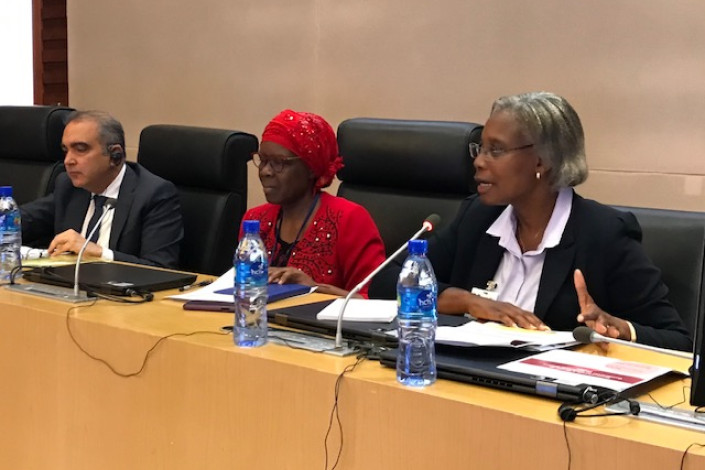
The ACQF-development process is holistic and builds on: evidence and analysis; AUC political leadership and consultation of African stakeholders (national, regional and continental); awareness raising and capacity development of African stakeholders. The ACQF Advisory Group held its first meeting on 4 September 2019, back-to-back with the inaugural ACQF workshop, at AUC Headquarters in Addis Ababa.
The main planned output of the project is the ACQF policy and technical document and action plan (by mid-2022), technically validated for decision making by the AUC.
The intermediate project outputs planned for 2019-2022 are:
- ACQF Mapping study (by mid-2020)
- ACQF Feasibility study (by mid-2021)
Other key activities:
- Stakeholder consultation workshops throughout the process (2019-2022)
- Awareness raising and capacity development actions (2020-2022)
- Digital tool / website to support ACQF development and information sharing
- ACQF related policy and technical information for STC-EST meetings
The AUC is the political lead of the process. ETF and GIZ have shared responsibility for the project implementation: ETF assures thematic and technical steering, working in close cooperation with the AUC, while GIZ oversees overall project coordination.
Contact: Eduarda Castel-Branco, ecb@etf.europa.eu
[1] African Union Agenda 2063: https://au.int/en/agenda2063
[2] AfCFTA: https://au.int/sites/default/files/treaties/36437-treaty-consolidated_text_on_cfta_-_en.pdf







Please log in or sign up to comment.