

Back to main finalists page
An after-school initiative bringing together vulnerable and refugee children to learn, connect, and grow through shared experiences.
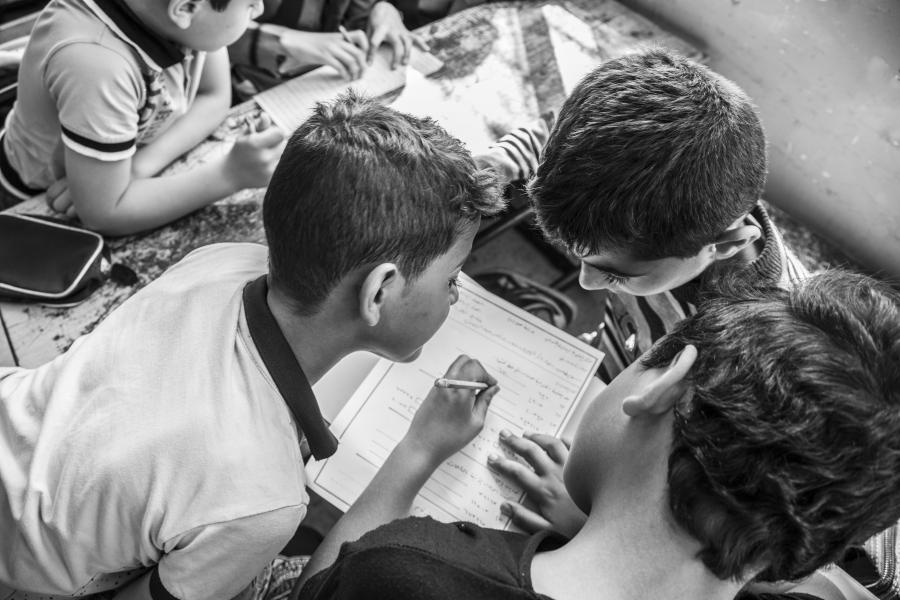
Ask anyone about their best school memory. It's rarely a lesson, more likely a club, a team or a special relationship that had a lasting impact. Yet for most children in Jordan's public schools, the spaces and opportunities to create such memories do not exist. Masahati, which means “My Space” in Arabic, was created to change that. These innovative after-school clubs create safe, inclusive spaces where children from different backgrounds come together to learn new skills, build friendships and imagine new futures. The combination of social and emotional learning with hands-on extracurricular activities including photography, music, sport, STEM and much more, have helped improve academic outcomes, strengthened social cohesion and given both students and teachers the tools to thrive in challenging environments.
By bringing together children who would otherwise be kept apart – refugees, students with disabilities and vulnerable host community children – the clubs have produced a 24% improvement in school climate, with notable reductions in bullying and absenteeism. Since 2016, Masahati Student Clubs have reached over 52,000 students across 318 schools in Jordan, supported by 1,000 trained educators. For a programme committed to transforming opportunities for the most marginalised children, that is just the beginning. The goal: one million children by 2034.
"The photography club taught me confidence and how to work with others. Now I use both to come up with ideas to help people." Female student, grade 10, photography club, Amman.

Read on to find out why this initiative was selected as one of the nine finalists of the New Learning Award 2026.
The project
Jordan is a country carrying an extraordinary weight. Home to one of the world’s largest refugee populations, its public education system is stretched to serve not only Jordanian children but generations of Syrian and Palestinian families searching for brighter futures and opportunities.
The Masahati Student Clubs were developed in response to this reality. Running after school, they create safe, inclusive spaces where vulnerable and marginalised children from different backgrounds can meet, interact and learn together. In a system where double-shift schooling often keeps these groups apart, the clubs play an important role in building trust, friendship and a sense of belonging.
Each school has three to six clubs based on student interests and needs, spanning human rights, career guidance, STEM, entrepreneurship, sports and environmental education. Clubs also tackle some of today's most pressing issues, with cyberbullying prevention campaigns and "Learn to Discern" classes helping children identify and counter misinformation. Teachers receive structured training, transforming their role from instructor to inclusive facilitator. It is their growing confidence that makes this programme sustainable.
Through interactive activities, students develop skills such as empathy, teamwork and communication, improving both their learning and wellbeing. And with the promotion of values such as inclusion, gender equality and peaceful interaction, these clubs help reposition school not just as a place to study, but also as a place to belong.
Why this practice stands out
The ETF and its partners have selected this initiative as one of the nine finalists for the New Learning Award 2026. Here is why this learning practice stands out:
- A proven programme reaching those most in need: Masahati gives vulnerable and marginalised children access to skills and opportunities that the standard curriculum doesn’t provide
- Impact that can be measured: Independent evaluations show improvements in academic performance and positive shifts in students’ beliefs around equality, non-violence and inclusion
- Transforming teachers, not just students: 94% of educators reported high confidence after training, creating lasting benefits for classroom culture and teaching practice
- Built to scale: With freely available materials and a model that needs no additional infrastructure, Masahati Student Clubs is ready to reach many more children across the region and beyond
“The clubs reduced bullying by bringing together students of different backgrounds and nationalities, teaching empathy and respect. Marginalised students are now integrated and accepted.” Female teacher, Jordan Valley
The future
Backed by Jordan’s Ministry of Education and recognised by global organisations including UNHCR and HundrED, Masahati Student Clubs is ready to grow, reaching new schools, new regions and even new countries.
For young people who once sat at the margins of school life, Masahati Student Clubs are helping them learn new skills, imagine their careers and build friendships across communities that rarely had the chance to meet. For the children of Masahati, a more inclusive, peaceful and collaborative future isn’t just an ambition – it’s already beginning.
VOTE FOR THIS PROJECT!
Your vote counts! Cast your vote for Masahati Students Clubs as an inspirational new learning practice.
- Back to: New Learning Award 2026
- Learn more: Masahati Students Clubs
ETF in partnership with

Please log in or sign up to comment.