
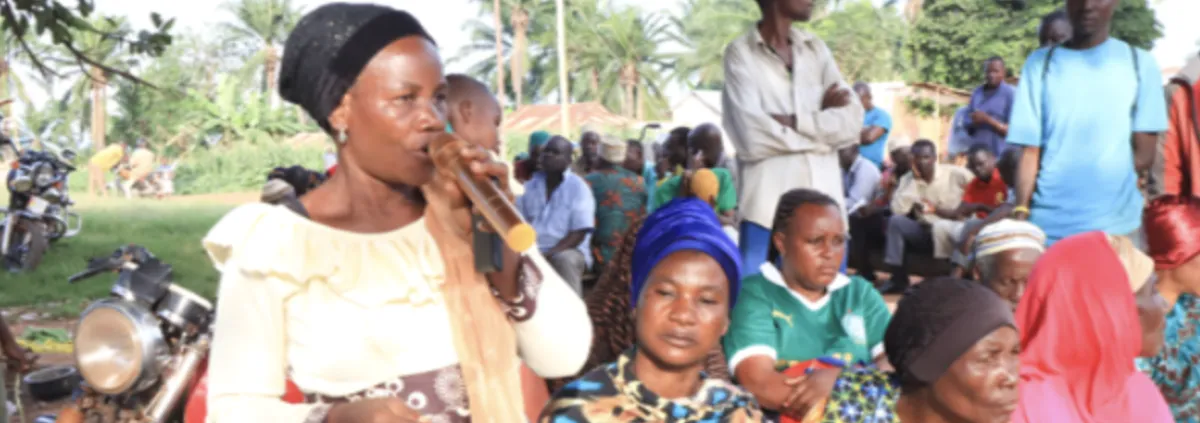
Empowering Volunteer Community Activists
to Prevent Gender-Based Violence (GBV) in Kigoma, Tanzania
Enabel, in collaboration with partners, is working in Kigoma's underserved districts to combat gender-based violence (GBV) and promote access to education, skills, and entrepreneurship for girls and young women. The initiative, started by Kivulini Women’s Rights Organization, uses the SASA! approach to train community activists who challenge harmful norms and raise GBV awareness. SASA! means “now” in Kiswahili and is an acronym for approach’s four phases: Start, Awareness, Support and Action. Operating in a context of poverty and entrenched patriarchy, the program engages local leaders and communities to change attitudes and lower violence rates, demonstrating the effectiveness of community-led efforts in crisis areas to advance gender justice.
1. Background and context
Kigoma is one of Tanzania’s least developed regions, marked by poverty, gender inequality, and patriarchal norms reinforced by customary laws. Women and girls face limited access to education, health, land, and economic opportunities, with 34% experiencing intimate partner violence. Despite women’s key role in agriculture, men control income, often misusing it and abandoning families after harvest through rural-urban migration. Economic dependence forces many women to remain in abusive relationships, leaving them vulnerable and marginalized.
2. Description of the project
The initiative was launched by Kivulini Women’s Rights Organization, a grassroots NGO committed to ending violence against women and girls, with support from local government, religious and traditional leaders, health centres, police gender desks, civil society networks, and women’s groups. Recognizing that top-down strategies were ineffective in Kigoma’s context, Kivulini adopted the SASA! methodology1 to empower local volunteer community activists to lead change from within. These trained activists mobilize communities through dialogues, meetings, Information, Education, and Communication (IEC) material distribution, and family-level discussions, aiming to challenge harmful norms and promote gender equality as a foundation for development.
The programme involves a wide range of activities, including community dialogues, awareness sessions in religious and educational spaces, one-on-one counselling, and participation in village meetings to mainstream GBV prevention. Inclusivity is central: the initiative engages individuals, couples, youth, people with disabilities, and both men’s and women’s groups, ensuring culturally sensitive and age-appropriate approaches that represent all sectors of the community.
3. Outcomes and impact
-
For the first time the community activists were able to build working relationship with the traditional and religious leaders who publicly denounced that GBV is unacceptable, and indeed it is an obstacle to peace and family development. They publicly joined with community activists during community dialogues by singing songs that were calling for peace in homes, speaking out and taking public action against Violence against Women and Girls (VAWG) without fear off threat, blame or power. The traditional leaders denounced that family’s abandonment during harvest and the tendency of men misusing the money obtained from harvests should stop immediately and encouraged women to report to them in any incidences of abandonment.
-
The trained volunteer Community Activists’ activities have restored peace and tranquillity in the homes. For example, it was normal in a week to hear 3 to 4 women crying during the night, but these incidences have stopped since the start of the dialogues. Volunteer Community Activists’ dialogues have brought mutual understanding and harmony.
-
Volunteer Community Activists’ capacity to document and reporting: Another achievement is that establishment of data collection flow by weekly, monthly and quarterly for each individual volunteer Community Activists and functional referral system at village and ward levels have been very helpful for survivors of GBV to access services and justice for the right time.
-
The change of attitudes among men: Men are respecting and supporting their wives hence this has given women confidence to make decisions that are more beneficial to their families.
-
Through trained volunteer Community Activists, GBV is now openly being a public issue discussed in groups, churches, village centres and men and women are now taking public actions to reject, prevent and provide support to survivors of GBV in close collaboration with local government and police gender desk without fear of threat, blame or breaking friendship or position and power of perpetuators.
-
“Before, we never talked about violence. Now, even our elders and leaders say it must stop. They support us and walk with us” (Volunteer Community Activist, Kasulu).
4. Challenges and barriers
-
Limited funding: Sustainability remains a challenge. Volunteers work without pay, and outreach efforts depend on limited resources for transport and materials.
-
Resistance from some community members: Some men, especially elders, initially resisted change, seeing it as a threat to traditional roles.
-
Insecurity for activists: Some activists faced verbal threats or social exclusion when speaking out, especially in the early stages.
-
Access issues: Poor road infrastructure and communication barriers hinder follow-up and monitoring in remote areas.
-
Gendered Impacts: Women activists often faced more backlash and isolation than their male counterparts, though this has reduced over time with growing community acceptance.
5. Lessons learnt
-
Empowering local communities to lead interventions fosters trust, sustainability, and long-term impact. Genuine ownership ensures that change is driven from within rather than imposed externally.
-
Engaging government, civil society, and traditional leaders creates a supportive ecosystem for GBV prevention and amplifies reach and credibility.
-
Programs must consider diversity in age, gender, and disability to ensure equitable participation and culturally sensitive approaches.
-
Systematic documentation and data-driven strategies improve program credibility and enable replication in similar contexts.
-
Economic hardship and patriarchal norms can undermine progress. Interventions should integrate livelihood support and male engagement strategies to reduce resistance and dependency.
-
Volunteer fatigue is a real risk. Recognition, incentives, and continuous capacity building are essential to maintain motivation and commitment.
-
Remote locations and potential backlash against survivors or activists require robust safety protocols and flexible outreach strategies.
6. Recommendations
To achieve impact in fragile contexts like Kigoma, success for Enabel and partners depends on a combination of adaptive, inclusive, and locally anchored strategies:
-
Adaptive and Flexible Programming: Fragile environments demand agility. Continuously adapting approaches (e.g. SASA! Together) to reflect local realities, languages, and literacy levels ensures relevance and responsiveness. Embedded feedback loops are critical for rapid learning and course correction.
-
Strengthening Local Ownership and Leadership: Sustainability hinges on empowering local actors - youth, women’s groups, people with disabilities, and other community leaders - beyond one-off training, with a focus on long-term leadership development and collective agency.
-
Psychosocial and Protection Support for Volunteers: Community activists face significant social risks. Providing structured psychosocial support, peer networks, and safety mechanisms is essential to maintain their engagement and wellbeing.
-
Resource Mobilization and Incentives: Reliable resourcing - including transport, materials, and modest incentives for volunteers - strengthens program reach and continuity. Local fundraising and in-kind contributions can complement external funding. Furthermore, mainstreaming this into government initiatives and seizing opportunities.
-
Integrated Socioeconomic Empowerment: Addressing the economic vulnerability of women and girls is vital. Linking GBV prevention to income-generating initiatives, savings groups, or agribusiness cooperatives enhances women’s agency and bargaining power. This is transformative approach is used by the Wezesha Binti2 project in Kigoma to advance to empower women through multiple pathways - education, skills development, and entrepreneurship - unlocking their potential for decent and green jobs.
-
Wezesha Binti is strengthening Institutional Linkages and Multi-Stakeholder Engagement: Effective coordination with local authorities, health services, police gender desks, and social welfare departments ensures holistic support and strengthens the referral ecosystem.
Link
Please log in or sign up to comment.