
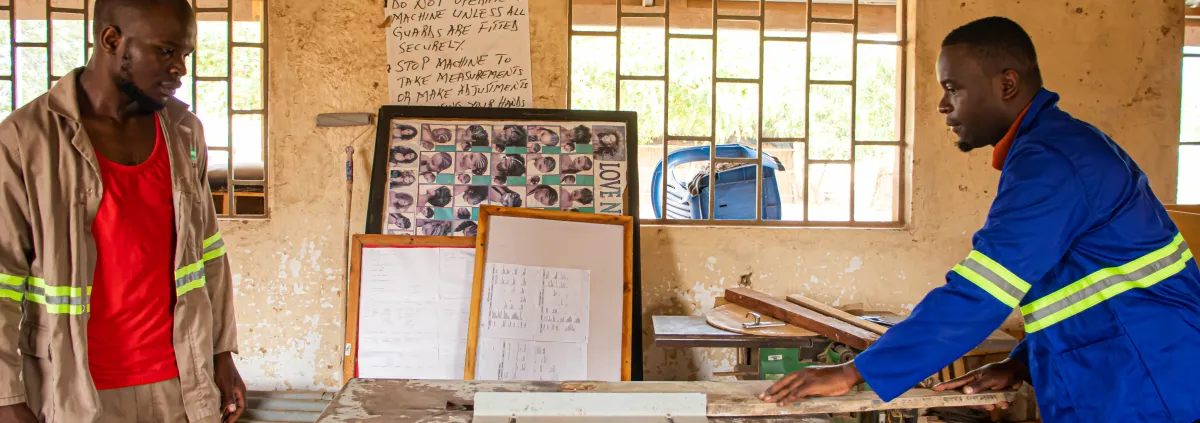
Mikolongwe Vocational School is a project under DAPP Malawi which have a vision and mission of a generation of youth /young people who are skilled and self reliant through thier engagementin variouis social-economic activities continues to contribute to the government of Malawi’s growth and development strategies through equipping youth with competent technical and vocational skills and knowledge for them to become active productive members of society by starting up small scale businesses or be able to secure employment. The school offers both formal and informal training courses and has a boarding capacity for 330 students. The school reach out to more youth with vocational skills to young vulnerable men and women through mobile training and satellite centres which are normally DAPP Teachers Training Colleges. Our emphases is addressing the enormous challenges faced by Malawian youth, the gap of unemployment rate among the youth is still on higher side and the skills and knowledge imparted to the youth promotes self-reliance through economic strengthening strategies like linking them to money lending institutions, cooperatives and self-employment initiatives to be taught business lessons. To achieve reaching out to more youth, the school continues making collaboration with various stakeholders who have same objective agenda of assisting venerable youth with informal skills development program both youth and local farmers around the school. Currently the school is working with six local partners namely MIQRAT, Sun4Water, UNDP, BA4Y, GIZ and Teveta. Despite of global funding challenge the school is still discussing with DREAMS project on informal training for the girls. Currently DREAMS projects are implemented in Chiradzulu the southern part of Malawi. The school has employed monitoring and evaluation officer for data collection. The idea is to assess and measure progress made by our students during attachment period and graduates after completion of their studies. In addition, the school with support from sun4 water project has installed and set irrigation system to 1.5 hectare. The system is expecting to boost agriculture yields to our school garden 1. PROJECT ACTIVITIES The following activities were implemented: Training of youths in various courses and vocational trades The school has enrolled and training 340 students in the formal programs. 250 students were under boarding formal program while 90 students under non boarding formal program in Agriculture, Bricklaying, Carpentry and Joinery, Cosmetology, Community development, electrical installation, Fabrication and welding ,Plumbing ,Shoe making and textiles and fashion design. Level three students will sit their final examination in July 2025 and level one student in December 2025. Working with other stakeholders in Vocational Skills training. During this quarter the school has engaged various stakeholders in the implementation of training activities through learning visits, education visit, open days, student internship, trade fair and student monitoring visits. The Technical, Entrepreneurial and Vocational Education and Training Authority (TEVETA) still play major role of being responsible for regulating training ,facilitation, moderation of training delivery. Apart from this core business, TEVETA with support world bank is sponsoring young Malawians under SAVE project. More than 54 youth are benefiting from the project. Community Outreach Programs The school has carried out a number of community programs for example; assisting old women, identification of youth with disabilities for vocational skills, intensify on vegetable production, production of Borcas manure, and training farmers in solar powered irrigation systems. Chifundo student club Chifundu student club was created to work hand in hand with community, school and needy students through various social activities like cleaning action,supporting needy students with basic sanitary ,fund raising and vegetable production as source of fund to support to carry out their planned activities. Production Planning Session During the reporting period the school management organized a production planning session for all teachers. The plans were for second quarter of their occupational trades. The headmaster qualifies the plan and plans are pasted in the classrooms These period plans assist both teachers and students to carry their planned activities. Teachers Learning Visits Benito martin teacher had a learning visit to Nigeria where he meet different agricultural institution in Africa and share experiences under a theme challenges faced by African countries regarding solar powered irrigation systems. The visit was sponsored by sun4 water project. During the visit he had opportunity to discuss face to face with experts in different specialization such engineers, extension workers, teachers and headmasters. Despite the challenges like institution hierarchy and high interest rates from lending institution Africa has potential to grow with solar powered irrigation system as it receives sun all year round. Knowledge and skills gained will help and assist our newly solar powered irrigation system. Supervising and monitoring student during attachments Students were monitored during attachment to see their progress and get feedback from the attachments places in the industry, companies and organizations. This assisted to improve service delivery and quality of training being offered. The attachments provide hands on experience for the students eventually some will be employed into the same companies and industries. Supervision and monitoring is still an ongoing progress. Boarding Life The school continues with its participatory holistic approach where all students take part in the governing and running of the school. Our carrying out their responsibilities together with teachers in areas of maintenance, catering, planning, sanitation, Library and computer among others. The school also intensifies on study groups, trios and promotes class presentations during Monday morning information meetings/ assemblies. Maintenance/ Construction The school has carried a number of construction activities in preparation of making our school a disability friendly like construction of standard ramps, maintaining sanitary appliances, fixing all roof water linkages in the hostels. 2. THE PROJECT IN NUMBERS # Key Targets Plan for Year 2025 Plan for Jan-June Achieved Jan-June Achieved in % 1.1 Number of students recruited under formal courses Level 1,2 and 3 350 300 350 104% 1.2 Number of students to be trained under informal program 150 0 0 0% 1.3 Number of people with disabilities trained in various trades 100 50 63 126% 1.4 Number of new former graduates to be added in the database for tracer studies 200 200 100 50% 1.5 Number of students going for attachment placement in the industry 220 120 125 104% 2 Other project figures in support of the objectives 2.1 Number of community clubs established to raise various awareness 4 2 2 100% 2.2 Number of inter-project visits 4 2 2 100% 2.3 Number of visits by external assessment teams by TEVETA on students to check their performance 4 2 2 100% 2.4 Number of follow up visit for former graduates 4 2 2 100% 2.5 Number of students to be recruited as DAPP employees at the school 5 2 2 100% EXPLANATION TO VARIANCES 1.3 Number of people with disabilities trained in various trades The target was over achieved by 26 % because we got more students from MACODA (Malawi council for disability affairs) 1.4 Number of new former graduates to be added in the database for tracer studies The other half is going to be achieved in the next quarter 5. THE EFFECTS (OUTCOMES) OF THE PROJECT The following are the effects of the project as a result of its activities: Increased capacity for students to establish small-scale businesses: Graduates are opening their own small scale businesses and some get employed and creating opportunities for attachment places. Through B4Y project 20 graduates have opened their legal registered business in Chikwawa district. Hence increasing access to competent skills for various vocational livelihood activities Creation of sources of income for young people Many graduates are trained in how to create source of income through our business incubation like UNDP (United nation development program) za ntchito project. Where 31students have been trained on how to run the business and currently students are on prototype stage. Increased collaboration with stakeholders Collaboration with different stakeholders is very important to the school and the school is still working hand in hand with various organizations and companies like: TEVETA PEP (Productivity enhancement programme) Rose Mary farm, Ekhaya farm, Bvumbwe research station, PC plumbing service, Blantyre city council and Chatha studio leather design. Influence on the job market: Our students get exposed to real world of work to various organizations and companies: Tea Research Foundation, Makande tea estate, Bvumbwe research station and Bvumbwe research station. Khonjeni Extension Planning Area and Thyolo Agriculture Development Department. Improved training through supervision and monitoring of student during attachments/apprenticeships The school has so far supervised students in different attachment places with an aim to improve quality of the training delivery so that the expected skills are responsive to the needs on the job market. Improved living standards of youth from vulnerable families Vocational skills on informal courses has really assisted the vulnerable youth to have competent skills and knowledge as sources of livelihoods that will lead to improved living standards. The skills enable the young people to mobilize financial resources through their small scale business that help both as individuals and also their families at large.
Website: dapp-malawi.org
Contact: csalema@dapp-malawi.org
Please log in or sign up to comment.