
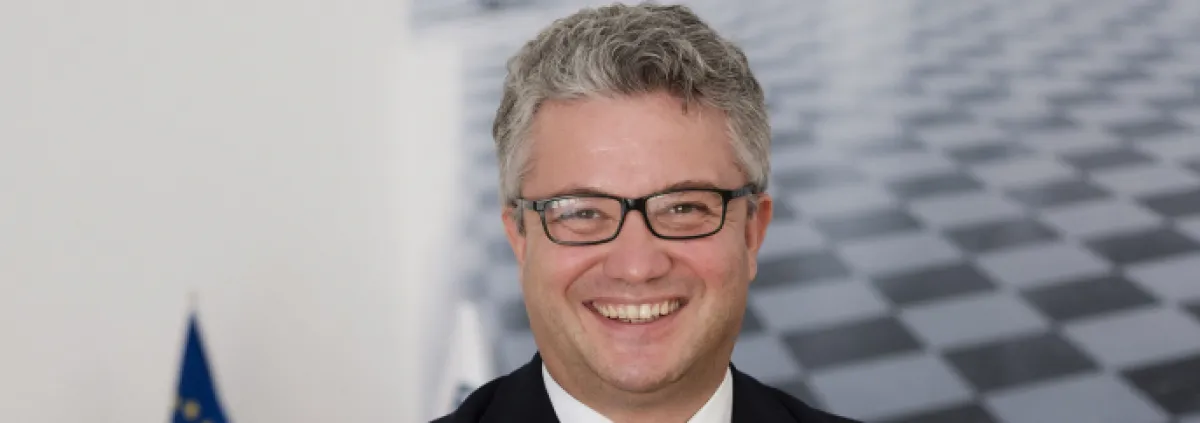
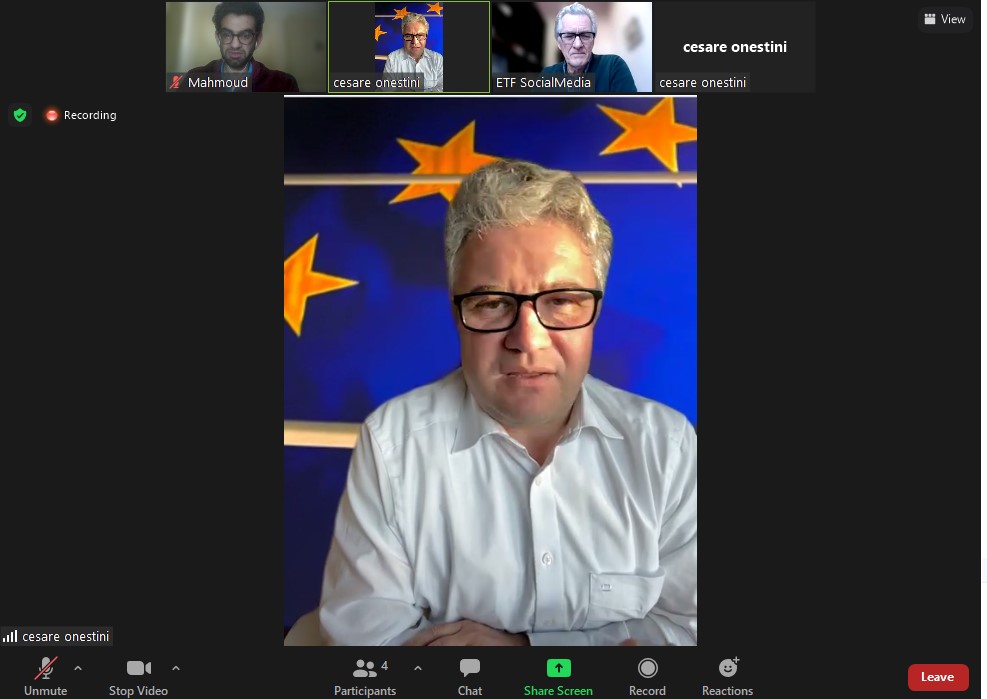
While the year 2021 was full of both achievements and challenges for ETF across many levels, we thought about talking to our director Dr. Cesari Onestini for him to tell us about his experience so far in ETF directory, his most critical milestones in office, alongside his vision for the future and expectations for the foundation's trajectory in 2022 after getting its new (2021-2027) strategy approved by the governing board. Our Strategic Communication Team members, Alastair Macphail and newly joined intern Mahmoud el Makkawe conducted this 45-minute interview with Dr. Onestini online.
Q1: What is the most important contribution that ETF makes to countries in the phase of reforming their education policies? What kind of support do you give to those countries?
The reform, the competence for the content and shape of education system seethe with each country. That's true in Europe, but it's also true in the partner countries. But I think when we look at the VET sector, there are some issues which are very different from the general education. We see the importance of developing partnerships with the private sector. So, it has to always be seen as bridging public policy concerns and private concerns. And in the case of many of our partner countries, this also means that there is a presence of international investment companies. So, the private sector includes all these elements. So, it's natural that it's more a sector that brings together these different elements and that we start learning from the different systems now. Looking at the experience of EU countries, but also of other countries ETF works with, which might be attempting some of the same reforms, especially when we talk about work-based learning, digitalization, green skills and all of that. That's where we focus more. So, I think there are many good examples of this, and that's where ETF plays this role, supporting the approach to the reform, pushing these participatory and evidence-based approaches, making sure that there is consultation and then looking for best practices and good examples.
Q2: Reflecting back on the past five years since you started working at ETF as director, what do you think the most important milestone that you have experienced, one that is unforgettable for you?
Looking back, there are two things one has to say. One cannot look back at the last five years without seeing the pandemic, which has been a huge and a new challenge for everybody, including ETF. It has been particularly disruptive in northern Italy, where we had it may be earlier than other countries. We had very high numbers and we just didn't know what it was. We had seen it in China. But if I think back of February last year, Torino was very, very much at the center of this. There is also the achievement of the ETF staff, the fact that, in spite of this incredible challenge, which was basically where we had no model, we were all basically in the first wave. We had to invent what to do together with the rest of northern Italy, and we had to adapt to this new reality. I think ETF staff was incredible. In all of this, we managed to keep business continuity. We managed to start working differently. We managed all of that. And if I look back now a year and a half later or even more, I see that this really required a lot of adaptability from ETF staff. And this was connected to an immediate concern from the colleagues looking at what COVID was doing to our partner countries. So immediately we started last year with COVID monitoring activity, looking at how different partner countries were reacting to COVID in terms of education and training systems, which schools and systems were going in lockdown, and which systems were going online or television, or other ways of learning and what that meant for different age groups. We had this monitoring that went on for a number of months, and these reports were immediately used by the commission and the delegations to also see what they could do in terms of support. And then we quickly, I think very early in May or so last year, started already with peer seminars for different colleagues from different countries to really discuss with one another very concrete issues. For example, how do you deal with end of school appraisals if you wasted half of the school year? how you do enrolment for the year after, if you cannot do tests or you cannot do so? We had this immediate reaction! We thought: what do we do with the countries? How do we monitor? How do we support them? And then how do we reorient all our work so that it includes the concerns of the countries? So, if there is one thing which really sticks out in the last years, it is this which then connects to the fact that behind it, we were already in the process of rethinking a little bit the role of ETF and going a bit broader from our focus on that to a larger focus on human capital development and lifelong learning, which had always been there. And so, we were already in the process with the new strategy and everything else to look more at the full spectrum. And I think that was a confirmation that that's indeed what needs to be done because the pandemic showed that whole system of education has had its own challenges, that the question of skills development was really cutting across different systems, including universities. Obviously, each segment could react differently. But the question was how does the system work together? How do you ensure that you react to a shock like this as a coherent system? And I think they're the work that we are doing now is continuing that direction so that's really what stands out to me if I look back.
Q3: what are the most important objectives that you are focused on achieving in 2022 terms of the overall strategy of ETF?
So, for the year 2022, we just, adopted with the governing board, our work program; it says, first of all, that we need to continue with what we started in 2021. So, the strategy remains there. The reference points - the eight projects that we have are present, but there is a specific focus on delivering on green skills. This is an area that is cutting across all of the EU actions, as well as, within the EU funds. Green space and green developments are very important, and we have seen in Glasgow as well how this agenda is growing in importance. Secondly, digital remains a key focus. We will continue expanding what we do. We have some new capacity to do this. We will do it through different ways. I mean, we have, for example, now new funds to work on networks of excellence across partner countries and in the EU. We will work on a few strands and digital is a strong part of that.
Q4: If you would have a brief message for our stakeholders for 2022? What would that be?
The message for the stakeholders is to say that ETF will continue to focus on the best way to support our stakeholders in the partner countries. That's really our unique mandate. The pandemic has really pushed us to refocus our activities to make sure that what we can deliver is in support of the priorities that the countries are seeing in this post-pandemic scenario. So that's the commitment we have from ETF. And then the wish we all have is that we'll be able to see each other again soon, meet again, be able to shake hands, discuss with one another and continue developing the friendships that we have cultivated over the years.
Please log in or sign up to comment.