
Stakeholders in Central Asia’s vocational education and training (VET systems need to put a greater focus on lifelong learning, improve dual education, and create better data capture and analysis if they are to meet labour market needs in the future, the final regional workshop of the fifth round of the European Training Foundation’s (ETF) Torino Process heard on 3 December 2021.
The Torino Process – the ETF’s flagship evidence-based tool for analysing human capital development issues and VET policies – was launched in 2010. Central Asian countries have participated from the beginning and four of the five countries (Kazakhstan, Kyrgyzstan, Tajikistan and Uzbekistan) prepared national reports for the fifth round, which ran 2018–20, using the so-called National Reporting Framework. Turkmenistan took part in the launch phase of the process and two regional online events.
Cesare Onestini, ETF director, introducing the meeting, noted:
“This round of the Torino Process has been different from all the others. The pandemic and the need to work differently and find new ways to stay connected has affected us all. We had been hoping to meet face to face in Nur-Sultan, instead we are here in this hybrid manner.”
The way stakeholders in Central Asia cooperated had changed, but the pandemic had also opened “new opportunities through these new platforms to reach and hear voices that are sometimes difficult to hear in person”, he added.
Referring to two regional online events – a workshop on distance and online learning in November 2020 and one in April 2021 on private sector involvement in VET and skills development – he said: “This online presentation enabled us to reach students, and counterparts beyond the capital cities.” He added:
“There has been a growing interest in what happens in other countries, with more comparative discussion and learning from one other.”
Mr Onestini reiterated the ETF’s “commitment to reach out to all of you as soon as possible”, adding:
“This Torino Process event marks the end of a cycle – we have had over ten years of these type of consultations, we want to move cooperation into a new format going forward. Innovation in vocational education and training is a cooperative effort from different stakeholders, based on dialogue and exchange. The participation of stakeholders has grown over the past decade and has enriched the discussion.”
“Reform of education and training is a project for generations – it does not happen week by week. During the time of the pandemic, we had to adjust our ways of working; we have already learned new ways of bringing education and training into new digital ways of learning. As we review the progress of the last ten years, we also want to thank you for being part of the learning journey.”
Nassymzhan Ospanova, head of the VET department at the Kazakhstan’s Ministry of Education and Training, praised the ETF's contribution to educational reforms during the latest Torino Process round.
“It has had a huge impact – all the research, the data that we got; all the analysis about VET that is the basis of our ambitious national project Education Nation.
The goal of this project is to improve quality in VET and make it accessible. We believe that the ETF made a great contribution to what is really a systemic project and framework for education in our country.”
She noted that under the Torino Process, Kazakhstan had modernised its VET curricula, retrained its teachers and trainers, and improved and increased dual education.
The pandemic had speeded developments, she added.
“We have a new format of cooperation with digitalisation – distance learning. Thanks to the ETF and our experts on the Torino Process, we have received plenty of recommendations; we have learned a lot through our international partners. I hope that we will take part in the Torino Process in the future and remain active member of our common movement.”
Christine Hemschemeier, ETF senior human capital development expert and focal point for Central Asia, outlined the key findings and recommendations of the national Torino Process reports.
“It is quite clear that the pandemic will affect the education system [in Central Asia] very badly,” she said.
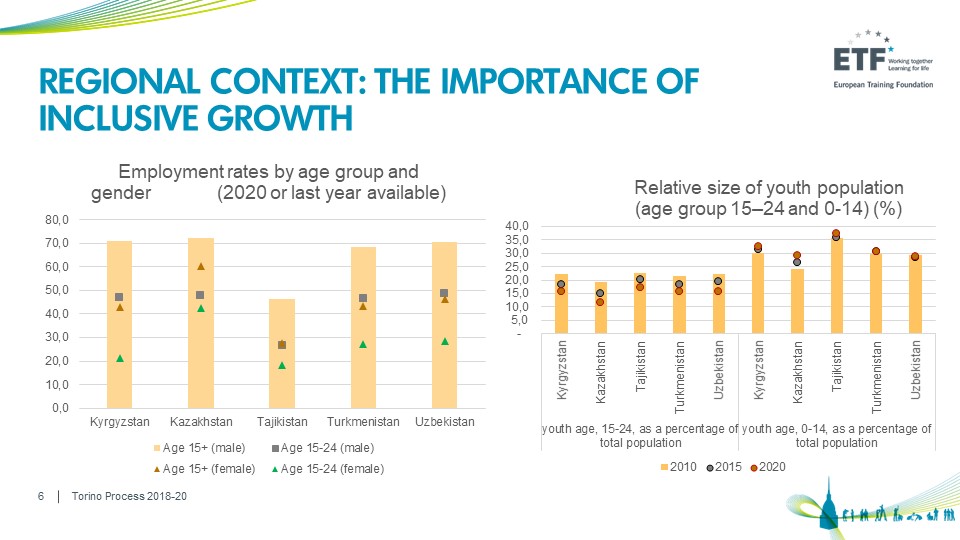
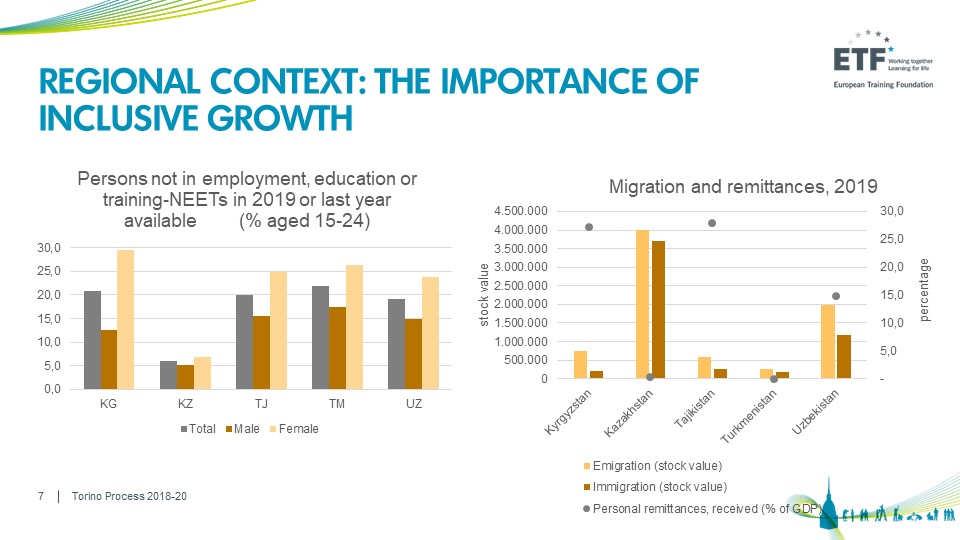
Economic growth had been rapid in all the countries during the period, but had failed to improve or impact learning opportunities for women and young people. Inequality between urban and rural areas had not been reduced and economic diversification had failed to meet expectations. “This means that job creation is not going as well as we had hoped,” Ms Hemschemeier observed.
“In the future more efforts are needed to make growth more inclusive. Inequality is still rife, women have less chance of being active in the labour market, therefore inclusion is extremely important.”
More work needed to be done to address the needs of a growing youth population, she said.
“To date there are few opportunities for young people; it has not changed over the years. Great numbers of young people are neither in employment, education or training, and the situation for women, particularly young women has not changed.”
On a more positive note, it was noted that the pandemic had driven the development of online education and the involvement of public-private partnerships. There were signs of increased and better cooperation between the VET sector and employers across the region.
However, more funding and attention was needed for lifelong learning, adult education and expanding autonomy within the VET sector to allow, for example, more effective recognition of non-formal and informal skills acquisition. Ms Hemschemeier added:
“Some countries – such as Kazakhstan – have switched to per capita funding; we also see the introduction of public private partnerships, which is a very positive development. Vocational education and training systems are funded from the public purse. There is limited funding for lifelong learning, for adult education, and there are no alternative schemes for funding and incentivising, which is an obstacle to the development of the training systems across the region.”
But it was clear, she said, that in all five Central Asian countries, “there is an understanding of the importance of modern 21st century education strategies and key competences; there is more emphasis on IT and digitalisation. We also see however that the process is not consistent; there are a lot of gaps between different levels; no clear definitions of what qualifications mean; the quality of teaching is sometimes poor. In teaching entrepreneurship it would be logical to work in cooperation with employers, but very often learning is confined to schools and little attention is paid to the external environment."
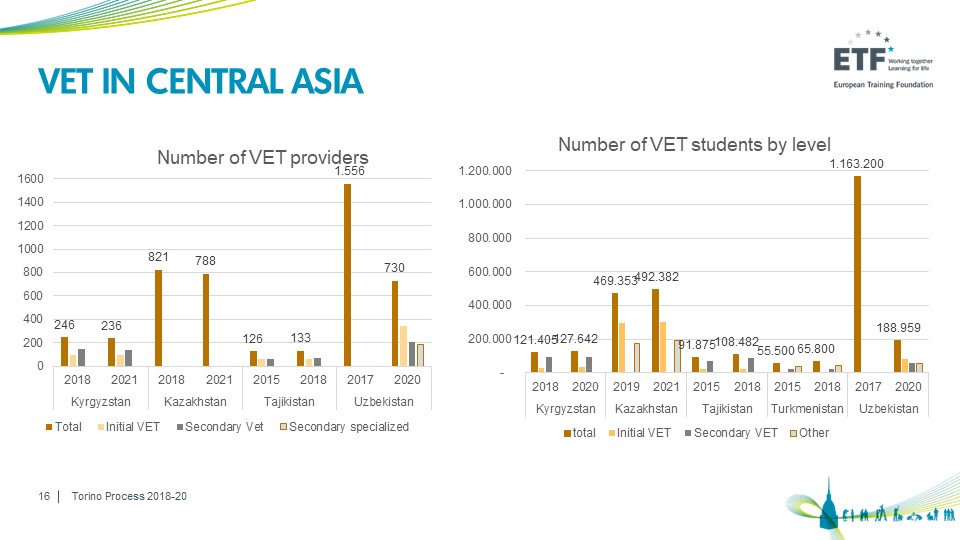
It was also noted that more needed to be done to prioritise those approaches that support the transition from education to work. And that workplace learning needed more emphasis on key competences, digitalisation, entrepreneurship, environmental protection skills, and sustainability.
Summarising developments in each of the Central Asian countries, Dr Feruza Rashidova, a TVET professor and national consultant to the Swiss project in Uzbekistan, Helvetras, said that in Uzbekistan there had been a major focus on the development of a quality framework to make vocational education more labour-market relevant. She said:
“The reforms that began in 2016 have demonstrated how important education is. Half a million people that have joined the labour market after the ninth year [of education] demonstrate the sustainability of education, but we had not prepared a proper system of qualifications – we were still using the system created in 1997.
Once we introduced a qualifications framework, we started to create indices, but we still have a challenge as regards databases that should be open, and accessible to all.”
More attention was also needed on “both formal and informal education”, she added.
In the Kyrgyz Republic, the introduction of dual education and a new approach to competency had led to the creation of a system of independent certification of qualifications where employers took part in the exams, Irina Gordeeva, of the Department of Initial VET at the republic’s Ministry of Education and Science, said.
“Entrepreneurial skills are also very important in our system – it is not a goal per se to educate entrepreneurs, but such skills are mandated in all curricula. Green skills also form an integral part of all curricula – industrial ecology – as we call it.”
Alisher Alizoda, deputy minister of Labour, Migration and Employment, Tajikistan, said there was a focus on using lifelong learning to “create opportunities for all”.
“We have adopted a decree on adult education centres that sets a framework and defines goals and obligations for adult education in Tajikistan.”
Under a presidential decree, there were plans to extend education and training opportunities to around a million people over the next five years, he added.
Gulnabat Gurdova, head of the Department for International Cooperation at the Ministry of Education, Turkmenistan, said the country aimed to establish an education system “comparative to that of developed countries” under a national social and economic development plan 2011–30.
“We intend to adopt international experience and best practice to improve our education system by introducing world standards,” she added.
In Kazakhstan, Kalamkas Algazinova, of the Department of Technical and Vocational Education and the Ministry of Education and Science, said better data capture and analysis promised to improve the coordination of vocational school offer with labour market needs. She said:
“Our short-term task is integrating our databases to allow stakeholders' access to use that information to inform better decision making.”
The conference wrapped up with the announcement by Nicholas Taylor, Central Asia team leader at the European Commission’s DG International Partnership, of a new educational support programme for Central Asia, which will be launched early in 2022. The programme – Dialogue and Action for Resourceful Youth in Central Asia – was designed “to strengthen training systems” in the region, he said, adding:
“The pandemic has brought massive disruption throughout education and society – putting pressure on people and in some cases taking away their livelihoods. Central Asia has also felt this impact.
Large numbers in the informal economy, and those reliant upon migrant earnings, have been particularly vulnerable.”
The region also continued to “face the growing effects of climate change”. Taylor concluded:
“The recent first ever EU-Central Asia economic forum, hosted in Bishkek last month, focused on the green recovery, digitalisation and creating a better business environment. These hold the keys to unlocking the potential of the region.”
Please log in or sign up to comment.