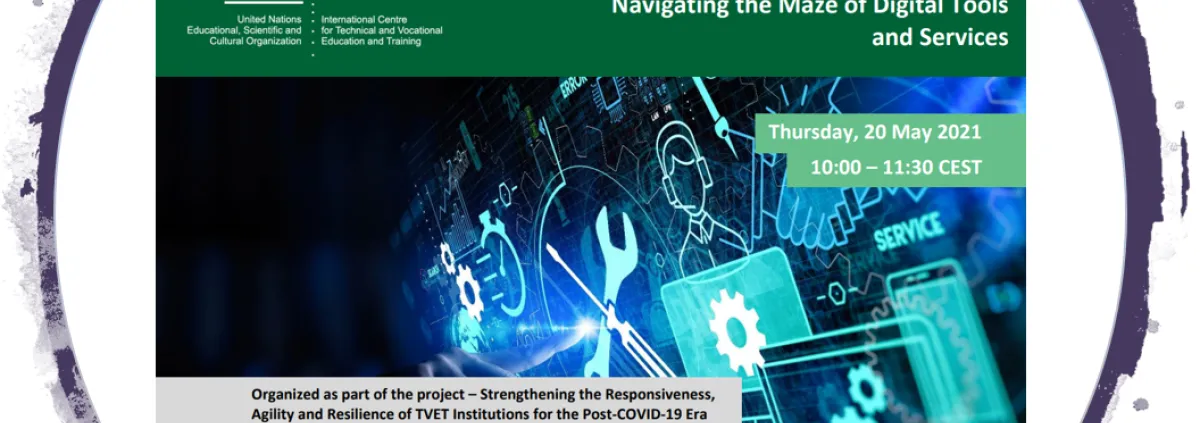

COVID-19 Education Response Webinar
Navigating the Maze of Digital Tools and Services
Organized as part of UNESCO-UNEVOC's ‘Strengthening the Responsiveness, Agility and Resilience of TVET Institutions for the Post-COVID-19 Era’ project
Registration link and further information is available at https://unevoc.unesco.org/home/COVID-19+response#webinar
Interpretation available in Spanish and French
Introduction
The global shift to distance and online learning in response to COVID-19 has accelerated the need to develop solutions at the TVET provider level and share good practices and guidelines pertaining to choosing digital services and tools. During the ongoing crisis, digital solutions have become a necessity, offering teachers the means to connect within their organization, and with students and social partners. At the organizational level, digital ecosystems have suddenly flourished and become a lifeline, enabling learning to continue. Yet many teachers are frustrated at the myriad of services and tools and are not comfortable with having to make hasty choices in terms of learning and unlearning the use of applications while developing new teaching and learning strategies on the go. For students, the situation can be even more challenging if teachers have not had the time and opportunity to coordinate choices pertaining to which digital tools and applications are used to enable and support communication and learning activities. The situation can leave TVET students frustrated, even alienated, and cause retention rates to drop. Many aspects must be considered when choosing a digital approach: connectivity and device-related limitations, diversity of users and their digital competence, desired pedagogical approaches, readiness and availability of support services, budgetary concerns, and possible rules and regulations pertaining to storage of data and privacy. For digitalization to be successful, it is important to understand different perspectives: management, IT support and TVET teachers. What might be the ideal solution from a certain perspective, might not work on an institutional level. This webinar will showcase different types of approaches and solutions and will address decisions on institutional services, such as learning management systems, as well as collaboration tools that can improve the quality of teaching and learning. The webinar will also showcase a model where students are involved in offering digital support services
Discussion questions
1. What should a TVET institution take into consideration when developing a digital strategy and making digital service decisions?
2. Should we allow teachers to make individual choices on digital tools? Pros and cons.
3. An IT administrative perspective vs. learning perspective – do the two clash?
4. How can we support teachers and learners in the digital maze?
I agree that we should pay great attention to digital pedagogy, especially, in my opinion, the implementation of digital cultural heritage (DCH).
Please log in or sign up to comment.