
Teaching digital skills: educating for the future
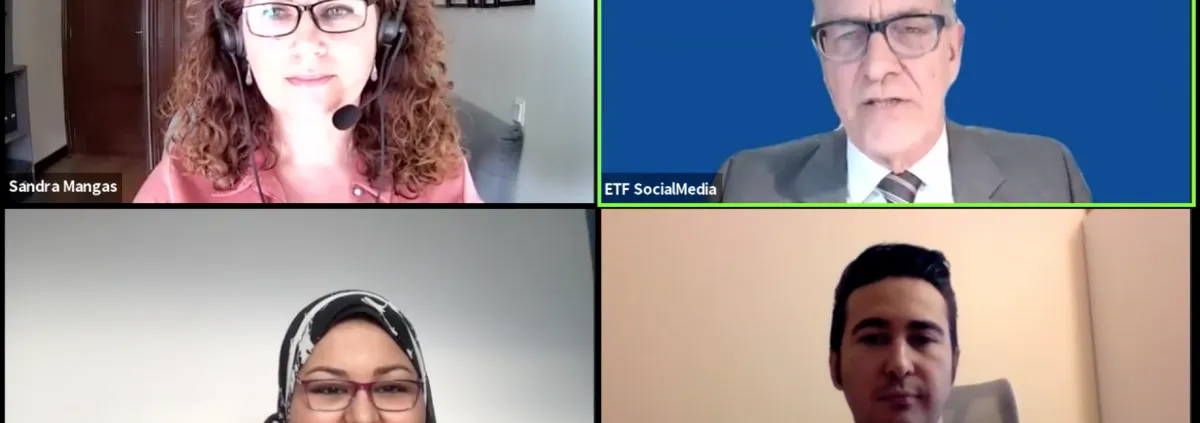
This week’s ETF LearningConnects Facebook Live focussed on teaching, learning and digital skills. The impact of technology and environmental concerns on skills is undeniable. Most, if not all, professions now require digital skills. But how can these skills be acquired? And how can teachers help students learn them? The ETF invited three highly experienced and passionate educators to answer these questions. They included Sandra Mangas, a teacher in business administration at IES Arca Real in Valladolid, Spain; Mona Mohy Eldin, the IBM P-TECH school liaison at I-TECH School for Applied Technology in Cairo, Egypt; and Selçuk Arslan, an award-winning computer science teacher at Ataturk Vocational and Technical High School in Ankara, Turkey. The ETF’s own Alastair Macphail brilliantly moderated the session, guiding the discussion with insightful questions and commentary.
Encouraging lifelong learning in teachers and students
While the issues involving digital skills acquisition in Spain, Turkey and Egypt differ in many ways, there are several points of convergence, namely a call for flexible and responsive education systems in order to keep up with digital transformation, which is taking place at unprecedented speed. Sandra Mangas pointed out that current ‘professional curricula are based on knowledge and knowledge in business is changing constantly’. For this reason, she says that teachers not only need to impart lifelong learning skills, but need to acquire these skills themselves. Like students they need to ‘up-skill and re-skill’ to ensure that the topics they teach reflect labour market demand. In order to do this, teachers need to be allocated time and resources. For teachers to become lifelong learners along with their students, training needs to be incorporated into their schedule.
Selçuk Arslan agrees with Mangas, astutely observing that technology plays an essential role in determining which skills to prioritise. Teachers need to adapt quickly to developments in artificial intelligence, augmented reality, big data, cyber security and cloud computing. Since it is not possible to become an expert in all areas, Arslan recommends that teachers choose one or two areas to master so that students can quickly benefit from their expertise. However, he also warns that technology is moving so quickly that today’s professions will not exist in the future. Flexibility in how digital skills are acquired by both students and teachers is key to overcoming this challenge.
Building partnerships with key stakeholders
In addition to building flexible and responsive educational ecosystems, collaboration with other sectors of the economy is essential. Training providers need to build strong partnerships with business, civil society and higher education. Their input and support is vital to providing relevant training that meets market needs and equips students with skills that are in-demand. In her capacity as IMB's P-tech liaison for the I-Tech School for Applied Technology in Cairo, Egypt, Mona Mohy Eldin provides the school’s curriculum with a business perspective. The partnership between industry and schools in Egypt is what Mohy Eldin refers to as a ‘pioneering initiative’. Internship and mentorship programmes reinforce this partnership and acclimate students to the business environment thereby improving their prospects on the job market.
The enduring importance of soft skills
According to all three educators, soft skills are core skills that lead to improved learning outcomes and employability. They include: communication, creativity, problem solving, resilience, critical thinking, versatility, self-management, self-awareness, social awareness, relationship skills and responsible decision making. How can teachers instill these skills in students? In Mohy Eldin, group work and role playing are encouraged. Students take turns being team leaders and team members; as such, they develop an awareness of what leadership feels like when one is on the receiving end as a follower and at the helm as the boss. At
IES Arca Real, Mangas’ students benefit from virtual enterprise platforms, which, as Macphail points out, are like flight simulators for business where students learn by doing. They run all aspects of a virtual company in a virtual market place. While there are no real life consequences if they crash and burn, the experience and knowledge acquired is anything but virtual. To succeed students are placed in a position that requires them to use both their hard and soft skills. In Turkey, Arslan advocates for a holistic approach to skills acquisition that combines social and emotional skills development with digital skills attainment. He proposes gamified solutions to bring both skill sets together in a comprehensive learning tool.
The myth of the digital divide and the gender gap
It was surprising to learn that the digital divide and the gender gap are not as prevalent as they once were. In Spain, Egypt and Turkey girls are encouraged to enter ICT. While the number of girls studying ICT remain low in Egypt and Turkey, in Spain, they make up the majority of students. Mangas says that the notion of ‘no girls in tech is a thing of the past’. From his experience, Arslan observes that girls are stronger in tech than boys. In Egypt, Mohy Eldin states that girls perform well in tech. They are encouraged to speak up in class and participate fully in all activities. From this testimony, it appears that the gender gap in tech is closing.
Regarding internet access, a similar trend can be observed. The digital divide is narrowing as well. When schools went online as a result of the pandemic, the state provided underprivileged students with the material necessary, including computers and phone cards, which enabled them to participate fully. In Turkey, NGOs and the government play an important role in ensuring that all segments of the population have internet access. However, according to Arslan, digital reach is less of an issue than it used to be. In Egypt, this is also the case. Mohy Eldin says the majority of Egyptians have at least a smartphone. When schools went online due to COVID-19, all courses were delivered virtually and students participated fully.
Looking ahead
The future of work cannot be imagined without the digital dimension. Vocational education and training’s role in imparting both hard and soft skills cannot be underestimated. Highly skilled and dedicated educators like Sandra Mangas, Mona Mohy Eldin and Selçuk Arslan are essential to ensuring no one is left behind as our societies go through digital transformation.
Dear colleagues, I am following your discussion with interest. The logical continuation of the development of students' individual educational and professional paths under open education (OER and MOOCs)
Thank you for the article. It was lovely talking to you all. When I said that "no girls in the tech was a thing from the past" I was refering to this article https://www.20minutos.es/noticia/4578842/0/espana-supera-media-europea-… on a Spanish newspaper, based on Eurostat data, that I had read a few days before. According to this article, Spain is one of the few EU countries whose female scientists and engineers are the majority in much of its territory. According to the data, all the communities - except Madrid and Andalusia - exceed the 50% rate of women dedicated to scientific fields...
Thank you for the link to the article, Sandra. It's useful to have the source.
Please log in or sign up to comment.