

Introduction and context
NQF snapshot
The NQF is described in an annex of Resolution N°1341 of the Cabinet of Ministers from 23 November 2011 on the confirmation of the NQF. The Higher Education Law (Law 1556-VII, 01/07/2014), made a direct link between higher education qualifications and the NQF by allocating qualifications to NQF levels. The Law on Education (Law № 2145-VIII adopted 05.09.2017) gave a central role to the NQF and lifelong learning and competence based education.
The Law has a chapter on the Qualification System and describes the tasks of the National Agency for Qualifications (NAK). NAK is a collegial body supported by government and social partners. It coordinates the development of occupational standards and qualifications, manages the registers of standards and qualifications, supports widening of Validation of Non-formal and Informal Learning (VNFIL), accredits qualification centres. The Statute of the National Agency for Qualifications (NAK) was adopted on 5 December 2018 with Resolution N 1029.
The draft Law on Vocational Education builds on the Law on Education and defines the approach to educational standards (based on learning outcomes derived from occupational standards), decentralised educational programmes (modular and competency based), more active learning methods and different forms of learning. A national methodology for developing occupational standards (Ministerial Order on Approval of the Professional Standards Development Methodology No. 74 as of 22.01.2018 Ministry of Social Policy) has been adopted, giving occupational standards a clear legal status.
The NQF originally had ten levels from 0-9. Each level has a general outcome descriptor as well as four outcomes statements for Knowledge; Skills¸ Communication; Autonomy and Responsibility.
The Ministry of Education is the main policy body. It collaborates closely with the Ministry of Social Policy. The Interdepartmental Working Group including ministries, research centres, employer representatives, trade unions, and NGOs meets every four-five months to discuss NQF implementation.
Educational, social, economic and political context
Ukraine faces major socio-economic challenges. Ukraine's population is has dropped to 42 million and is predominantly (close to 70%) urban. The country is aging, and the population is in decline. Labour force aging is worse in the rural areas. Big enterprises still play an important role in the economy and in employment, which has a very sizeable industrial and mining sector, next to a large number of small and medium enterprises. There are significant economic, social and cultural regional differences in the country.
The occupation of the regions in the East of Ukraine where a major part of its industrial potential was concentrated and annexation of the Crimea have aggravated the situation. An area where six million people lived was cut off from the rest of Ukraine and affected by destruction. Operations of thousands of enterprises were suspended. The GDP has plummeted and recovery is slow. The number of internally displaced persons grew significantly. There are close to two million IDPs within the Ukraine while an estimated two to five million Ukrainians left the country, mainly for the EU and some to Russia. Since the start of military actions, there is an increase in the number of people with disabilities. a sharp decline in industrial production; contraction of FDI inflows; termination of business ties with enterprises in the occupied territories; declining rates of economic activity; an increase in forced part-time work; a decline in disposable incomes due to growing wage arrears; increased migration of employable population.
The number of employed people in Ukraine fell from 18.07 million in 2014 to 16.03 million in 2018. With a reducing labour force, unemployment has not seen a big increase. In 2018, the unemployment rate was 9.7% while the youth unemployment rate was 19.7%.
Ukrainians are well educated. The gross enrolment rate in tertiary education is close to 80% and attainment level of the working population in Ukraine is high. In 2017, 52.9 % of the adult population have completed or are engaged in tertiary education.
More education did not translate in better labour market outcomes. Over education has become a wide spread phenomenon. Most higher education graduates cannot find employment at the appropriate level, and many have to accept skilled worker jobs. Ukraine has the lowest labour productivity in the entire Europe and Central Asia (ECA) region (IMF, 2015). Skill gaps significantly constrain firms’ performance. In a 2014 survey , four firms out of ten reported a significant gap between the type of skills their employees have and those they need to achieve business objectives. Skill gaps limit the company’s efficiency, service quality, and ability to retain and grow its client base. This also is impeding firms from finding the right candidate for the job in the hiring process. Despite the dissatisfaction with results of learning, businesses mainly rely on formal education to train the workforce, as formal workplace trainings remain scarce.
Policy objectives
Education and training reforms
The objectives of the NQF have been evolving over time. Initially the focus was on the need for more relevant qualifications and quality assurance through European standards, showing as well the desire for European integration and especially the link to the Bologna process. With the articulation of the education reforms, the NQF is becoming instrumental to support reforms. The NQF facilitates higher education reform, the reform of general and vocational education, lifelong learning and a better coordination between education and labour market policies. The NQF supports competency-based education, through the reform of education standards and curricula, and can ensure safeguards for equity, access and progression and quality assurance in a decentralised education system in which providers are more autonomous.
On the labour market side, the development of occupational standards and the introduction of validation of non-formal learning and independent assessment of candidates are seen as the most important tools to ensure that the workforce acquires and keeps up to date with identified skill needs. This is important as there is a huge mismatch between supply and demand. The desire to link qualifications with European frameworks and to ensure more transparent qualifications that will be recognised abroad is important, but not the top priority at this stage. Self-certification against the QFEHEA and alignment with the EQF will gain importance when we move closer to 2020.
Higher Education reforms have been shaped by the Bologna process, breaking the linkage between higher education and the Tariff Qualification System, and abolishing qualification types inherited from the Soviet System.
Current education reforms are addressing the contents of education, preparing young people better for the twenty-first century by the introduction of decentralised competency based general education, starting from preschool education and giving more emphasis to developing key competences and transversal skills, while also aligning the duration to secondary education to European practices. These changes (part of the New Ukrainian School concept) are also affecting secondary VET, that will span level 3-5 of the NQF.
A Concept for modernised VET has been developed. Modernised VET will be provided in a decentralised VET system that is competency-based and much more closely linked with the needs of local companies and individual learners. Educational programmes will be modularised and developed from the learning outcomes defined in the educational standards by training providers. Educational standards are based on occupational standards, which have received a national status through changes in legislation issued by the Ministry of Social Policy. Instead of a centralised system based on state order, qualification characteristics and state educational standards and subject based training programmes, the new approach should be more demand driven based on regional priorities, occupational standards, educational standards, decentralised educational programmes and modular training programmes. Teacher competence and qualifications need to be reinforced. Assessment standards will define the requirements for (independent) summative assessment.
In the field of adult learning are there important reforms, linked with the legislation of professional qualifications, the validation of non-formal and informal learning; independent assessment by Qualification Centres and the development of sector qualifications frameworks. Partial qualifications have been regulated in addition to full educational and professional qualifications.
New institutional settings are created through the establishment of the Quality Assurance Agency for Higher Education (Nazyavo), the National Agency for Qualifications (NAK), Qualification Centres, Independent Assessment Bodies and Sector Committees.
International cooperation
The Bologna Process is one of the main drivers for the development of the NQF. It should ensure an NQF that is in line with the Qualifications Framework for the European Higher Education Area. The Law on Higher Education has started implementation. The establishment of a Quality Assurance Agency has faced many challenges and four years after the Law on Higher Education, the agency is not yet fully functional. New processes for accreditation, new higher education standards and new curricula have been developed and introduced. All programmes and their components are now expressed in learning outcomes. But, the whole system is still very much focused on teaching and no steering is in place to ensure that assessment is also based on learning outcomes (See The European Higher Education Area 2018, Bologna Process Implementation Report). The role of students is also limited in comparison to other countries, as is the role of employers. Most students are encouraged to continue from a bachelor to a masters degree.
The Association Agreement between Ukraine and the European Union includes a number of elements that are relevant for implementing the qualifications reforms. The Agreement promotes convergence in the field of higher education deriving from the Bologna process; establishing a national framework to improve the transparency and recognition of qualifications and skills drawing, where possible, on the EU experience; and helping young people acquire knowledge, skills and competencies outside the educational systems, including through volunteering, and recognising the value of such experiences. It also mentions joint work to bring Ukraine’s vocational training system more closely in line with the modernisation of EU VET structures via instruments such as European Qualifications Framework (EQF), the European Credit system for VET (ECVET) and the European Quality Assurance Reference framework for Vocational Education and Training (EQARF). This has helped to give the NQF a central place in reforms.
A number of education projects have been implemented during the past seven years after the adoption of the NQF, but many of them have been very small in size and scope. The Tempus and Erasmus Plus Programme for Higher Education have been a continuous source for cooperation in Higher Education and the British Council has also given some support in this area. In General education the Polish and Finnish government have been providing bilateral support to implement the New Ukrainian School. In VET there have been a Twinning Project and some smaller bilateral initiatives, including cooperation to develop dual education. Estonia has started to implement a project for the region of Volyn that provided school partnerships and curriculum development support. The ULEAD project from the EU has been providing some support for the decentralisation of VET.
Since major educational reforms have been launched without substantial donor support ETF has started to develop bridging support for the implementation of the NQF Action Plan 2016-2020, to support legislative and institutional changes and to support the clarification of processes and approaches for the development of standards and curricula.
Currently preparations are advanced for a combined EU and member states 53M€ initiative to support the Modernisation of Vocational Education, that foresees policy and legislative support, support to raise the quality of Vocational Education and investment in Infrastructure. This project will include support to the development of the National Agency for Qualifications, the elaboration and implementation of standards and VET curricula for 100 profiles and widening the offer of VNFIL.
Levels and use of learning outcomes
NQF levels and level descriptors
The NQF is described in the annex of the Resolution N°1341 of the Cabinet of Ministers from 23 November 2011. The NQF Decree is relatively short and asks for the implementation of the NQF by different stakeholders and institutions, the developments of rules for its implementation, an action plan and the establishment of an interdepartmental Committee. The Annex explains what the NQF is, what it’s purpose is, and explains key concepts and is then followed by a table with the NQF descriptors. The NQF has ten levels from 0-9 that have a general outcome descriptor for each level as well as four outcomes statements for Knowledge; Skills¸ Communication; Autonomy and Responsibility respectively.
The NQF levels are not aligned with the Tariff Qualification System, and in particular, the wage levels (розряди), but are a genuine break with the past. This poses a number of problems. Wage levels have been abolished for higher education qualifications, but still play a role in vocational qualifications and in the definition of educational standards. They are not reflected in modern occupational standards. However, decoupling qualifications from wage levels has consequences for the way wages are defined.
With the introduction of learning outcomes in ISCED 2011 and the adoption of eight ISCED levels, including level 0 for preschool education, there has been an attempt to align ISCED with the EQF, that has found resonance in Ukraine, but has also created a unique set of level descriptors.
There is progressive use of NQF levels, in particular in education. The law on education mentions which educational qualifications will be issued for which levels. Following article 36 of the Law on Education an additional level was introduced.
The 10-level framework is seen as a framework for recognising lifelong learning from the level of pre-school education up to Doctor of Sciences. It has been an attempt to unify the approaches introduced by ISCED 2011, introduced in the year that the NQF was adopted, and the EQF in order to create a truly lifelong learning framework from the cradle to the grave. The idea was promoted by the Ukrainian National Academy of Pedagogy. Levels 0 and 9 were preserved in spite of critical comments of the CoE and ETF. Level 9 is seen as essential for enhancing the scientific and research leadership in the country, building on a strong academic tradition that goes back to the Soviet period, and is seen as important to innovations and scientific discoveries. Level 0 is the first stage in the lifelong learning system and should ensure basic values on which the education system is built. The descriptors for Knowledge, Skills, Communication and Authority & Responsibility are complemented by integrating professional competences, bringing the essence of the different categories together. Among the other essential social dimensions of the NQF are the need to enhance democratisation and social partnership in education. The Law on Education (article 36) introduced an additional level to accommodate the Junior Bachelor and distinguish it from the Junior Specialist, in the future described as a pre-higher professional qualification. In 2019 the last generation of Junior Specialists is going to enter into higher education, and from then onwards this qualification will be falling outside the HE field. The Ministry of Education has proposed an adapted set of level descriptors in 2018 that has not yet been adopted to accommodate these changes. Public Consultation of the new levels did not produce any response, while the whole issue of integrating the Junior Specialist into VET is very much contested by colleges
Qualifications
According the Law on Education qualification is a standardized set of competences (learning outcomes) achieved by the person that is recognized by an authorized body and confirmed by a respective document.
Use of the term qualifications standard is changing as stakeholders have now started preparations to develop assessment standards. For educational qualifications issued in the education system the standards that regulate the award of the qualification (so-called “documents of education”) are educational standards, but these are changing in nature. For professional qualifications occupational standards or assessment standards should be the basis. Partial qualifications can be based on a module or unit of a standard.
Traditionally the state educational standards for vocational education and higher education started from a description of the qualification characteristics, that were derived from one of the 92 sectoral handbooks on qualification characteristics. This system of the qualification characteristics contains more than 6000 entries for different occupations, but is only very partially maintained and many descriptions of the labour market needs are therefore out-of-date.
A new model is emerging with qualifications focused on demand rather than the state order. ETF has been supporting this development. Occupational standards define competences for occupations that are in demand on the labour market and are developed with stakeholders (sectoral and professional councils). This work has started voluntarily since 2010 with employers developing more than 80 occupational standards and has been legislated last year, making occupational standards formally part of the new system. The Ministry of Social Policy now approves occupational standards and will development a repository of occupational standards until the National Qualifications authority is established. Occupational Standards should be used to develop assessment standards that will be the basis for independent assessment of VET graduates, the certification of unqualified workers and the validation of non-formal and informal learning. Education standards are simplified and provide the minimal information needed to support curriculum development by VET providers.
Since 2012 VET providers can develop their own curricula which need to be approved by the Ministry of Education. This system of national standards and independent assessment will ensure the quality and comparability of the outcomes of vocational education, while allowing for more freedom to providers and local employers to develop and deliver curricula that meet local needs.
In the new model education standards for VET are describing modules and learning outcomes that have been derived from the labour functions in the occupational standards. Common education requirements and key competences are integrated in a basic block that provides the learning outcomes common to all VET qualifications. In accordance with the draft Law on Vocational Education students should all be trained to complete secondary education and obtain the key competences and occupational competences that they need for successful integration in the labour market. The latter need to be successfully completed by all students. Some students will however complete their education and training without completing secondary education, indicating that the priority for VET is obtaining relevant competences for the labour market. Moreover, after successful completion of each module, students will be able to get a partial qualification. These partial qualifications will also form a bridge with professional qualifications.
Access, progression and credit
Access to educational qualifications is guaranteed by the Law on Education. Special measures will need to be developed for learners with special needs. Discrimination on the basis of gender is prohibited. The new flexible and modularized structure is meant to make VET more accessible and can facilitate as well the integration of different groups of learners in one group. Individual development plans and individual programmes are specifically mentioned in the Law. There are already a number of partial qualifications in operation for integrating different target groups into learning and the labour market. These include e.g. Ukrainian language proficiency tests. The modularized approach is opening the opportunities for a credit based approach, but this is not yet currently on the agenda. The draft Law on Vocational Education uses workload more in a traditional context of a fixed number of contact hours. In Higher Education ECTS is in use, but is not very much defined by outcomes.
Use of learning outcomes
Under the concept of the New Ukrainian School, a new twelve year education system is introduced existing of a basic nine year secondary education, followed by a profiled three year specialisation, bringing Ukrainian education closer to common practices in other industrialised countries. The reform focuses very much on renewing the contents of education. Students should be trained to become responsible citizens, patriots, innovators, and critical thinkers. The education system has been too much disconnected from the society and economy of the country. Education needs to be stronger embedded in society, and schools will need to work closer with parents and communities.
All secondary school graduates need to develop ten key competences: Communication in the state language and in foreign languages; mathematical literacy, sciences and technology, and digital competences; the ability to learn and adapt; social and civic competences for effective and constructive participation in society; entrepreneurship; general cultural literacy to understand works of art, express ideas artistically, and help to understand cultural diversity; and environmental and health competences. Moreover, the following skills are seen as indispensable for developing the key competences: Reading abilities, oral and written expression, critical thinking, ability to give one’s opinion logically, the ability to constructively manage one’s emotions, initiative, creativity, problem solving skills, evaluating risks and decision making, the ability to work in teams.
The first phase of general education will be focused on developing basic skills, which should normally last 6 years depending on the learning outcomes that are obtained. During the next phase, the focus should be much more on developing the key competences. That is why currently extensive work is ongoing to redevelop the secondary education curriculum. The last three years of secondary education is proposed to take place in academic lyceums for specialisation in arts and humanities, maths and sciences or other academic fields, and professional lyceums, or in professional colleges or technicums that can provide a qualified worker or junior specialist diploma.
The new educational standards and educational programmes that are needed to reshape the contents of secondary education will be part of the national qualifications framework register and developed in line with the learning outcomes descriptors. The key competences development will need to continue to play an important role as well in vocational education and training, higher education and adult learning. The new approach has been clarified progressively over the last two years. In higher education learning outcomes are already used in all education standards and related programmes, but assessment has not been systematically addressed. In VET experience with learning outcomes based curricula on an experimental basis goes back to 2006. Since then 330 new standards have been introduced with aspects of a learning outcomes based approach, although only a small number of them has a direct link to occupational standards. During 2016-2018 ETF has been working closely with the Ministries of Education and Social Policy and with the Institute for the Modernisation of the Contents of Education (IMZO) to review current approaches and build a common competency-based approach for occupational standards, educational standards, assessment standards and decentralised curricula.
The development of standards and curricula needs to be followed up by implementation. Learning and assessment practices needs to change. It is therefore proposed that separate assessment standards are developed to facilitate independent assessment. These will be used by Qualification Centres (Law on Education) for the assessment of Professional Qualifications and by Independent Assessment Bodies (draft Law on Vocational Education) overseeing the assessment of educational qualifications for VET. The Validation of Non-Formal and Informal Learning based on occupational standards has already started for cooks. This practice implemented by the State Employment Services is expected to be widened during the coming years. The New Ukrainian School is entering its second year of implementation and the number of teachers that is involved in delivering competency based education programmes is growing substantially through a cascading model. In VET the EU project to support the modernisation of VET will support the implementation of many new standards and curricula.
NQF scope and structure
The NQF is a framework for lifelong learning with a focus on education, but also on employment and social-labour relations and individuals. With the Law on Education the NQF has clearly become an instrument for lifelong learning. The features for Adult Learning however will need to be further developed before they can be implemented. Especially in the area of assessment is there a need to develop applications to move towards assessment based on learning outcomes.
The NQF is described in the annex of the Resolution N°1341 of the Cabinet of Ministers from 23 November 2011. The NQF Decree is relatively short and asks for the implementation of the NQF by different stakeholders and institutions, the developments of rules for its implementation, an action plan and the establishment of an interdepartmental Committee. The Annex explains what the NQF is, what it’s purpose is, and explains key concepts and is then followed by a table with the NQF descriptors. The NQF has ten levels from 0-9 that have a general outcome descriptor for each level as well as four outcomes statements for Knowledge; Skills¸ Communication; Autonomy and Responsibility respectively.
The NQF levels are not aligned with the Tariff Qualification System, and in particular, the wage levels (розряди), but are a genuine break with the past. This poses a number of problems. Wage levels have been abolished for higher education qualifications, but still play a role in vocational qualifications and in the definition of educational standards. They are not reflected in modern occupational standards. However, decoupling qualifications from wage levels has consequences for the way wages are defined.
With the introduction of learning outcomes in ISCED 2011 and the adoption of eight ISCED levels, including level 0 for preschool education, there has been an attempt to align ISCED with the EQF, that has found resonance in Ukraine, but has also created a unique set of level descriptors.
There is progressive use of NQF levels, in particular in education. The law on education mentions which educational qualifications will be issued for which levels. Following article 36 of the Law on Education an additional level was introduced.
Stakeholder involvement and institutional arrangements
Legal basis of NQF
The NQF is described in annex of Resolution N°1341 of the Cabinet of Ministers from 23 November 2011 on the confirmation of the NQF. This resolution was not sufficient to ensure implementation.
The Higher Education Law (Law 1556-VII, 01/07/2014), made a direct link between higher education qualifications and the NQF by allocating qualifications to NQF levels.
The Law on Education (Law № 2145-VIII adopted 05.09.2017), gave a central role to the NQF and lifelong learning and competence based education. The law supports principles for lifelong learning, giving a central place to learning outcomes and key competences at the basis of standards and curricula, more autonomy to providers, and more attention to independent assessment. The law establishes a competency-based approach for general education and secondary VET through the New Ukrainian School concept. VET standards will be based on occupational standards. The law distinguishes between education qualifications, delivered through formal education, and professional qualifications, focused on use in the labour market. It introduces Sector Qualifications Frameworks and partial qualifications.
The Law has a chapter on the Qualification System and describes the tasks of the National Agency for Qualifications (NAK). NAK is a collegial body supported by government and social partners. It coordinates the development of occupational standards and qualifications, manages the registers of standards and qualifications, supports widening of Validation of Non-formal and Informal Learning (VNFIL), accredits qualification centres. The Statute of the National Agency for Qualifications (NAK) is close to adoption.
VNFIL was regulated by the Law on Professional Development of Employees (Law № 4312) stipulating that the State Employment Service established recognition centres for the validation of non-formal and informal learning. The Law on Employment (Law No. 5067-VI of 5 July 2012) confirmed the right of unemployed to validate their skills obtained through informal learning. Order № 256 of 2016 of the Ministry of Social Policy initiated the implementation of the VNFIL of guards, cooks and welders. The draft Law on Vocational Education builds on the Law on Education and defines the approach to educational standards (based on learning outcomes derived from occupational standards), decentralised educational programmes (modular and competency based), more active learning methods and different forms of learning.
A national methodology for developing occupational standards (Ministerial Order on Approval of the Professional Standards Development Methodology No. 74 as of 22.01.2018 Ministry of Social Policy) has been adopted, giving occupational standards a clear legal status.
Roles and functions of actors and stakeholders
Since the beginning many stakeholders have been involved in the development and implementation of the NQF and the qualification system. Currently developments include the Cabinet of Ministers, the Ministries of Education, Economic Development and Trade, Social Policy, Regional Development, Finance, Culture, and Agriculture, all participate regularly in meetings on the NQF, as are also the Verkhovna Rada, the National Academy of Pedagogical Sciences, the Academy of Sciences, the Institute of the Modernisation of Education, the State Employment Service, the VET Research Institute, regional training and methodological centres, the Federation of Employers, the Confederation of Employers and the Institute for Professional Qualifications, the Chamber of Industry, Professional Bodies, Economic Clusters, the Federation of Metallurgists, Sector Committees, lead entreprises, the State Railways, trade unions, universities, ngo’s and other training providers. In the coming five years the number of institutions and people will grow as we are moving more into implementation.
The Ministry of Education is the main policy body. It collaborates closely with the Ministry of Social Policy. The Ministry of Social Policy is in charge of validation of non-formal and informal learning, occupational standards, guidance and counselling. The Interdepartmental Working Group including ministries, research centres, employer representatives, trade unions, and NGOs meets every four-five months to discuss NQF implementation. The group was re-established in 2017 and widened its composition in 2018. The Minister of Education chairs the group. The Ministry of Education is responsible for reporting on the NQF Action Plan 2016-2020. The Federation of Employers has been a continuous active promotor of the NQF. It prepared several law initiatives that failed In June 2017, the Federation proposed to establish the National Agency of Qualifications in a joint decision of social partners and government. Article 38 of the Law on Education legislates the Agency (abbreviated as NAK in Ukrainian). NAK will be a collegial body, co-founded by government and social partners to strengthen coordination. The Agency will have 17 tasks. These include coordination and information of stakeholders, supporting legislative developments, developing and maintaining the registry of qualifications, coordinating the development of occupational standards, supporting the development of educational standards, accrediting qualification centres, overseeing the recognition and validation of non-formal and informal learning, and establishing the criteria for the recognition of foreign qualifications.
Quality assurance of qualifications
Quality assurance has been a main objective of the NQF. All qualifications should define minimal requirements in terms of learning outcomes. The systematic use of occupational standards is a guarantee to make qualifications relevant for the labour market. Educational qualifications should promote competency-based education and include key competences. New education standards and curricula for general education, vocational education and higher education are prepared. Minimal requirements facilitate autonomy of providers for learning and set safeguards for assessment. Independent assessment should ensure that individuals meet the learning outcomes in the standards. Quality Assurance principles are legislated in the Law on Higher Education (2014), VNFIL regulations (2016), the Law on Education (2017) and the Draft VET Law (approval expected in 2019). New approaches are developed for elaborating occupational, educational standards, curricula (educational programmes) and assessment standards. The New Ukrainian School and the Modernisation of VET will put these in practice in 2019-2024 with EU and member state support.
According to NQF Decree, the National Qualifications Framework is implemented in order to introduce European standards and principles of quality assurance with regard to the requirements of the labour market to the specialists` competences. Quality assurance has therefore been one of the main objectives of the NQF in order to strengthen confidence in qualifications. The focus has been on bringing standards more in line with European practices, moving from a curriculum focused subject-oriented approach to an outcome-based approach, strengthening the relevance of standards, strengthening assessment processes and programme accreditation of providers. There is consensus that qualifications/ educational standards should become part of a single national register of qualifications. The establishment of such a register is foreseen in the NQF Action Plan 2016-2020. Another register is also foreseen for occupational standards. Both registers would have a filtering function as repositories of validated relevant qualifications and standards. Under the responsibility of the National Agency for Qualifications it is proposed that both registers and other databases will be linked. International experiences have already been studied and a NQS website is already designed. These sources are also very important to mobilise the implementers of the new standards and explain the benefits to final beneficiaries (learners, employers), dissemination of practices beyond a small group of experts is needed.
There are decisions to move to independent assessment. The Law on Education regulates the establishment of qualification centres, that will be accredited by NAK. An experiment in independent assessment in vocational education is scheduled for five profiles next year. The validation of non-formal and informal learning is already being implemented for three occupations in three locations, organised by the State Employment Service. Existing training providers are expected to play a role in these processes. Assessment has been the weak link in the existing system of educational standards, with very limited indications on how competences should be demonstrated. There is a need to experiment with new assessment approaches, with the increased involvement of stakeholders from the world of work in assessment and train assessors and verifiers to ensure that candidates can demonstrate that they have reached the learning outcomes in the standards. This becomes increasingly important within a decentralised education system with more autonomy for providers to adapt the provision to local and learner needs.
Programme accreditation is foreseen for higher education and for vocational education, by verifying that programmes are in line with the state educational standards. But this in itself does not mean that summative assessment can be left completely to providers, without any external validation. It has been mainly the lack of trust in qualifications and the poor performance of the education system in terms of labour market outcomes that has promoted the introduction of the NQF.
The roles of the new agencies for quality assurance are critical in promoting new quality assurance practices. The quality assurance agency for higher education has just become operational. For vocational education different bodies at regional, national or sectoral level are foreseen in the draft Law on Vocational Education that deal with the quality assurance of qualifications. It is important that there is coordination of all these different bodies.
Recognising and validating non-formal and informal learning and learning pathways
The law on professional development of employees (Law № 4312/ January 2012) introduced the establishment of recognition centres by the State Employment Service. In order to verify the employee’s professional qualification, the recognition centres should work with training centres of the State Employment Service, VET institutions, enterprises, and other providers licensed to carry out educational activities for certain occupations. The certificate to be awarded could be a certificate for specific professional skills or for improvement. The procedure for evaluation is determined by the Ministry of Social Policy in consultation with the Ministry of Education.
In 2012 a new Law on Employment was adopted that stated that unemployed are entitled to have their skills assessed. This legislation was followed by other regulations providing further guidance for implementation. In May 2013, the Cabinet of Ministers adopted the Resolution "On the Procedure for validation of blue-collar occupations non-formal and informal learning outcomes" № 340. This was followed in December 2013 by Ministry of Social Policy order 875/1776 which sets criteria for (private) assessment centres and the ministerial order 886 which sets list of occupations for assessment. During 2013/2014 a first pilot in Validation of Non-Formal and Informal Learning for Cooks was undertaken with support of ETF.
In spite of the rapidly advancing legislation the pilot showed that legislation alone is not enough to kick start a system for the validation and there are still many aspects related to the preparation of candidates, assessors, the availability of standards and the appropriate certification processes that need additional work. Through the Order № 695 of 26.09.2014, the Ministry of Social Policy established an Interagency Working Group to determine how enterprises`, institutions`, organizations` could become compliant with the needs for the validation non-formal and informal learning of blue-collar occupations.
The system has become operational in 2016 through the Order № 256 of 2016 of the Ministry of Social Policy starting the assessment of guards, cooks and welders. The Odessa and Rivne training centres of the State Employment Services and the Higher Commercial College of the National Trade and Economic University in Kiev acquired the status of assessment centres. The progress with cooks is advancing slowly. Progress is limited. Currently there have been approximately 129 persons certified since July 2016. There is a need for more assessment centres, trained assessors, verifiers and standards that can facilitate the assessment to widen these first pilots to a truly national system.
In Higher Education, there is no progress with the introduction of validation of non-formal and informal learning. Ukraine did not report on it for the 2015 Implementation Report on the EHEA. The Law on Higher education does not mention the possibility of Validation of Non-Formal and Informal Learning.
The NQF does not directly refer to validation of non-formal and informal learning, but it explicitly mentioned the use of qualifications for employment, social-labour relations and for individuals. Also the resolution 340 of 15 May 2013, on the validation of blue collar workers does not refer to the NQF. However, stakeholders do see VNFIL and NQF as part of a common system. The Law on Education has created a more direct links between them. The establishment of Qualification Centres, the development of professional qualifications, the regulation of assessment standards, the training of assessors and the role of NAK to coordinate this system is expected to provide a further boost.
NQF implementation
Inclusion of qualifications in a register
In 2017, the Ministry of Social Policy became responsible for the repository of occupational standards until the establishment of NAK (https://www.msp.gov.ua/timeline/Profesiyni-standarti.html) NAK will also manage the NQF register including assessment/ qualification standards. Educational standards remain the responsibility of the Ministry of Education. Preparatory work on scoping and developing the register will start in 2019.
In 2012 a first implementation plan for the NQF was adopted and an interdepartmental committee established to oversee implementation. There has been progress in various areas of work during these first years. This started with testing new approaches and developing methodologies for standards, and development of a concept for the National Qualification System (which was not approved), the development of occupational standards by the employers in cooperation with other stakeholders and in developing the legislation for the validation of non-formal and informal learning and the preparation of a new law on higher education.
In 2014-2015, the discussions in the parliamentary committee on the Law on Education and the Law on Vocational Education brought the NQF back as a tool to support lifelong learning, with a stronger focus on competences, and on more relevant qualifications. Moreover, the Association Agreement mentioned the need to development a functioning NQF. But the NQF was not mentioned as a priority in the coalition agreement of the new government. Higher Education had become the priority for the Ministry of Education in 2014/2015 after the adoption of the new Law on Higher Education and the NQF vanished from the radar.
A self-evaluation of the first NQF implementation plan 2012-2015, presented by ETF in early 2016 showed however that most planned activities had not or only partially been implemented. There was the least progress in legislative developments (in spite of higher education and VNFIL), the communication on the NQF to stakeholders and the public at large, capacity building and the allocation of resources and international support. These were all essential for operationalising the NQF. The NQF was doomed to fail without a stronger commitment and a new plan for implementation.
In 2016, under the responsibility of a new government the situation changed. A new plan was developed with support of ETF by a team of experts coming from different stakeholders and the Ministry of Education, and included consultations with almost 200 stakeholders and all ministries. A thorough stakeholder analysis took place and feedback was received from more than 160 different organisations including many stakeholders from the private sector and NGO’s beyond the already active employers, professional associations (17 out of an estimate 115 associations contributed to the plan) and student representatives. On 14 December 2016 the Cabinet of Ministers of Ukraine (Governmental Order N°1077) adopted the NQF implementation plan for 2016-2020. The plan is the result of constructive cooperation between stakeholders from the world of work, from vocational and higher education under the leadership of the Ministry of Education and Science and with an active role of the Federation of Employers.
The plan foresees work in seven areas.
1. Coordinate activities and provide legislative and regulatory support for the formation and development of the National Qualifications System
2. Modernize the system for skills needs anticipation and occupational standards development
3. Develop qualifications of different types (educational standards and curricula based on learning outcomes) in line with the National Qualifications Framework
4. Develop a system for the validation of VET learning outcomes (awarding professional qualifications).
5. Improve processes for qualifications quality assurance
6. Improve the communication on the implementation of the National Qualifications Framework
7. Ensure international recognition of the National Qualifications Framework and national qualifications
For each strand there are actions, tasks, responsible bodies, deadlines and measurable results defined. In 2017 a new interdepartmental working group was established to monitor NQF implementation. The Law on Education provided a much stronger legal framework for the NQF as a pillar for wider education and training reforms. In 2018 these have been succeeded by a methodology regulating occupational standards and the development of guidelines for the development of occupational standards. New educational standards formats and methodologies have been developed and are implemented for higher education, general education and for vocational education. Decentralised curricula are also planned. In 2019 a large EU and member state project will start to support further implementation and the development of the National Agency for Qualifications. No evaluation has yet been conducted, given the early stage of development of the NQF.
Monitoring, evaluation and review of the NQF
Ukraine is still at an early structured stage, so no evaluation of the NQF has been conducted.
Impact for end-users
The end users benefitting from the new systems are still limited, but the group is growing among candidates for VNFIL, pupils in primary education, participants in adult learning courses, and some employers that are using occupational standards. Over the coming five years the people that will be involved in implementation are expected to grow substantially.
Referencing to regional frameworks
Self-certification to the Qualifications Framework of the European Area for Higher Education has not yet started. The National Agency for Qualifications should support the alignment of the NQF with the Qualifications Framework of the European Higher Education Area and the EQF (enabled by the new EQF Recommendation). The Association Agenda foresees a functioning NQF by 2020.
Important lessons and future plans
The first five years after the adoption of the NQF Decree have shown that there is a need for commitment and concerted action to successfully implement the NQF. The new action plan for the implementation of the NQF 2016-2020 provides a clearly staged path towards implementation that can support on-going education reforms, bringing provision more in line with the needs of the labour market, focus on the development of learning outcomes and change learning and assessment practices. This has already paid off as we have recently seen with the nomination of the Interdepartmental Working Group, the new Law on Education, the draft Law on VET, new approaches to standards and curricula.
The establishment of a National Agency for Qualifications as foreseen in the Law on Education will particularly strengthen coordination of all these processes. The Laws on Vocational Education is also needed to regulate many aspects of the new competency-based education system and bring it in in line with the NQF. The new qualification system needs to be populated with new standards and curricula. The new approaches for these are being developed. This starts with occupational standards replacing outdated qualification characteristics. That is now regulated. The use of occupational standards for developing educational standards and assessment standards for vocational education is integrated in a new approach to educational standards. Assessment standards are also planned but their use in higher education needs to be clarified. Professional qualifications and the functioning of Qualification Centres to independently assess them are included in the New Law on Education. This will have an impact on adult learning.
There need to be more occupational standards developed than are produced so far voluntarily by the employers, requiring shared responsibilities and co-funding for their development. The EU project on the EU4Skills: Better Skills for Modern Ukraine is offering unique opportunities to advance these developments. But apart from donor support more is needed. The development of standards for general education, vocational education, higher education and adult learning needs to be aligned. Some integration and overlap between sector standards is imperative if the NQF is to create a smooth, seamless, logical progression consistent with its level descriptors and stated purposes. One common issue that needs to be addressed is the use of key competences. It is important that the registers for occupational standards and qualifications are established as soon as possible.
The National Agency for Qualifications plays a key role in these developments and needs to start its functions as soon as possible. The development processes involve many different actors and there is a need for continuous review of new initiatives, and consolidation and coordination of approaches. In order to mobilise the implementers of the new standards and explain the benefits to final beneficiaries (learners, employers), more guidance materials and dissemination of practices going beyond selected groups of experts is needed. The draft NQS website needs to be launched.
New standards should be used to change learning and assessment practices. A critical issue for the implementation is the training and retraining of teachers. Providers will have more autonomy to adapt provision to the needs of local companies and learners. The NQF has an important role in balancing the increased autonomy of providers and ensure achievement of minimal learning outcomes throughout the education and training system.
Summative assessment cannot be left completely to providers. There is a need to experiment with new assessment approaches, with the increased involvement of stakeholders from the world of work in assessment and train assessors and verifiers to ensure that candidates can demonstrate that they have reached the learning outcomes in the standards in independent external assessment settings. Current pilots in the validation of non-formal and informal learning should be widened.
In higher education the development of standards and curricula and the establishment of effective quality assurance procedures have priority, taking into account institutional autonomy. Ukraine is not yet ready for self-certification against the Qualification Framework of the European Area for Higher Education, but preparations will have to start sooner or later.
An open issue that has no solution yet is the use of the NQF levels for vocational and adult qualifications in parallel with the wage levels (розряди) as NQF levels are not aligned with the Tariff Qualification System.
The NQF Implementation plan 2016-2020 offers a good basis for developments over the coming two years and it is hoped that political changes during 2019 will not weaken the commitment of the government to implement the changes.
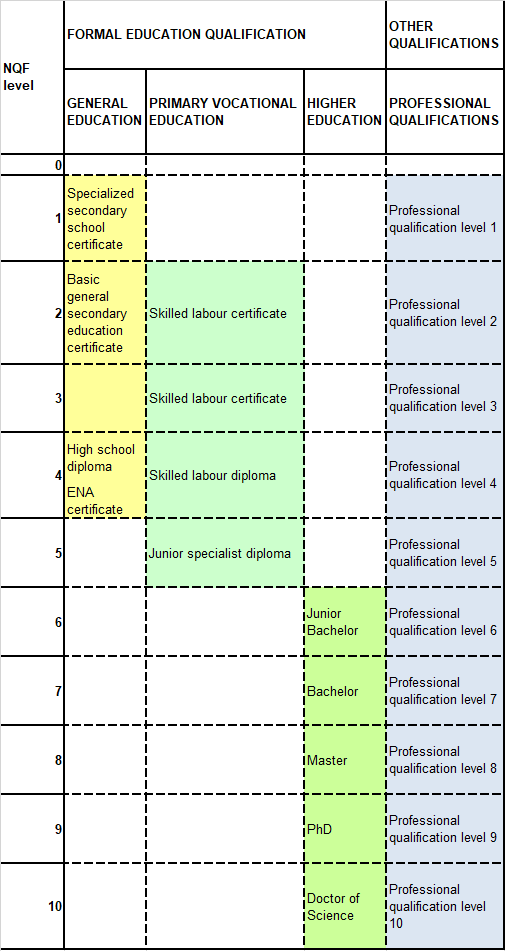
Annex C Types of Qualification in NQF
Types of qualification in NQF
Abbreviations
CoE Council of Europe
EQF European qualifications framework
IDPs internally displaced persons
ISCED 2011 international standard classification of education, statistical framework for
organising information on education maintained by the United Nations Educational, Scientific and Cultural Organisation (UNESCO)
ISCO international standard classification of occupations
QF -EHEA qualifications framework in the European higher education area
NQF national qualifications framework
TAIEX Technical assistance and information exchange instrument of the European
Commission; supports public administrations in the approximation and application of EU legislation and facilitates sharing of EU best practices
VET vocational education and training
Please log in or sign up to comment.