

Introduction and context
NQF snapshot
Bosnia and Herzegovina’s Council of Ministers adopted the baseline qualifications framework (BQF), in March 2011; the decision carries the force of law. The Council of Ministers adopted an action plan to implement the BQF in February 2015.
The BQF has eight levels and includes all types and levels of qualifications and certification. The 19-member Intersectoral Committee (ISC) is the policy-making body for the BQF. It comprises six members per each of the three major population groups – Bosniak, Croat and Serb – plus one member for minorities such as Roma. The ISC is chaired by the country-wide Ministry of Civil Affairs. However, the ISC has not sat or operated since spring 2015: nomination of representatives has been delayed for political reasons.
Bosnia and Herzegovina has a strategy to implement the BQF and begun developing tools and approaches; it therefore straddles the initial and structured stages. Institutional arrangements for coordination of the BQF implementation are still pending for approval.
Educational, social, economic and political context
Bosnia and Herzegovina – also referred to in this text as BiH – has a population of circa 3.2 million , which is both ageing and declining numerically, partly through migration. It is an upper-middle- income market economy. Nearly half (48%) of the population live in urban areas, while 14.6% are aged 15 to 24. The literacy rate is very high, at 99% in 2013; most of the population have primary or secondary school education (41.7% and 48.6%, respectively), while 9.7% have higher education. There is a low early school leaver rate (6.7%). People tend to postpone entering an uncertain labour market by extending their stay in education. Participation in higher education has almost doubled since 2000, but this has not led to better employment opportunities.
The labour market in the country continues to be characterised by a low activity rate, high and long-term unemployment, especially among young people, including a high level of informality. Young people (15 to 24 years) have the lowest activity, with less than one third (28.3%) participating in the labour market and with marked gender differences of 19.4% female and 36.3% male.
Like many developed and transition countries, Bosnia and Herzegovina is facing population growth stagnation, with a negative annual growth of-0.12% in 2013. Demographic projections show that the labour force will shrink considerably in the next 40 years. The country will be ageing rapidly, with the dependency ratio rising to 55.1% by 2050 (from 45.5% in 2013). The main cause is lack of confidence in the future. Highly skilled workers, in particular, are keen to look for further and better work possibilities abroad, adding to the problem of brain drain. More than 20% of graduates from tertiary education in the 25+ age group are currently estimated to live in OECD countries. The national labour market clearly needs more jobs and more attractive jobs to ensure sustainable social and economic development.
Approximately three quarters of students in upper secondary are enrolled in VET. Career and development opportunities are clearly worse than in most other European countries. The education attainment levels of the population are still lagging behind those of the EU, although they are improving. And there are high levels of structural long-term unemployment.
Policy objectives
Education and training reforms
Bosnia and Herzegovina adopted its vocational education and training (VET) development strategy for 2007-13 in 2007; a new VET strategy for 2015- 20 is being drafted. The baseline qualifications framework is an element in the strategies and in the strategic directions for the development of education with the implementation plan 2008-15, and the Strategic platform for development of adult education in a lifelong learning context for 2014-20.
International cooperation
BiH is an EU potential candidate country. In February 2016, BiH submitted its application to join the EU. It receives financial assistance from the EU via the IPA (Instrument for pre-accession). An IPA-funded project, managed by the British Council, sought to develop the qualifications framework for primary and general secondary education in the country. It aimed to raise the quality of education and reform the school-leaving matura exam; the project prioritises training for teachers, pre- and in-service, in primary and secondary education. It ran from October 2014 to October 2016.
The EU VET IV project developed vocational qualifications based on occupational standards. The German Technical Assistance Agency (GIZ) is a strong presence in the country and is currently running a project Support to adult education. One element of this is the ‘passport of competences’ designed to recognise informally acquired skills, a type of recognition of prior learning (RPL). In higher education, a joint EU and Council of Europe (CoE) project on higher education qualifications developed a good practice guide for development of qualifications and occupational standards in higher education.
From March 2016 to June 2018, the EU-funded project "Qualifications Framework for Lifelong Learning" worked on several aspects of the BQF, such as quality assurance, accreditation procedures, EQF referencing, validation of non-formal and informal learning.
Levels and use of learning outcomes
Alignment to other classification systems
The BQF is the national instrument for structuring and classifying qualifications in Bosnia and Herzegovina. The country already had a classification system of qualifications, the nomenclature, which comprehensively reflects the world of education, but does not provide meaningful links to the world of work.
There is no register or catalogue of qualifications available in the country, although the agency charged with primary, secondary and VET (APOSO), holds data on qualifications and provision. Creation of a BQF web portal (to serve as a BQF register) was a part of the remit of the EU project on qualification frameworks for VET and adult education.
Validation of non-formal and informal learning (VNFIL) or recognition of prior learning (RPL) forms part of the action plan and of the EU project programme but, apart from isolated cases, remains a goal to be achieved, not a national, working system. However, given the number of adults who have been displaced and the current numbers of migrant workers from Bosnia and Herzegovina, VNFIL/RPL would be most valuable and practical. The lack of standards is a hindrance. One exception has been the ‘passport of competences’ led by GiZ, the German Technical Assistance Agency. This supports employability of adults by identifying informally acquired competences.
Reform in higher education has been influenced by the Bologna declaration and the Lisbon convention on the recognition of qualifications concerning higher education in the European region. Higher education reform is supported by the EU and the Council of Europe. All State universities started to implement the first and the second cycle in 2006, in accordance with the Bologna process, and the European credit transfer and accumulation system (ECTS) has been introduced in all new study programmes. Though the framework law on higher education was adopted in 2007, its full implementation is taking its time. Many amendments incorporated in the final adopted version have made it difficult to implement but all entity and cantonal legislation has been harmonised with the State-level framework law.
NQF levels and level descriptors
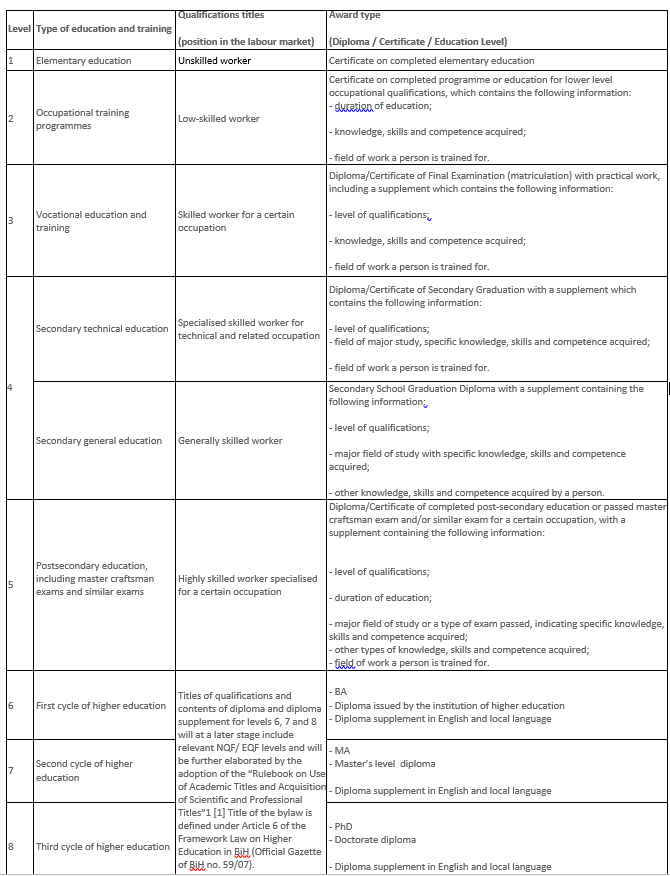
The BQF currently has eight levels and no sublevels: other countries in the region, including Montenegro and Croatia maintain sublevels. The eight levels are intentionally designed for straight level-to-level linking with the EQF (e.g. level 4 BQF to level 4 EQF).
The current level descriptors are derived from the EQF level descriptors and use the same domains: knowledge, skills and competence. Further development may be necessary to fit national and local conditions better, as well as for EQF referencing.
Qualifications
The definition of ‘qualification’ in the action plan is: ‘Qualifications: a formal title of the result of a process of assessment and validation obtained once a competent body determines that an individual has achieved the learning outcomes as per the defined standards’. In practice, it can be difficult to distinguish between curriculum and qualifications in Bosnia and Herzegovina.
Access, progression and credit
The BQF sets out vertical and horizontal progression as one of its main aims. Credit, with the exception of higher education and levels 6 to 8, is not described in detail in the BQF document.
Use of learning outcomes
The framework levels descriptors are described using learning outcomes; it is not explicitly stated that all qualifications in the framework have to be outcomes-based, but the text refers to levels.
NQF scope and structure
The BQF is inclusive/comprehensive. It includes all types (general education, vocational education and training, higher education and lifelong learning) and levels of qualifications (1 to 8) and certification. The BQF illustrates different types of certificate/ qualification in principle attainable at the various levels.
Qualifications that are not the outcome of formal education can in principle be included in the BQF but criteria and procedures for inclusion and for referencing to levels have yet to be defined. The EU project on Qualification frameworks for Lifelong Learning has developed a methodology for this purpose.
Stakeholder involvement and institutional arrangements
Legal basis of NQF
Bosnia and Herzegovina’s Council of Ministers adopted the baseline qualifications framework (BQF) in March 2011; the decision carries the force of law. The Council of Ministers adopted an action plan to implement the BQF in February 2015.
Two main documents were adopted, the Decision on Adoption of the Baseline of Qualifications Framework in Bosnia and Herzegovina (Official Gazette of BiH, No. 31/11, 39/12) and Decision on Adoption of the Action Plan for the Establishment and Implementation of the Qualifications Framework in Bosnia and Herzegovina for the Period 2014-2020 (Official Gazette of BiH, No. 28/15).
The following Laws have been adopted at the state level:
- the Framework Law on Primary and Secondary education (2003);
- the Framework Law on Pre-primary Education (2007)
- the Framework Law on Higher Education (2007);
- the Law on the Agency for Pre-primary, Primary and Secondary Education (2007);
- the Framework Law on VET (2008).
In 2014, the Council of Ministers of Bosnia and Herzegovina adopted ''Principles and Standards in the Field of Adult Education in BiH'' and ''Strategic Adult Education Development Platform in the Context of Lifelong Learning for the Period 2014-2020'', which constitute pre-requisites for regulating the field of adult leaning and development of lifelong learning in BiH. The adoption of these framework documents at the entity and cantonal levels is a lengthy process.
Governance and institutional arrangements for the NQF
The 19-member Intersectoral Committee (ISC) is the BQF’s current executive, policy-making body, during framework development. It is chaired by the Ministry of Civil Affairs, a country-wide office. The action plan provides for eventual establishment of a BQF Council as a decision- making/governing body, and sectorial councils as technical/expert bodies.
Formally, ISC membership should comprise representatives of the following sectors/institutions:
- five representatives of the education sector (Ministry of Civil Affairs – Education Sector; Federal Coordination of Ministers of Education: two canton representatives; Ministry of Education and Culture of Republika Srspka; Education Department of the Government of the Brcko District of BiH);
- three representatives of the Rectors Conference of Bosnia and Herzegovina;
- three representatives of education agencies in Bosnia and Herzegovina (Agency for Pre-school, Primary and Secondary Education; Agency for the Development of Higher Education and Quality Assurance and the Centre for Information and Recognition of Documents in Higher Education);
- three representatives of the statistics sector (Agency for Statistics of Bosnia and Herzegovina, Federal Institute for Statistics, Republic Institute for Statistics of Republika Srpska);
- three representatives of the sector for labour and employment (Ministry of Civil Affairs – Section for Labour and Employment, Federal Ministry of Labour and Social Policy, Ministry of Labour and Protection of Veterans and Disabled Persons of Republika Srpska);
- one representative of employers (Association of Employers of Bosnia and Herzegovina) and one representative of the labour unions (Confederation of Labour Unions of Bosnia and Herzegovina).
In practice, institutional arrangements are complex and fragmentary. As a consequence of the Dayton Peace Agreement of 1995, the country’s constitution is highly decentralised, which poses challenges in creating a national qualifications framework (NQF) with equal validity and application across the country.
There is the State level: in education, this means the Ministry of Civil Affairs (MoCA); the two entities, the Federation of Bosnia and Herzegovina and the Republika Srpska; 10 BiH Federation cantons; and cities and municipalities. There is also the Brcko District of BiH. Each of the two entities, plus Brcko, plus the 10 cantons inside the federation, has its own administration, meaning there are 14 separate education authorities.
In 2018, the ISC remained suspended for political reasons. Some of the institutions and ministries referred to above decline to participate in any initiative beyond temporary EU or other donor- funded projects, and not in a more established national body.
Roles and functions of actors and stakeholders
The ISC, after an initial phase and one-year mandate, according to the action plan should have a seven-year mandate once appointed (2014-20). Its decisions are majority-determined, qualified by the requirement to include a minimum of two thirds of votes from the representatives of each constituent people. Its principal functions are to oversee and ensure implementation of the action plan.
The Agency for Pre-primary, Primary, and Secondary Education (APOSO) includes a VET department. Its principal concern is with quality; its functions include developing standards (education and occupational) and guiding curricula. Cantons and the two entities – the Federation and Republika Srpska– develop individual qualifications and determine the awarding process.
This raises questions about the reliability and validity of qualifications: it is not clear if outcomes are comparable, as standards are different between the cantons and entities. EU-funded projects in qualification frameworks for general, VET and adult education have an important task to ensure that outcomes, standards and methodologies used by all managing authorities are harmonised and comparable.
Employers and trades unions are represented on the BQF policy-making body, the ISC, though they are generally not strong across the country’s wider institutional set-up. The Ministry of Civil Affairs (with its responsibility for coordination in education and work and employment sectors at country level), EU projects, and the State agencies APOSO and HEA (Agency for Development of Higher Education and Quality Assurance) have sought to link education and training more closely to the labour market. Employer organisations such as the chambers of commerce, complain that decentralisation leads to excessive difficulty in engaging with government bodies and officials in VET. They also underline that graduates, VET or otherwise, lack soft or core skills.
In technical work, the involvement of sector representatives remains weak and the development of occupational standards is carried out mainly with the support of teachers from schools, who visit a large number of enterprises.
Resources and funding
The BQF development has been supported mainly by EU funded projects. The recently completed EU project on Qualification Frameworks for Lifelong Learning had a budget of 1.4 million Euro over its 2-year timespan. The other EU project in qualification frameworks in general education had 2 million Euro over its 2-year timespan. Budgets of State/public institutions are otherwise very limited.
Quality assurance of qualifications
In practice, with exception of Higher Education, quality assurance in qualifications is little developed in the country. In particular, in VET, it is highly fragmented.
In higher education, the institutional lead lies with the HEA - Agency for Development of Higher Education and Quality Assurance, based in Banja Luka (but covering all of Bosnia and Herzegovina). In recent years, it has conducted accreditation of higher education institutions, private and public, of which several offer short-cycle, level 5 qualifications, which are VET in orientation. To date, this has been general accreditation as providers, not for programmes or individual qualifications. The Agency has also been updating QA procedures, in higher education, to meet the Bologna Process’ European Standards and Guidelines.
The Baseline Qualifications Framework document of 2011 refers in general terms to standards but does not go beyond this level; the Action Plan specifies a timetable to develop Quality Assurance measures, including development of occupational standards; the EU project developed methodologies to support the design of new qualifications, which includes quality criteria.
The Agency for Development of Higher Education and Quality Assurance is an affiliated member of the European Association of Quality Assurance in Higher education (ENQA) and plans to apply for full membership.
In higher education, quality assurance is regulated by the Agency for Development of Higher Education and Quality Assurance. Higher education institutions (HEIs) develop programmes and qualifications, validated for use by the agency.
VET is more complex. APOSO develops qualification standards and assessment criteria but schools do the assessment, which is mainly internal. Ministries and cantons are the principal awarding bodies: it is their stamps which appear on certificates.
Neither in VET nor in higher education are there yet agreed criteria for validation of qualifications, which would support quality and levelling of qualifications in the NQF. The EU funded Project developed guidelines including standards and criteria for external evaluation and self-assessment based on best European practices and models. Most assessment remains in-school, or internal, though for matura, the school-leaving exam, a pilot was developed, which included external assessment.
A Manual for Enhancement of Vocational Qualifications was developed by the EU funded project "Qualifications Framework for Lifelong Learning". The Manual is a result of the working group composed by representatives of all competent education authorities and other key partner institutions and it is intended for all institutions and bodies involved in developing the basic elements of the qualifications framework (occupational standards, qualification standards, curricula and programs, use of learning outcomes). The Manual is directly linked to the training program for enhancement of VET qualifications, which includes additional material for training qualifications developers.
The main issue and challenges for quality assurance of qualifications are lack of comparable education or occupational standards, lack of agreed criteria for development and validation for use of qualifications, minimal external assessment, and fragmented functions among the many actors. There are good cases of quality assurance practice, e.g. some qualifications are written in learning outcomes, there is some validation of qualifications, but there is no consistency across the system or country.
Recognising and validating non-formal and informal learning and learning pathways
Validation of non-formal learning (VNFIL) is part of the action plan but there is no country-wide system as yet. Individual providers offer it for access to programmes, while the German development agency GIZ developed the ‘competence passport’ to support recognition of adult and adult learner skills. VNFIL is at the ad hoc stage in Bosnia and Herzegovina. A first concept was developed by a working group in the scope of the EU funded project "Qualifications Frameworks for Lifelong Learning", but no other developments have been registered.
NQF implementation
Inclusion of qualifications in a register
There is currently no register or database at national level, although APOSO (see above) maintains a general overview of existing and new VET qualifications, and Higher Education Agency of higher education qualifications. Creation of the BQF web portal is foreseen in the near future within the EU-funded project on qualification frameworks in VET and adult education.
ETF conducted an Inventory of Vocational Qualifications in Bosnia and Herzegovina in 2017, comprising all types of qualifications from Level 2 up to Level 5. The inventory includes 1,155 vocational qualifications, of which 836 are formal, obtained in vocational schools, while 319 are obtained through lifelong learning programs. The largest number of qualifications comes from formal VET at levels 3 and 4. Only 6 qualifications are at level 2, while at level 5, 88 qualifications were collected. Looking at the number of qualifications at each level, it could be concluded that further development of the qualifications at level 2 might be required, especially given the need to provide qualifications for long term unemployed adults and persons with special needs.
Vocational qualifications at levels 3 and 4 are classified in 13 occupation families. More than half of the 742 qualifications at these levels (56.1%) were developed in 1995 and 1996 and they need to be revised. The greatest numbers of qualifications are found in two occupation groups: metal processing (20.3%) and electrical engineering (15.8%). However, the number of students per group shows that economics, law, administration and trade is the most popular group. At level 5, structural modernisation from old qualifications for “high skilled worker” to new “master-craftsman” represents a challenge for all educational authorities.
Learning outcomes are not used at level 2 and only in very few cases at level 5. However, about 43% of the most popular qualifications at levels 3 and 4 are based on learning outcomes. Learning outcomes are a compulsory element and a requirement for each qualification to be placed into the qualifications framework and the process of designing learning outcomes-based qualifications will be one of the greatest challenges in dealing with vocational qualifications. Curricula for the aforementioned 419 qualifications that contain learning outcomes have them only at the level of the module, but not as an exit profile of the entire qualification.
Monitoring, evaluation and review of the NQF
Mechanisms to monitor the effectiveness of BQF implementation have not yet been fully defined, but the ISC will have an important role in this process. No monitoring or assessment has been conducted as yet.
Impact for end-users
The BQF is not yet being used as a reference system or tool by learners, providers and workers.
Referencing to regional frameworks
Bosnia and Herzegovina has been a potential candidate for EU accession since 2013. The Stabilisation and Association Agreement (SAA) entered into force on 1 June 2015. The country joined the EQF advisory group in October 2015 as a full member. Making the BQF ready for referencing to the European qualifications framework is, therefore, a priority. Similarly, BiH participates in the Bologna process in higher education, whose requirements include self- certification against the qualifications framework for the European higher education area.
Important lessons and future plans
EU projects will deliver useful tools such as qualifications development methodologies, and lay groundwork for elements such as quality assurance systems, but these technical advances will not have an impact on qualification or VET systems in the country without political backing. This means, in the first instance, re-establishment of the Intersectoral Committee and creation of a BQF Council at political level.
Vocational training reform has initiated changes in almost all education functions, but its quality remains a challenge, particularly in terms of learning outcomes, accreditation of training providers and programmes, and teaching and learning. The reform has continued to focus on bringing vocational training closer to labour market needs.
The complex institutional arrangements with state institutions which have very limited mandates makes the overall pace of reform slower than might otherwise be the case.
Implementation of the Action Plan for the BQF is far behind its own schedule. While the EU projects have performed much of the technical work necessary to implement the Action Plan, the completion of both projects by now may create a hiatus between the design of those methodologies and its adoption and further implementation. There needs to be a sustained follow-up of implementation of the NQF infrastructure, with the necessary allocation of financial resources from the BiH public funds at all relevant levels of government.
Abbreviations
APOSO Agency for Pre-primary, Primary, and Secondary Education (includes VET)
BiH Bosnia and Herzegovina
BQF Bosnia and Herzegovina baseline qualifications framework
CoE Council of Europe
EQF European qualifications framework
GIZ Deutsche Gesellschaft fur Internationale Zusammenarbeit, GmbH (German Technical Assistance Agency)
HEA Agency for Development of Higher Education and Quality Assurance
IPA Instrument for pre-accession, the EUs support programme for candidate and potential candidate countries
ISC Intersectoral Committee
MoCA Ministry of Civil Affairs
NQF national qualifications framework
RPL recognition of prior learning
VNFIL validation of non-formal and informal learning
Further information
NQF structure (annex to the BQF)
Please log in or sign up to comment.