
2021 – Billions of people are working and learning online. The world is ever more connected but education and training systems and qualification systems remain basically national systems.
Some people challenge the need for qualifications. You can learn everything from YouTube and other online resources and in the workplace you really develop your knowledge and skills in a real world contexts. Qualifications do not seem to be needed anymore….
And yet, qualifications are still gaining importance. Not only because few people would invest in education without a certificate, and many jobs still require one, but because qualifications expressed in learning outcomes are the tool to translate labour market needs into results of education and training and the start of developing different learning pathways. What we can observe is that worldwide the number of different types of qualifications is growing and that the number of people that acquire qualifications is growing too. Moreover, qualifications are also changing to make them more fit for purpose and adapted to personal needs. They are adapted to allow for recognising non-standardised forms of learning. In addition to traditional large qualifications there is a growing number of smaller qualifications seeing daylight.
Many countries have developed qualifications framework to classify, compare qualifications issued by different organisations in the country and link them. Frameworks of qualifications is a better word for them in my view, as they link concrete qualifications and frameworks without qualifications in them are useless constructs. These frameworks can be used to create shortcuts, create access and new progression pathways, recognise what we have learned already, so that we don’t have to relearn what we already know or can do. This can also facilitate mixing learning with work and personal interests.
But when people move across borders, they often face difficulties in getting recognition for what they are able to do. Regional Qualifications Frameworks (RQFs) are part of the solution. RQFs are qualifications frameworks agreed by a number of countries or national organisations with a common agenda for economic, labour or educational cooperation, to strengthen trust in each other’s qualifications. Individuals looking for jobs and learning opportunities abroad can benefit from regional qualifications frameworks as their qualifications are easier to understand and compare. RQFs can turn qualifications into passports for jobs and studying abroad.
The European Qualifications Framework for Lifelong Learning is such an RQF. The EQF for Lifelong learning involves 38 European countries. These countries compare the levels of their framework with the EQF levels and explain the processes behind allocating levels to their qualifications. This is called referencing and the referencing reports are discussed in the EQF AG where all the countries are represented. After referencing, countries can mention the EQF level on their qualifications and link their database of qualifications with those of other countries through EUROPASS. However, this process is limited to the 38 countries that are in the EQF Advisory Group.
In 2017 a new Recommendation on the EQF was adopted and the EQF is now opening up to other countries by exploring if national and regional qualifications frameworks can be compared with the EQF based on a dialogue. The dialogue is very important to treat every qualifications framework equally. EQF is not the global standard, but we want to connect.
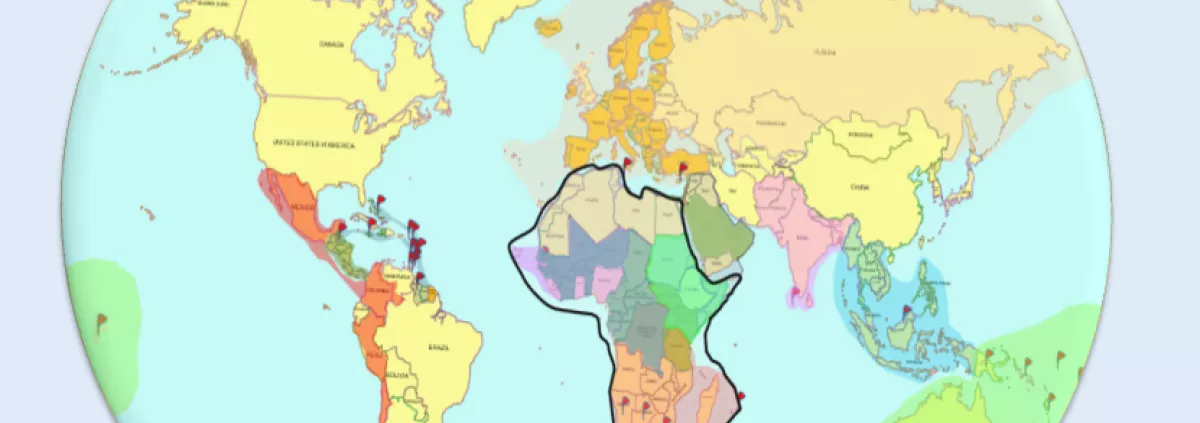
As ETF was involved in developing this process, we were asked to take a closer look at RQFs. We mapped the latest developments of RQF and explored ways to compare them with the EQF.
Our investigation focused on 15 RQFs that are not linked to the EQF
-
African Continental Qualifications Framework (ACQF),
-
Arab Qualifications Framework for Higher Education (AQF; ANQAHE Model),
-
ASEAN Qualifications Reference Framework (AQRF),
-
CARICOM Qualifications Framework (CQF),
-
Conseil Africain et Malgache pour l'Enseignement supérieur (CAMES),
-
ECOWAS Regional Qualifications Framework of West Africa,
-
East African Qualifications Framework for Higher Education (EAQFHE),
-
Gulf Qualifications Framework (GQF),
-
Intergovernmental Authority on Development (IGAD) in Eastern Africa,
-
Marco de cualificaciones Alianza del Pacífico (Pacific Alliance) (MCAP),
-
Marco de Cualificaciones para la Educación superior centroamericana (MCESCA),
-
Pacific Register of Qualifications and Standards/Pacific Qualifications Framework (PQF),
-
Southern African Development Community (SADC) Qualifications Framework,
-
South Asian Association for Regional Cooperation (SAARC) Regional Qualifications Framework,
-
Transnational Qualifications Framework for the Virtual University for Small States of the Commonwealth (TQF VUSSC).
As there is little online information about these initiatives, we used interviews. We also benefitted from the mapping study of the African Continental Qualifications Framework (ACQF) providing new information on qualifications frameworks in Africa.
RQFs are at different stages of development. Many are still in an early stage, which makes them difficult to compare now, although they all seem to pursue solutions for developing, registering and quality assuring qualifications. The EQF might be the best known RQF but it is neither the oldest nor the most modern. None of the RQFs analysed is a copy of the EQF, but all benchmark themselves with EQF.
Most RQFs have been established by middle-income and low-income countries. The efforts to develop RQFs for the 21st century have been hampered by a lack of capacities and resources, fickle donor funding, and the Covid crisis. There is a strong interest to share experiences between RQFs and more cooperation beyond comparison.
The findings of our study will be discussed in a webinar on 19 May 2021 with interpretation in English, French and Spanish. Actually, we will have two sessions, to facilitate the time differences between the participants. We have invited participants from more than 80 countries and from all the existing RQF initiatives and we plan to follow up the event with a global dialogue between national qualifications agencies and RQFs here online.
You can find a link to the study here. It is available in English, French and Spanish.
If you are interested to participate, we still have a few places in the webinars. Register your interest Registration link_open.
For all those who register we will keep you up to date on new developments.
hi Arjen, sounds like good progress, can you share the links again, they don't seem to be accessible, regards, James
Dear James,
I have added the link to the study. The other links will follow. All participants in the WRLs group are going to be invited. This includes you.
Galia Bozhanova Yuriy Rashkevych Büşra TEKELİOĞLU Volker Rein Ruta Porniece Hannah Manogaran [~2346] Milica Jelic Mariokov Micole Bistoquet Eusebius Mukhwana Yulia Martyn Anastasia Pouliou Tetyana Semigina Volodymyr Kovtunets Volodymyr Kovtunets Vasyl Fediuk Firdovsi Mutallimov Mirjana Bojanic WOJCIECH STECHLY Dr. Thani Almheiri Suleyman Arıkboga Ramsamy NOOKADEE Joe Samuels Joe Samuels Olfa LARIBI DRIDI Anna Kahlson Alqi Mustafai A. Besim Durgun
Dear Arjen, this looks very interesting! Would it be possible for me or one of my colleagues to participate on the 19th?
Best, Anna
Dear Dr. Arjen, this is great study. I am currently doing a study on Gulf NQFs and would like to join the webinar.
Dear Colleagues, your interest is noted. We will come with instructions early next week for registering for additional participants.
Arjen Deij is it possible to stream the event here on openspace or on youtube, and also to hold a session for openspace community directly on openspace?
We are planning to stream the plenary part of the event in English and record the French and Spanish versions as well. The breakout rooms will only be accessible for the invitees, but the introduction by the ETF Director and EU Commission, the presentation by the authors, the Mentimeter exercise and QA session and the conclusions can be followed live and we can also facilitate the chat on ETF YouTube Channel via Open Space.
We have decided today that we will stream the event on ETF LinkedIn and of course on Zoom register above
Please log in or sign up to comment.