
You may remember my previous post “the school must go on”. At that time, we were facing the start of the school lock-down with the need to hard switch from face-to-face to distance digital learning, using synchronous and asynchronous methods, broadcasting lessons, using virtual classrooms and online library. To different extent, emergency remote teaching solutions were put in place in all ETF partner countries, partially replacing face-to-face lessons at school.
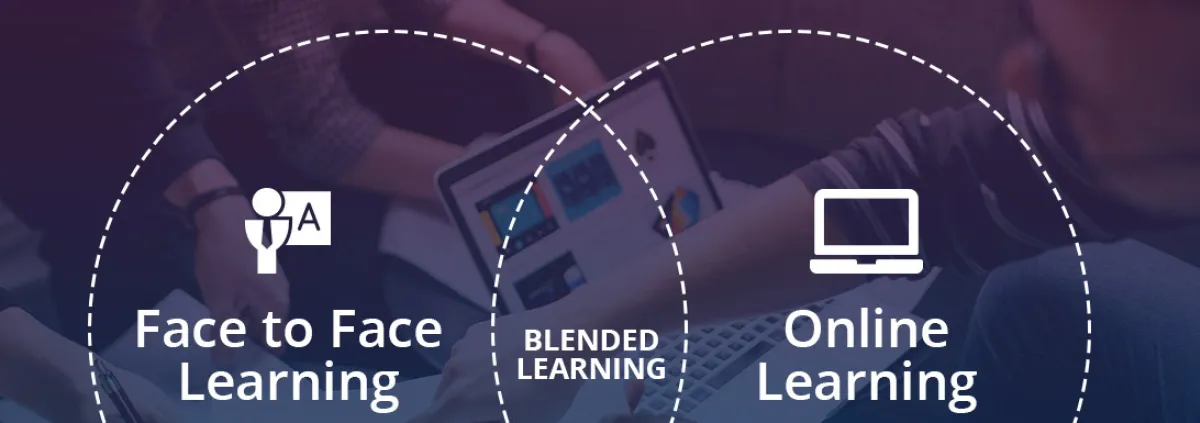
Now, in September, a new school year must start, facing the same challenge, the COVID19 pandemic, yet having in mind different and more sophisticated solutions, blending learning in schools with digital and online learning (DOL), aiming to:
- Ensure continuity of lessons while ensuring physical distance and safety standards. On this line, some ETF partner countries foreseen hybrid models, where lessons are delivered from school to students in classroom and, in parallel, online to the ones following the lesson from home;
- Offer flexible learning models, combining teacher expository with individual-, peer- and collaborative- online learning.
More specifically, blended learning is expected to offer hybrid/hyFlex solutions to ensure continuity of lessons and, in the meantime, make skills and competences acquisition a tailored, more focused and timely process, connecting different learning methods and environments.
Yet, in concrete terms, how many blended learning models exist?
A lot of researches and analyses of practices have been undertaken on this topic providing different models for different contexts, needs and purposes. A research paper, already published in 2016, identify four main models of blended learning:
- Rotation model, probably the most relevant model for the upcoming new school year, where students within a single class rotate between a number of different learning activities, one of which is digital and online learning;
- Flex model, where each student blend face-to-face and digital learning to fit their own personal learning pace, so more linked to personalisation of learning;
- Self-blend model, where digital learning could be the solution for courses not offered in their own school campus;
- Enriched virtual, where students spend most of their time online, accompanied by face-to-face learning sessions with their teacher.
In this respect, as already spotted out from my colleague Julian in a post, the European Commission has recently published guidelines on blended learning in schools for the start of the academic year 2020/21, exploring opportunities and challenges.
The COVID19 crisis has brought the use of technology in schools centre stage; as always, technology will not replace good teaching but can certainly supplement good teaching and maintain classroom relationships at this time.
Are schools in your country planning to use blended learning models?
Grateful if you consider share your experience and view on this topic.
Source:
Distance Digital Learning during COVID19 in ETF partner countries: https://www.etf.europa.eu/sites/default/files/2020-06/mapping_covid_ddl_050620_1.pdf
Blended learning models: https://www.raiseyourhandtexas.org/blended-learning/understanding-different-models-blended-learning/
European Commission blended learning guidelines: https://www.schooleducationgateway.eu/downloads/Blended%20learning%20in%20school%20education_European%20Commission_June%202020.pdf
Cover photo on docebo
On the line expressed in the blog, a concrete case of guidelines from Welsh Government about the use of blended learning, really to the point! - https://hwb.gov.wales/api/storage/5792637c-fa0d-4af2-884e-66d0abeca36b/…
Please log in or sign up to comment.