
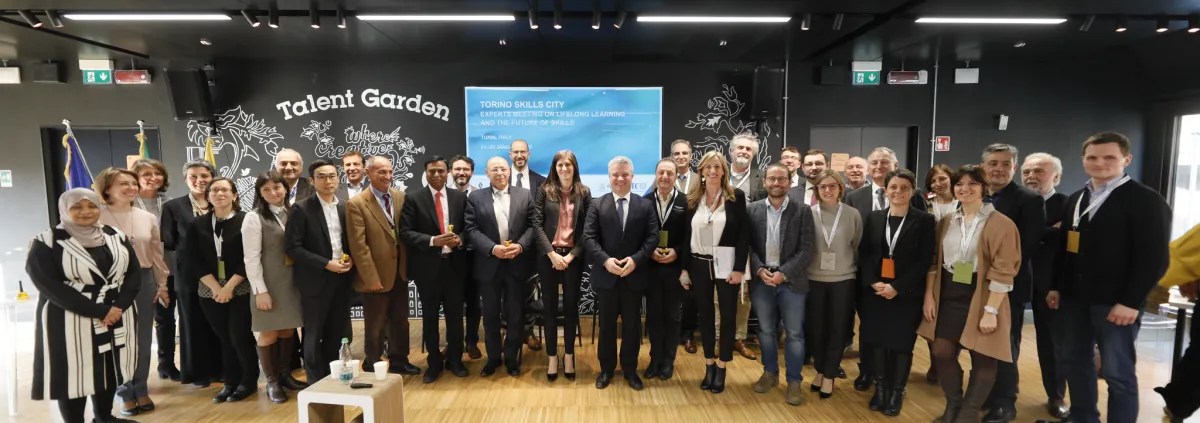
What happened in the Torino Skills Week event?
From 21 to the 23 of January 2020, a group of eighty people from all over the globe gathered in Turin for a three-day workshop: a real brainstorming session aimed at developing local solutions to the challenges of the future of work and skills.
Among the topics under discussion were the development of lifelong learning policies to ensure the updating of skills in a constantly evolving job market.
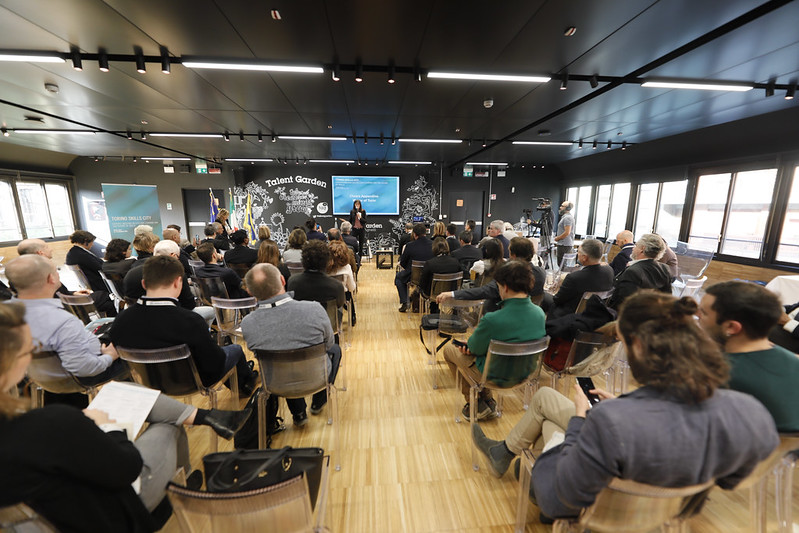
Ranging from high-level public actors in charge of policy making and shaping, funding and regulating authorities to local lifelong learning-focused authorities, from social partners representatives to civil society and academia experts, from company owners to youth leaders, the participants had the opportunity to reflect on the changing world of work and the role of lifelong learning in addressing the challenges caused by these changes.
The event was co-organised by the European Training Foundation (ETF) and the International Training Centre of the International Labour Organization (ITC-ILO) - the UNESCO Institute for Lifelong Learning, the City of Torino, the Torino Chamber of Commerce, and Italian co-working network Talent Garden.
The meeting ended with the pitch of the Experts’ Hackathon, the aim of which was to respond to the Torino Challenge, with an eye to find global solutions for changing cities.all the solutions for the Torino Challenge proposed by the participants, at Talent Garden in the presence of the Mayor of Torino Chiara Appendino, ETF Director Cesare Onestini, ICT-ILO Program Director Snehal Soneji, Talent Garden Head of Corporate Relations Barbara Graffino, and Head of the UNESCO Learning Cities Network Raul Valdés-Cotera.
Also present were representatives of the cities of Cork (Ireland), Manizales (Colombia), Qatar and Singapore, who shared their experiences of using lifelong learning to support sustainability, innovation and inclusion.
“The World Economic Forum in Davos has confirmed that the future of work is uncertain and that the work of the future has still to be created. In this crucial moment of economic and social transition, the experts stress the importance of focusing on the new skills to be created. These are the skills and competences that, together with individual talent, give local job markets a global edge.
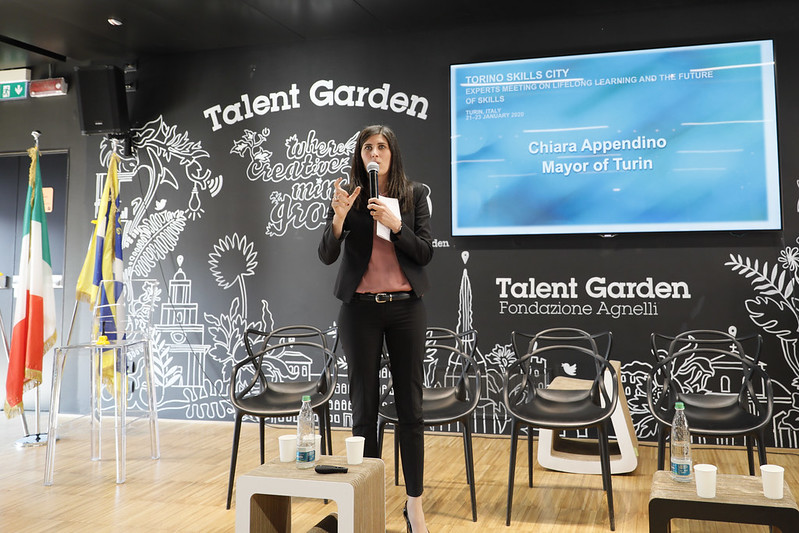
Chiara Appendino, Mayor of Torino.
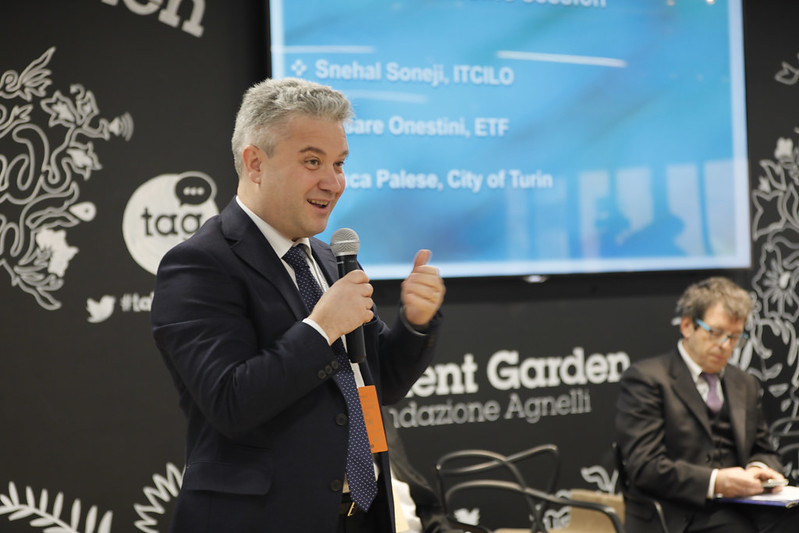
The ETF works for the European Union in almost thirty countries on the future of skills and work and the creation of lifelong learning systems. These challenges are present and pressing in our partner countries exactly as they are in the city, here in Torino. It is essential to work together, as this experience has shown, to build a dynamic partnership that sparks action and new initiatives.
Cesare Onestini, Director of the European Training Foundation
The solutions that emerged from the three-day brainstorming focused attention on the need to create a vision for lifelong learning and to activate agents of transformation - which can include all citizens - outside the existing innovation hubs.
Among the ideas that emerged were:
- investing in technology to digitise education provision;
- facilitate the matching of supply and demand, for example by creating 'digital badges’ to recognise lifelong and informal training;
- ‘reverse mentoring’, i.e. activating young people as mentors for the rest of the population in digital skills;
- 'championship support ', i.e. including the city in a network of successful international experiences.
In this last point there was a great deal of discussion about the UNESCO Global Network of Learning Cities.
What is the UNESCO Global Network of Learning Cities (GNLC)?
Source: http://uil.unesco.org/lifelong-learning/learning-cities/members
The UNESCO Global Network of Learning Cities is an international policy-oriented network providing inspiration, know-how and best practice. Learning cities at all stages of development can benefit greatly from sharing ideas with other cities, as solutions for issues that arise as one learning city develops may already exist in other cities.
The Network supports the achievement of all seventeen Sustainable Development Goals (SDGs), in particular SDG 4 (‘Ensure inclusive and equitable quality education and promote lifelong learning opportunities for all’) and SDG 11 (‘Make cities and human settlements inclusive, safe, resilient and sustainable’). The UNESCO GNLC supports and improves the practice of lifelong learning in the world’s cities by
- promoting policy dialogue and peer learning among member cities;
- forging links;
- fostering partnerships;
- providing capacity development;
- developing instruments to encourage and recognize progress made in building learning cities.
What is a learning city?
A #learningcity promotes lifelong learning for all. UNESCO defines a learning city as a city that:
- effectively mobilizes its resources in every sector to promote inclusive learning from basic to higher education;
- revitalizes learning in families and communities;
- facilitates learning for and in the workplace;
- extends the use of modern learning technologies;
- enhances quality and excellence in learning; and
- fosters a culture of learning throughout life.
In doing so, the city enhances individual empowerment and social inclusion, economic development and cultural prosperity, and sustainable development.
Why learning cities?
Lifelong learning lays the foundation for sustainable social, economic and environmental development. Studies have shown that lifelong learners – citizens who acquire new knowledge, skills and attitudes in a wide range of contexts – are better equipped to adapt to changes in their environments.
Lifelong learning and the learning society therefore have a vital role to play in empowering citizens and effecting a transition to sustainable societies.
While national governments are largely responsible for creating strategies for building learning societies, lasting change requires commitment at the local level. A learning society must be built province by province, city by city, and community by community.
Learn if your city is in the list of Members of the UNESCO Global Network of Learning Cities HERE.
During the Torino Skills City the ETF had the opportuniy to have a conversation about lifelong learning with Cesare Onestini (EFT), Raul Valdez Cotera (UNESCO) and Srinivasan Baki (ILO):
Denis Leamy, from Cork Municipality, talked about learning cities and innovation:
Dr. Camilo Younes from Universidad Nacional de Colombia about Learning Cities, and Manizales example.
✅What is the key element to become a #Learningcity?
✅How does the future of #skills look like in your city?
✅What is the role that communities play?
Check out our photo gallery from the event here.
Please log in or sign up to comment.