
The “Creating New Learning (CNL) is a new initiative of ETF and it’s part of ETF 2027 Strategy. It supports the vision of the ETF as a global knowledge hub in human capital development” The aim of CNL is to identify solutions that could be applied to boost innovation in vocational teaching and learning in different national contexts. One of its 3 Components is the ‘New Learning Vista” which analyzes innovative trends in teaching and learning and conditions that foster and boost innovation. Focussing on VET and skills development in the ETF’s partner countries from the lifelong learning perspective, the geographical area includes the SEED, Turkey, and SEMED countries as well.
The following Innovative Practice (IP) comes from Jordan as a nice example of how to exploit the potential of the human capital through a good combination of VET and labor market needs for further analysis.
According to the Jordanian Department of Statistics 28.4 % of male bachelor's degree graduates are without a job. The number rises to 80.1% for women. The Jordan Engineering association has further reported that unemployment among recent engineering graduates has reached 50%. Among female engineers, this rate is even higher.
To combat the alarming unemployment phenomena and simultaneously contribute to global water, energy, and food security nexus, as the main challenges in this area, there is a need for holistic, global solutions to boost green jobs creation in a greener and sustainable economy. As such efforts gain more momentum because the local needs started to emerge the up-skilling and knowledge management. To support the future innovators through new knowledge management tools and gives an opportunity for more skilled new green entrepreneurs (for educated Jordanian women as well) with proven solutions tackling water and/or energy issues in urban or rural food production, new teaching/learning practices are required in green skilled labor forces.
Young graduates carry relatively enough theoretical information about a single topic/specialty, yet most of those engineering, science, and business graduates lack the practical skills and understanding of the nexus and the interconnectivity between water, food, energy, society, and environment. This led to the design of several upskilling and training programs to bridge the knowledge gap and introduce the young generation to the future. A promising example of such upskilling modules is the one implemented through a partnership between The Sahara Forest Project (SFP) which is a Norwegian NGO and Al Hussein Technical University (HTU) in Jordan. (https://www.saharaforestproject.com/ The HTU uses an innovative collaboration model in which industry experts and business leaders are educators with a curriculum aiming to equip students with specialized skills that match real market needs and bridge the gap with employers.
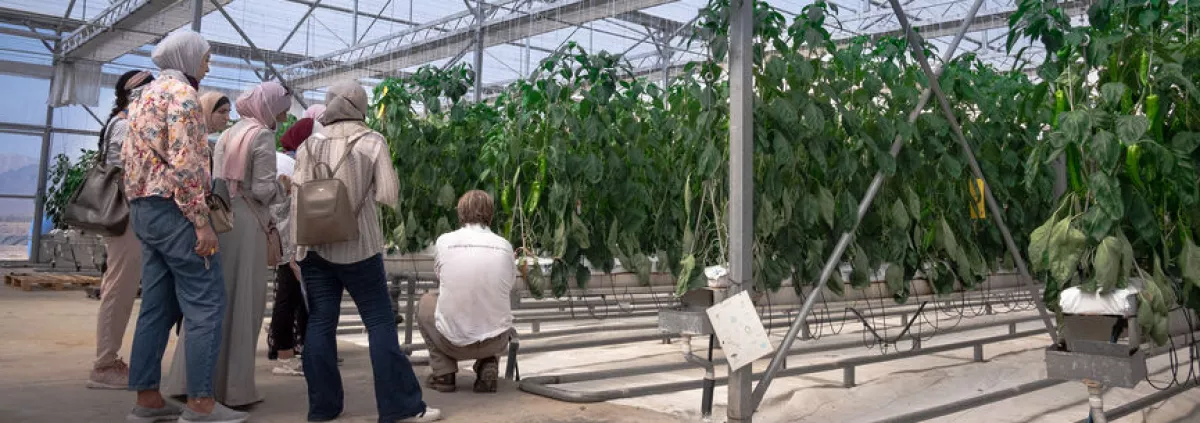
This Upskilling Program for Female Engineers in Agritech and Food Security is being piloted on 30 young females in 2021 from various Jordanian governorates that got selected based on an open application and preset criteria. The participating trainees are exposed to field training at The Sahara Forest Project in Aqaba, technical lectures and seminars by practitioners, mentorship by female leaders, and inspirational talks by market experts. The first stage of a comprehensive training program was successfully completed by 15 female engineers in December 2020.
The overall goal of the training program is capacity building for unemployed female engineers in innovation and food production within the Water-Energy-Food nexus. The program aims to increase the employability chances for the participants through three main training components: technical skills, soft skills and English. Theoretical aspects are covered at the HTU campus in Amman, and the practical component at SFP in Aqaba. To inspire the participants even further and with the aim of growing their professional network, Jordanian and/or international female mentors follow each training Group. During the course of the program, each participant works on case studies representing real challenges for SFP and/or other relevant actors Finally, upon completion of the program, each participant presents their work to an expert panel. Solving interconnected global challenges and creating green job opportunities related to the production of food, fresh water and clean energy is the main objective of the training. In-depth focus has been put on the following: The Water-Energy-Food nexus definition and boundaries; Emerging clean, climate-smart technologies within the nexus context; Cutting-edge agricultural technologies within the nexus context; Opportunities provided by different crops in realizing outdoor desert revegetation; How to desalinate saltwater into freshwater; Learning and understanding by hands-on training at SFP how to use the sun, saltwater, desert areas, and CO2 to produce food, freshwater, and clean energy.
The practical training includes horticulture production, desalination, irrigation systems, electrical control systems, and outdoor vegetation. Each training group is able to follow the process from planting the very first seeds to the final harvest. The participants also get valuable business insight into the high-end professional agricultural industry both in Jordan and internationally. Non-technical training includes understanding how to raise awareness towards decision-makers in industry, politics, and media and the importance of sales and marketing of end products, as well as administrative routines. The objective of such programs should not be to only help the unemployed youth find jobs but rather to widen their perspective to be able to create opportunities for themselves and for their peers and local communities. Re-anchoring the value of agriculture, water, energy, and nature is by itself a trigger for transformation in the future of work in the MENA region. The generous support came from the Norwegian Ministry of Foreign Affairs and the Costa Crociere Foundation. (More: https://vimeo.com/user14632123)
Thanks Tunde for sharing this interesting example. Within the CNL project we are looking for more inspiring practices. So a call for all Open Space members to share your innovative practice with us!
Please log in or sign up to comment.