
Existing VET Curricula, even modular, often inherit an outdated content-based approach to Curriculum development. So far, a basic approach to the correct design of Curricula is known – a design started from the learning outcomes agreed with employers, associations and other interested parties.
All experts engaged in development of VET Curricula inevitably face the challenge of efficient and accurate identification and description of learning outcomes, which correspond to a certain qualification (skill level) within a specific occupational area.
When building a vocational Curriculum, a team of developers should proceed not so much from the provisions of the available educational/qualification standards but, to a greater extent, from the needs of sectoral/occupational area – considering the qualifications that are in demand within a particular sector and the work functions that make up the essence of a specific qualification. Labor market research, direct contact with employers, combined with the expertise, allow Curriculum developers to identify and relate the market demands to the existing restrictions as to the content and form of Curriculum performance according to 1) educational standards representing the aggregated experience and understanding of educational community and 2) occupational standards representing the experience and understanding of employers and professional associations.
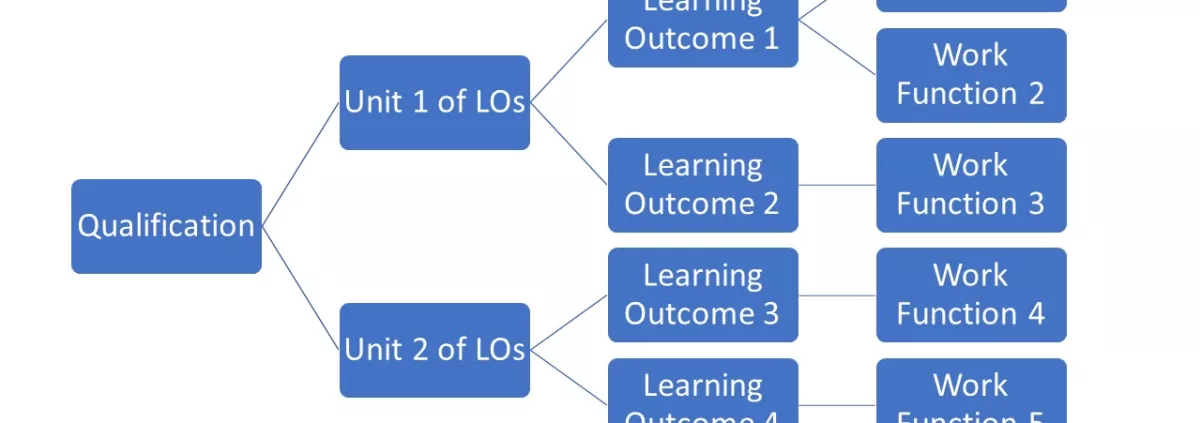
The most developed method of identifying learning outcomes for a Curricula is a comparison of the projected learning outcomes with the functional map designed for a specific qualification. In most cases, such functional maps are not developed and, thus, before designing a Curriculum, one must provide a functional map of the qualification. The learning outcomes organized in a hierarchical system form a functional qualification map, which becomes the basis / framework for designing the Curriculum for the corresponding level of education/qualification.
For each vocational Curriculum, several steps are required in order to correctly describe the units of learning outcomes that are both components of the qualification and what the student should achieve at the end of the study programme. All these actions are based on a single procedure - a functional analysis of the chosen profession and skill level, which ends with the drawing up of a functional map, as schematically shown in the figure.

In addition, when developing a Curriculum, functional analysis acts as a tool for finding a "consensus" between the requirements of occupational and educational standards and contributes to understanding the list and composition of work functions from the point of view of a real employer (employers' associations).
Work functions are activities that a person must perform as part of the job. These activities are not accidental, they have a clear purpose and output that are valuable to the employer. Using functional analysis, it is possible to break down the selected area of work into its constituent components that need a coherent set of knowledge, skills and competencies of the employee. It is very useful to create learning outcomes by speaking with employers about work functions, i. e. what employees should be able to do at a workplace. Once these work functions are identified, it is possible to develop a unique set of units of learning outcomes representing requirements for the qualification.
Carroll G., Boutall T. Guide to developing national occupational standards: Revised June 2011.
Please log in or sign up to comment.