

How do we ensure the greening of vocational educational training (VET)? It all begins with a Green Mindset – and having the teachers on-board!
On Wednesday 1 June 2022 the ETF launched the first of six thematic webinars as part of its programme, ETF Network for Excellence (ENE) and GRETA - Greening Responses to Excellence Through Thematic Actions. In collaboration with the Danish Technological Institute (DTI), the online meeting, hosted by ETF’s José Manuel Galvin-Arribas, Content Coordinator for ENE, and Susanne M. Nielsen, ETF’s expert leading GRETA, accompanied more than 60 online attendees on a virtual ‘study tour’ of Denmark, where VET educational experts and Centres of Vocational Education (CoVEs) shared their experience and knowledge in updating programmes and curricula to meet the challenges of the green transition.
The progress of GRETA
Jose Manuel kicked off the meeting with a recognition of progress made so far as part of the programme to support CoVEs in their greening processes.
“This GRETA initiative is helping us all to improve our awareness of green issues and is inspiring the development of training programmes which not only deliver on green skills but also encourage staff, students and industry to collaborate on green issues and become key actors” in the green transition.
A special mention was extended to GRETA’s Ukrainian partners who together helped Ukraine to win recognition at the European Commission’s European Vocational Skills Week in May of this year. “We are so happy and proud for them, our partners, friends and family” said Jose Manuel.
Iryna Shumik, Director of the VET Directorate in the Ukrainian Ministry of Education and Science commented, “We appreciate your huge support for Ukraine in our battle against Russian aggression” and went on to highlight “the new philosophy of the green economy and the green transition” that would form the basis of the development and reconstruction of Ukraine.
(61) Green Skills Award 2022: Special Mention Ukraine - YouTube

Iryna Shumik – Ministry of Education and Science, Ukraine
Greening – actions speak louder than words
In the introduction, Susanne Nielsen explained that GRETA uses a whole institutional approach in supporting the greening of VET. Intensive peer review meetings organised throughout Spring of this year and the six Thematic Action Webinars planned from June – December 2022, aim to present and share good practices in different dimensions of CoVEs’ greening processes.
Teachers’ training and continuous professional development is one key to the success of greening VET which was the topic of the first Thematic meeting. Teachers require green knowledge and need to know how to translate this into their training programmes.
Susanne Nielsen, Leading GRETA
The first Thematic Session was organised as a virtual visit to Denmark where participants ‘travelled eco-friendly’ around in Denmark learning from Danish practices and experience.
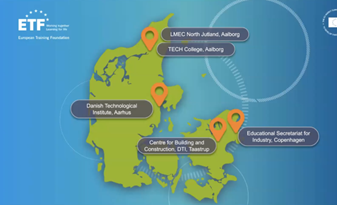
Places visited on the online tour
Andreas Bjerre Lunkeit, Expert at the DTI, whose clients include EU institutions, Danish government agencies and enterprises, highlighted the opportunities that GRETA provides CoVEs to exchange experiences, practices and ideas relating to the greening of VET.
“The real greening needs to start on campus” with CoVEs “greening themselves, by way of solar panels, managing waste and organising extracurricular activities such as collecting litter from riverbanks.”
Referring to the results of the GRETA peer reviews implemented in Spring, some of the biggest barriers to successfully greening the curricula, he noted, is “an insufficient level of qualification of the teachers, many of whom need more knowledge of the green transition and the skills and competences needed for it to be successful”. The role of industry was also highlighted as an ongoing challenge, acknowledging that “many private companies still do not prioritise environmental sustainability”. Also, CoVEs see difficulties in how to engage in international and regional partnerships in support of greening VET.
Andreas Lunkeit, DTI
Green Professional Development - GPD
Julian Stanley, Senior Human Capital Development Specialist at ETF, focussed on the challenge for teachers to acquire new knowledge in order to shape the future of green education. Suggesting a new acronym of GPD or Green Professional Development, Julian suggested that “CoVEs should be “active users and creators of professional development”. Reflecting on the ways in which teachers themselves learn, and highlighting some of the opportunities and challenges for GPD, Julian stressed the urgency of the need for a green transition but acknowledged an uncertainty about which skills, technologies and sectors should be targeted. Julian identified that while VET has been “trained” to respond to the needs of employers and the labour market over the past 25 years, “industry is itself behind, industry is itself not demanding green skills or is not prioritising the skills needed for the green transition”. High level international agreements which do exist, such as Cop 26, are not yet “operational in terms of educational governance” which means there is still not a systematic set of responses that can be used in order to close the gap between high level global targets relating to the green transition and targets at school level. Understanding which teacher competences need to be addressed, Julian emphasised that “scientific, social and civic knowledge about green issues, knowledge of curriculum development, and a mastery of technology and materials” would all be essential to support the green transition.
Pretotyping and the Green Mindset – how to meet industry’s workforce needs
Taking over from Julian’s ‘context-setting’ of the importance of teacher training, Mette Hyllested-Winge, Chief Consultant of Copenhagen’s Educational Secretariat for Industry, took a deeper look into how green teacher training programmes are being devised in Denmark and specifically the concept of ‘pretotyping’ with enterprises, a methodology of collaboration to determine which competences industry needs in the workforce to deliver the green transition. Working with social partners and trade unions who were “very alert to the political agenda of the green transition and who requested a programme of continuous vocational training (CVT) to meet the demands of going green”, the Educational Secretariat went through a process of mapping the types of qualifications needed, mapping the demand from industry for them and then devising pretotypes of courses for industry to assess and evaluate. Of the 500 companies involved in the process, the responses provided a unique picture of the competences and qualifications that companies need immediately and those that will be needed in the future.
“The number one thing that all companies said they needed the most was a green mindset, they need employees to be able to embrace change and to learn new ways of doing things, not only to understand but to co-own the green transition in all aspects of life”.
For this to happen, there is a need for teachers who themselves have a green mindset and a deep understanding of what the green transition is.
Every minute counts!
Palle Svensen and Soeren Ingerslev Himmelstrup from the Labour Market Training Centre in North Jutland went on to discuss their role in “greening the ways teachers teach” and considered teachers to be “interdependent learning facilitators” because of the need to work together to meet the challenges of the green transition. Detailing the context of the global ecological crisis, the urgency with which transformative action needs to happen at all levels of society was underscored – “every minute counts” exclaimed Palle! The approach they use, to bring teachers together to discuss and explore the complex issues of the green transition, helps to instil a green mindset, essential when teaching skills about greening society.
Train the Trainers – and respond to young people!
Lise Lyngfelt Molander, Team Leader of the Green Spearheads (DTI) went on to exemplify their activities working in the field of sustainability, the circular economy and the green transition in the construction sector. The collaborative programme “Train the Trainers” sees an initial participation from 7 VET schools from Sealand and Jutland, as well as the Advisory Board for Education and Training for the Building and Construction Industry.
The idea behind the programme is “building green mindset and strategies in both large companies and SME’s” and taking the knowledge of what companies want and need to create targeted training programmes. The very pragmatic end-goal of this project is that “all the schools will have one or more training courses ready to go, to plug and play into their curriculum”.
Romain Boitard, Advisor of Greening in the Policy Advice Unit at the ETF asked Lise about the lead times involved in updating the programmes and training the teachers to successfully implement all the different dimensions of greening. “The long and short of it” replied Lise “is a long time, 9 months to a year!”. And the project is just at the beginning.
“The trainers we are training at the moment are primarily teaching adults between the ages of 20 and 55. But the young ones, at high school and in VET are very demanding on this topic. The schools desperately need to upskill their teachers, and they are being pushed by teenagers who want to know about and be trained in the green transition”.

Lise Lyngfelt Molander Romain Boitard, ETF
‘Butterflies’ of the future
Mette Gram, Educational Specialist of the TECH College in Aalborg (https://youtu.be/krnajkC0WeY) also confirmed the need to upskill VET teachers in order to meet the demands of younger learners. Using the 17 Sustainable Development Goals as a backdrop, the teaching staff are trained to assess what their actions mean to the students and to create an “experimental learning environment” that supports collaborative relationships and reduces complexity, where possible.
Mette noted that the labour force of the future, the younger generation, could be likened to butterflies, flying from “flower to flower but not staying anywhere for long”. They have an increased need to understand value and meaning with regard to participation and this requires teachers to change the way in which they present information to facilitate the learning process and find the shortest path towards the green transition.
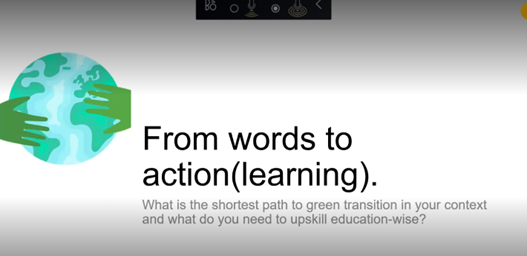
Rounding off the discussion, participant Annika Behrens commented
"The fastest way to bring about change is to “reduce fear and to show people that the green transition is not a threat but that it will only change lives for the better”.
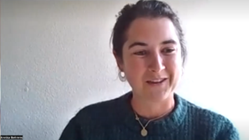
Annika Behrens, TU Dortmand University, Germany
With thanks to all collaborators and participants, Susanne Nielsen closed the meeting in agreement that fear must not be an obstacle to taking action to embrace the green transition and went on to applaud the participation of all GRETA team members. A hugely beneficial meeting setting out clear strategies of how to equip teachers for the green transition.
Watch this space!
The next GRETA thematic sessions in the coming months:
30 June: International Partnerships – green projects
September: Regional Partnerships – skills ecosystems
October: ‘Deep Dive’ into green training programmes
December: School management and green strategy
January: ‘Green Surprise’!
Thank you so much for your support. Ukraine is the winner. Thank you for this captivating and useful meeting. HVS#3 Mukachevo, Ukraine is extremely grateful for the invitation.
Jose Manuel Galvin Arribas Susanne M. Nielsen Romain Boitard Annika Behrens Andreas Bjerre Lunkeit
Please log in or sign up to comment.