
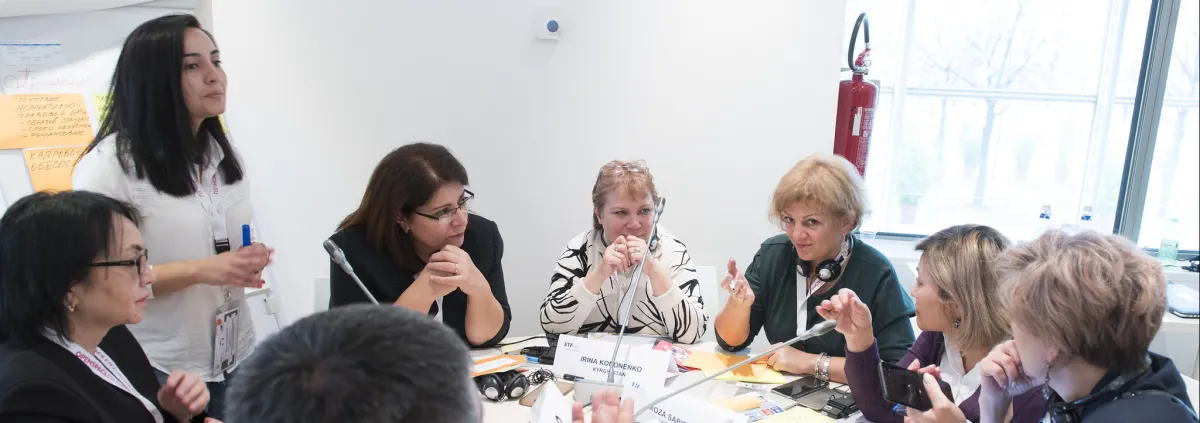
One of the workshops during the conference ‘Skills and Qualifications: Benefits for People’ focused on future proof curricula. During this workshop, we discussed characteristics of future proof curricula, scored different example curricula against these characteristics and discussed what it would take to implement the different types of curricula in different countries. In this blog I would like to share the outcomes of the discussion on the characteristics of future-proof curricula.
We started the workshop with the following question: What are the characteristics of a modern and future-proof curriculum? The answers resulted in the following word cloud.
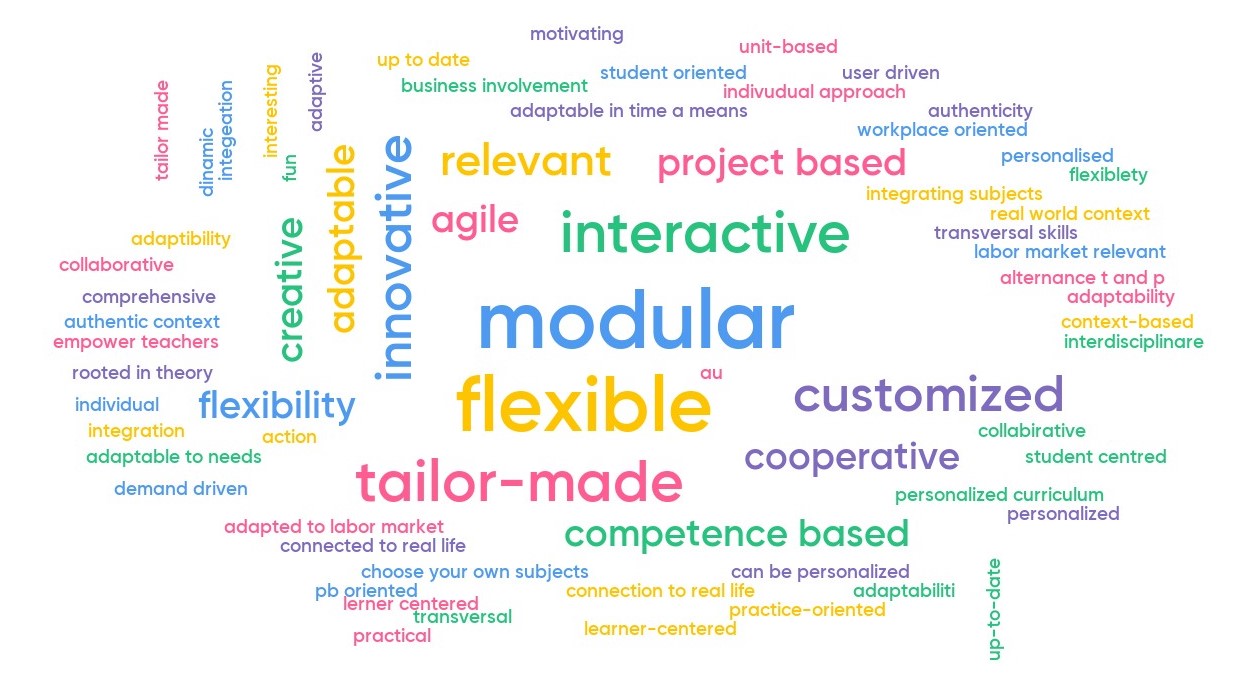
This word cloud matched quite well with the characteristics we had prepared for the workshop beforehand:
- Flexibility for learners: the possibility for individual learners to go faster or slower or to follow only a part of the programme. (Examples of word cloud related words: flexible, modular, personalised, customised)
- Adaptability to labour market demands: the curriculum is designed in such a way that it is easy to incorporate new skills and knowledge requested by the labour market. (Examples of word cloud related words: adaptable, labour market relevance, relevant)
- Authenticity of the learning environment: learners work on realistic tasks in a learning environment that reflects their future workplace. (Examples of word cloud related words: authenticity, connection to real life)
- Integration of theory and practice: related theory and practice are not offered as separate classes, but are closely linked to each other. Both theory and practice are offered just in time when a learner needs it to continue his/her learning process. (Examples of word cloud related words: competence based, transversal skills, practice oriented, interdisciplinary, modular)
- Collaborative learning: learners have many opportunities to learn and work on assignments together or with others. (Examples of word cloud related words: cooperative, interactive, collaborative)
No words in the Word Cloud mention the use of technology in future proof curricula. Surprised? We had added it as one of the characteristics, but with the note that technology can be used in all curricula, whether they are subject-oriented or modular, workplace oriented or project-based. It is important to explore how technology can be used to facilitate learning, but it is not a distinctive feature when comparing different curricula, as technology can be implemented in all kind of curricula.
One characteristic proposed by one of the participants at the end of the workshop was inclusiveness. I believe this is also an important feature, but as with technology one that should always be taken into account when designing and developing curricula.
As mentioned at the end of the workshop, the discussion during the workshop was only a start. We would like to know more about the different curricula developed and implemented in different countries and how you think future-proof curricula should look like. What do you think, can we start this exploration with the characteristics described in this blog or did we miss any important characteristics?
For more information on curriculum development and new pedagogies, visit the second layer of our Toolkit Skills and Qualifications: Benefits for People.
Please log in or sign up to comment.