

Inclusion and sustainability, both topics get a lot of attention in education and training systems nowadays. In our READY Model, a reference model that aims to offer a structured way to identify the professional practices and development needs of 21st-century educators, they form together one domain of professional activity. The domain ‘Sustainability & Inclusion’ consists of four professional practices:
- Create inclusive learning environments
- Be attentive to personal well-being and that of others
- Manage one’s own and others’ emotions
- Adopt and promote environmental, social and economic sustainability
At first sight, it could look strange to cluster them together, as we could argue that they are separate domains of activity that both need attention. I will explain why we clustered them. The explanation lies in the clustering of all four professional practices in this domain of activity. We called the domain ‘Sustainability and Inclusion’, but maybe we should have called it the domain of ‘Well-being’. Both ‘inclusive learning environments’ as well as ‘environmental, social and economic sustainability’ contribute to well-being. Secondly, for both we can also find a relation with emotions. A learner that feels included will more likely show positive emotions, on the other hand if the learner faces difficulties to ‘fit’ into the learning environment the learner could show emotions such as anxiety, anger, disengagement that could all have a negative impact on the learning experience and outcomes of the learner. We also see heated discussions around climate change and the actions to take, so also here it can be useful to be able to manage your own, but also other’s emotions.
But now the important question, how can you work in your daily practice on these four professional practices? In this blog I will share some resource to start the discussion and I hope that with your help we will be able to identify more.
Resources on inclusive learning environments seem to almost always cover well-being as well. An interesting resource to start with is the MOOC developed by the team delivering Inclusive Schools 2 (Inscool) project.
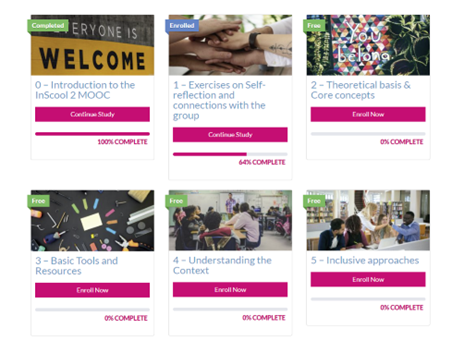
Source: MOOC Inclusive Schools 2 Project
The MOOC introduces the main concepts and pedagogies supporting inclusive educations. The course offers options for action research and reflective activities that will encourage you to try out inclusive pedagogies in your classroom.
Another interesting starting point could be the publication on the ‘Data collection and analysis of Erasmus+ projects’ with a focus on inclusion in education. It studies 15 practices supporting inclusive education in different educational sectors. Based on the analysis of all practices lessons learned and recommendations are formulated. For concrete examples you can read the case study descriptions offered in the annex. The cases selected cover different educational sectors, as presented in the Table below.
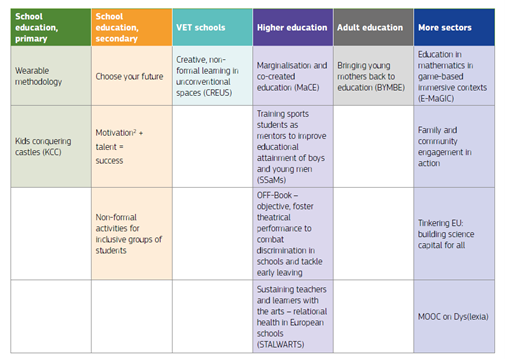
Source: European Commission (2022). Data collection and analysis of Erasmus+ projects. Focus on inclusion in education. Luxembourg: Publications Office of the European Union (p.18)
And a last resource, with a link to domain on Digital Technologies of the READY model, is the website “Micro-Learning Modules on Inclusion in Digital Education Contexts”. It consists of 6 micro-learning modules that are designed around a set of 15 skills for digital inclusion.
Let’s move to another professional practice in this domain; environmental, social and economic sustainability. This topic gained a lot of attention in schools during the past years. Many teachers and schools are looking for, but also developing, materials to include sustainability in their curricula. The European Commission launched the Education for Climate Community where you can join challenges to work together with others on a specific topic. There is for example a challenge on ‘Collecting Climate Education Resources’ where you can find resources and can add new ones. You could also join the GreenComp Community which is organised around GreenComp, the European sustainability competence framework. And for other ideas and inspiration you could also watch our webinar on ‘Teaching for Green Societies: Skills and Practical Experiences’.
Do you have tips for resources on inclusion or sustainability, please share them in the comments below!
This was the second ‘READY insight’, you can find the first on ‘Digital technologies’ here. Stay tuned for the next one in June!
Dear Jolien, thank you very much for this resourceful information!
Please log in or sign up to comment.