
This blog has been jointly authored by Soufiane Lahime and Julian Stanley
Nowadays, handheld devices have become an integral part of our lives. We use them for absolutely everything, from communicating with loved ones, shopping, ordering food, playing games, etc. Should we also use our smartphones to educate ourselves? What difference does m-learning make to education?
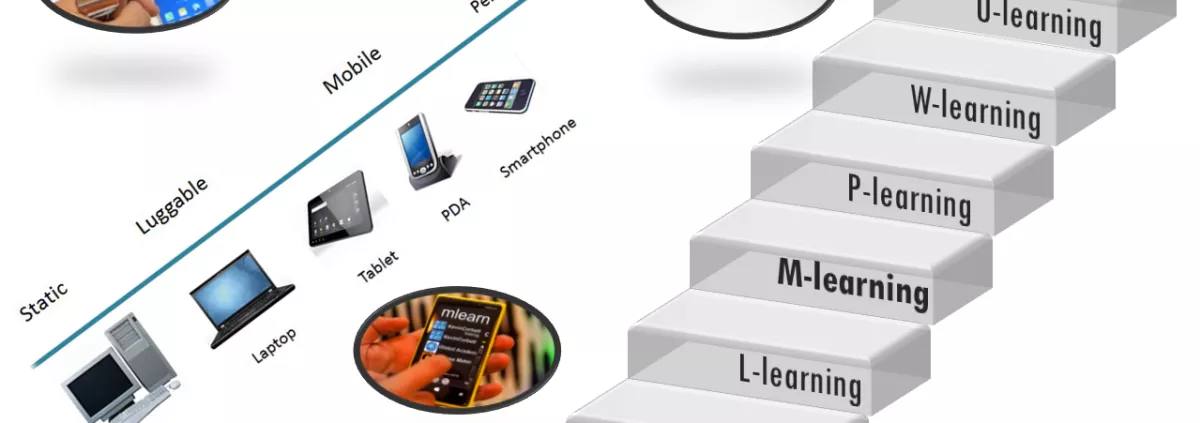
Mobile learning or m-learning means accessing educational content from a mobile device. Since we always have our smart phones with us, this means that we will always be able to participate in m-learning, any place, any time, further it implies that your mobile device is all that you need – books and classrooms may continue to exist but they start to seem slower and less convenient.
Why employ m-learning??

Research suggests that there is a growth in demand and supply of m-learning and that it can be more motivating and effective:
- Learners’ motivation is often higher when instruction is on the mobile, even higher than on a computer
- Typically, m-Learners study 40 minutes more than students on desktops and tablets
- M-learners course material completion is 45% faster than computer learners.
Mobile learning makes learning more dynamic, especially for ‘visual and auditory’ learners with a preference for pictures, animations, charts, and diagrams, e.g. through short 2–3-minute micro-learning videos. Mobile learning incorporates movement, allowing learners to drag, drop and tap. It also provides frequent opportunities for interaction in the form of quizzes interspersed between the learning content. Gamification, gamified quizzes and gamified learning paths can be built in.

The main disadvantages of m-learning
M-Learning raises new challenges and problems. Currently little educational use is made of smart phones within schools and training centres because learners are not trusted to make ‘sensible’ use of their devices. Our mobile devices are, to some degree, controlled by international technology companies so there is a risk that they will determine what kinds of educational and training content is accessible. In many countries, for economic and political reasons, mobile devices are relatively expensive or are not approved of, which means that only wealthy or privileged groups can own them and have access to m-Learning. This is not only a matter of the cost of the devices but also of that of data – which, in many countries, makes mass streaming impossible. Further it is clear that much m-Learning is of poor quality and does not deliver what it promises.
Why mobile learning? understanding the psychological side of m-Learning
M-learnng brings with it opportunities for personalization or differentiation: alternative learning tasks can be offered depending on the learners’ needs and preferences. However, it is not just a matter of differentiaton by challenge. It is important to recognize that learners with low-level qualifications are often highly motivated by higher-level tasks such as creating, rearranging, or criticizing. These higher-level tasks implicitly require learners to engage with knowledge or understanding and canact as an effective strategy to create “learning by stealth” since they motivate learners to explore the lower-level knowledge required for the task. Broadly it is usual to distinguish between two kinds of m-Learners:
- The “considered” user
In the case of considered learners, mobile learning is as a refresher of things they learned in a more extended formal training event, including face-to-face training, synchronous e-Learning, asynchronous e-Learning, or even study of printed information. After a training session, your head is full of information. A mobile device is away of retrieving what you have learned, either to consolidate your learning or close to the time and in the place where you need to apply it. Highlighting the critical learning points can help the m-Learner efficiently and accurately recall deep-level semantic memories.
- The “trigger” user
For trigger users, the mobile device can act as a retriever for procedural memory. Procedural memory is our long-term memory of skills, procedures, and know-how.
In both cases, it seems that, apart from convenience and accessibility, the really innovative feature of mobile learning is it capacity to make connections between that which has been learned, that which needs to be learned and the application of knowledge and skills. Mobile learning means more than portable devices – at its best it means that your can recover, consolidate, top-up, apply, revise and communicate your knowledge and skills continuously as you learn, work, travel, create and relax. In this way learning can be personlised to the lifestyle and needs of individuals; distances in time and space between learning and doing can be narrowed. This then is the potential – it is up to us as teachers and learners to make it a reality.
Please do feel free to share your feedback regarding teaching and learning experiences using handheld devices:
Do you have any funny moments to tell while implementing a mobile learning environment?
What strategies do you think work best for mLearners?
What are the limits pushing you back from innovation in your teaching and learning??
Why do so many Arab education systems/countries forbid the use of smartphones in class?
What bad experiences of mobile learning have you suffered?
Thank you my dear friends for the explanation of this phenomenon. What I see just now. A team has started 2-month online course on Telegram with video, tasks, group discusssion and other things. 41 participants are planning to use only m-learning, no desktop at all!
Yes - I find that, without ever having made an explicit choice, more of my learning is becoming m-learning..
Please log in or sign up to comment.